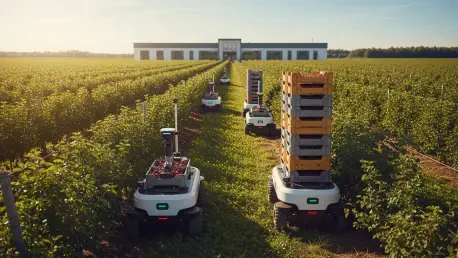

Labor shortages in the British agricultural sector have reached a critical tipping point, forcing growers to reconsider traditional manual logistics in favor of sophisticated robotic assistance. The FLEXBOT initiative, formally recognized as the “Building a Flexible, Extensible Cobot Platform for Farmers” project, is a strategic response to these pressures, funded by Innovate UK and led by the technology firm Antobot. This collaborative effort focuses on the soft fruit industry, where the transport of harvested crops remains a significant operational bottleneck. By deploying collaborative robots—or “cobots”—that work alongside human staff, the project effectively streamlines farm logistics. These autonomous platforms are designed to handle the physically taxing labor of hauling heavy crates, which in turn allows human workers to focus on picking activities that require manual dexterity. This shift represents a modernization of the farm workflow, creating a resilient operational model.
Maximizing Productivity and Financial Practicality
Improving Harvest Speed: The Race Against Decay
The biological clock of soft fruit begins a rapid countdown immediately upon being detached from the plant, necessitating an efficient path from the field to temperature-controlled storage. Rapid cooling is the most effective way to slow down cellular respiration and prevent spoilage, yet manual transport often introduces delays that compromise fruit quality. The FLEXBOT platform addresses this challenge by establishing a consistent and autonomous relay system that maintains a steady flow of produce throughout the day. Unlike human-driven transport, these cobots can operate continuously without fatigue, ensuring that fruit is moved into the cold chain as quickly as possible. This logistical efficiency directly translates into a higher percentage of high-grade fruit reaching the marketplace. By automating this “last mile” of on-farm logistics, growers can significantly reduce produce waste and maximize the value of every harvest while ensuring consumers receive the freshest possible product.
Furthermore, the introduction of automated transport provides growers with a layer of data that was previously unavailable during manual operations. Each robotic platform can be integrated with tracking software that logs the precise time and location of every crate pickup, creating a digital audit trail for the entire harvest. This level of traceability is becoming increasingly important for food safety regulations and retail transparency requirements. It allows farm managers to analyze productivity patterns across different fields and adjust labor allocation in real-time based on the speed of the robotic units. By closing the gap between harvesting and cooling, the project not only preserves the physical integrity of the fruit but also enhances the economic efficiency of the supply chain. As shelf life is extended by these faster transit times, retailers see a reduction in spoilage, ensuring that consumers have access to fresher produce for longer periods within the competitive global market.
Modular Accessibility: Breaking Down the Cost Barrier
One of the most significant barriers to the adoption of advanced technology in the agricultural sector has been the high entry cost associated with specialized, single-use machinery. The FLEXBOT project overcomes this financial hurdle through a modular and extensible design that caters to the needs of small and medium-sized farming operations. Instead of requiring a massive upfront investment in a monolithic robotic system, the platform allows growers to start with a foundational base unit and gradually add complexity. This “building block” approach means that a farm can begin by automating basic transport tasks and later introduce more advanced sensors or specialized tools as their operational needs and budgets evolve. This financial flexibility democratizes access to cutting-edge technology, ensuring that smaller producers are not left behind in the global push toward modernization. It provides a scalable and realistic path for diverse farms to modernize their legacy processes effectively.
The economic utility of these cobots is further enhanced by their ability to transition between various agricultural tasks throughout the different seasons of the year. While their primary role during the peak summer months is fruit transport, the underlying hardware is designed to be multi-functional, supporting tasks such as crop monitoring, equipment distribution, and soil sampling. This multi-purpose capability significantly improves the return on investment for farmers, as the technology remains an active asset rather than sitting idle during the off-season. By reducing the reliance on expensive, specialized vehicles, the modular platform helps to lower the overall capital intensity of modern farming operations. This approach encourages a culture of continuous improvement and technical literacy within the workforce. Ultimately, the flexibility of the FLEXBOT system ensures that it can adapt to the unique landscape and specific crop requirements of various regional and international farms.
Integrating Advanced AI and Collaborative Engineering
Advancing Autonomous Navigation: Seeing the Fields
Navigation within the dense and structured rows of a soft fruit farm requires a perception system that can interpret complex surroundings without relying solely on satellite signals. To meet this need, the University of Surrey developed the CueBEV robot vision system, which serves as the primary navigational core for the FLEXBOT platforms. This AI-driven technology utilizes sensor fusion, combining input from high-definition cameras and LiDAR sensors to generate a real-time view of the environment. By processing this data simultaneously, the cobots can identify their location relative to the crop rows while also detecting obstacles such as crates, equipment, and irrigation lines. This environmental awareness is crucial for ensuring that the robots can operate autonomously without the risk of colliding with existing infrastructure. The system is designed to provide reliable navigation even in varying light and weather conditions, which is essential for the unpredictable nature of outdoor farm work.
A high level of technical safety is paramount when robots are intended to work in close proximity to human personnel, animals, and delicate equipment. The CueBEV system allows the cobots to distinguish between static obstacles and moving entities, such as workers or farm dogs, adjusting their speed or path accordingly to avoid any contact. This collaborative aspect is essential for maintaining a seamless workflow where humans and machines can operate within the same physical space without safety hazards. Furthermore, the AI components are capable of learning the specific layouts of a farm, optimizing their routes over time to reduce travel distance and conserve battery energy. This constant refinement of the navigation algorithms ensures that the robots become more efficient with every hour of operation. By providing a safe and reliable autonomous platform, the project builds trust among the workforce and demonstrates that technology can be a helpful and intuitive partner.
Technical Refinement: Engineering for Real-World Durability
The transition from a laboratory prototype to a commercially viable field tool required extensive testing and engineering refinement to ensure durability in real-world conditions. Industry partners like Dogtooth Technologies played a vital role in adapting the autonomous navigation systems for outdoor use and within the specific confines of polytunnels. These structures often block traditional GPS signals, which would normally render an autonomous vehicle immobile. To solve this, the engineering teams implemented localized positioning methods that rely on the robot’s onboard sensors to triangulate its position within the tunnel environment. The physical chassis of the robots was also engineered to be robust, featuring weatherproofing and specialized suspension to handle the uneven and often muddy terrain of a commercial farm. These technical enhancements ensure that the robots can maintain their precision and reliability throughout the most demanding periods of the harvest cycle for the growers.
The project successfully addressed the complex technical and operational barriers to on-farm automation, establishing a new standard for collaborative robotics in the agricultural sector. In the final phases, the UK Agri-Tech Center collaborated with industry stakeholders to refine the engineering requirements and ensure the long-term sustainability of the platforms. These efforts resulted in the creation of standardized, “plug-and-play” protocols that simplified the integration of third-party tools and sensors onto the modular base. By utilizing electric power, the initiative significantly reduced the carbon emissions associated with harvest logistics, supporting the transition toward greener food supply chains. The successful deployment of these cobots demonstrated that automation could be implemented in a way that augmented the human workforce effectively. This collaborative model provided a clear roadmap for future agricultural innovations, emphasizing the importance of interoperability and long-term technical scalability.