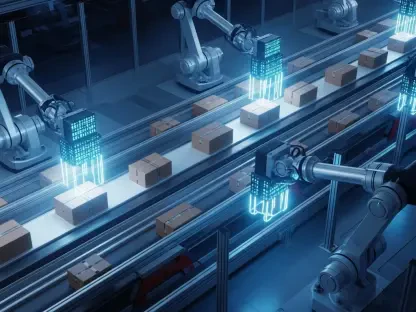

The low hum of autonomous guided vehicles moving with perfect precision across the warehouse floor is now as common as the morning coffee ritual, a testament to an industrial revolution that happened not with a bang but through the quiet rewriting of operational code. This is the landscape of 2026, where artificial intelligence is no longer an overlay or an experiment but the very central nervous system directing the flow of goods, managing production lines, and optimizing supply chains in real time. The conversation has shifted from the potential of AI to its pervasive, non-negotiable presence.
From Experimental Tech to Standard Operating Procedure
The rapid transition from AI as a speculative technology to a fundamental component of the industrial ecosystem has been breathtaking. What were once isolated pilot programs for predictive maintenance or route optimization have now scaled into fully integrated, intelligent systems that form the backbone of modern operations. This evolution marks a critical tipping point where AI integration has become the primary determinant of competitive advantage, separating industry leaders from those struggling with legacy processes.
This reality poses a central question for every organization: is its structure prepared for a world where AI is not just an option but the default? The challenge is no longer about adopting a single AI tool but about re-engineering the entire operational philosophy around intelligent automation. Companies are now measured by their AI maturity, a metric that reflects their ability to leverage autonomous systems for greater efficiency, resilience, and strategic foresight.
From an Add On to the Architectural Core
The journey to this point was accelerated by a period of rapid technological expansion through 2025, but this year marks the true embedding of AI into deep operational functions. Persistent pressures in production, logistics, and supply chain management created an undeniable demand for the efficiency and autonomy that only AI could provide. The vulnerabilities exposed in global supply networks over the past several years became a powerful catalyst, forcing a move toward systems that could predict disruptions and adapt without constant human oversight.
The core thesis for this new era is a fundamental shift in perspective. The focus is no longer on applying isolated AI applications to solve specific problems but on systematically rewriting corporate software, operational workflows, and critical infrastructure with AI at their center. Modern business applications are now being built “AI-native,” where learning algorithms are not add-on features but inherent architectural elements, making the system itself intelligent by design.
Five Defining Trends Shaping the New Industrial Landscape
A significant driver of this transformation is the rise of autonomous AI agents in operational management, which have evolved from passive analytical tools into active, decision-making participants. These intelligent agents now manage complex daily operations, capable of not only monitoring manufacturing lines but also initiating corrective actions. This is most powerfully demonstrated in collaborative agent ecosystems, where, for instance, a production agent can detect a material shortage and communicate directly with a logistics agent to autonomously secure alternative sourcing, ensuring continuity without human intervention. This capability is enabled by software architecture that is itself AI-native, with AI-generated code and automated testing becoming standard development practices.
Concurrently, the industry is moving away from generalized AI models toward highly specialized, modular systems trained on domain-specific data for superior accuracy. This “Lego-block” approach allows organizations to combine distinct AI components—such as a capacity forecasting model with a task prioritization model—to solve multifaceted challenges with greater precision. As these systems take on more critical roles, the imperative for transparency and governance has grown, leading to the establishment of “AI observability” as a key quality criterion. Driven by maturing legal frameworks like the EU AI Act and the NIS2 Directive, organizations are now mandated to ensure their AI operations are safe, auditable, and fully compliant.
This technological revolution has naturally spurred an evolution in human roles and competencies. The AI-driven workplace has given rise to new, specialized roles at the intersection of business, data science, and AI application management. More importantly, existing roles like dispatchers and planners have transformed into those of AI collaborators. These professionals now leverage AI-generated recommendations to enhance their strategic decision-making, focusing their expertise on complex exceptions and long-term planning while intelligent systems handle the moment-to-moment optimization.
An Expert Consensus on Foundational Transformation
There is a clear industry consensus that this year represents a pivotal moment where the practical application and operational maturity of AI have become deeply entrenched. The technology is no longer viewed as a supplementary tool but as an integral, autonomous component of the business engine. It actively participates in and shapes operational outcomes, functioning as a silent but essential partner in every aspect of the industrial value chain.
This profound shift demands more than just a technological upgrade; it necessitates fundamental changes in corporate governance, organizational structure, and workforce skills. Companies that are thriving in this environment are those that have embraced this holistic transformation. Maintaining a competitive advantage is now directly tied to an organization’s ability to not only deploy AI but also to build the cultural and structural frameworks required to support a truly intelligent enterprise.
Preparing for the AI Core a Practical Framework
The first step for industrial leaders navigating this landscape is to audit and identify high-impact operational areas where autonomous agents can deliver the most immediate and significant value. Pinpointing specific workflows in manufacturing or logistics where AI can reduce bottlenecks or enhance decision speed is critical. This strategic identification must be paired with a complete rethinking of the technology stack, moving beyond patching legacy systems and toward designing an AI-native architecture where intelligent algorithms are a foundational element, not a late-stage integration.
Beyond the technology, the most crucial investment is in people and processes through structured change management. Developing targeted upskilling and reskilling programs is essential to empower the existing workforce, ensuring they can collaborate with sophisticated AI systems effectively and confidently. Simultaneously, building a robust governance model centered on transparency and observability is no longer optional. Proactively establishing frameworks for AI monitoring and compliance ahead of regulatory deadlines is a cornerstone of responsible and sustainable AI deployment.
The journey to making AI the core of industrial operations was a deliberate one, built on years of incremental progress and accelerated by necessity. The organizations that successfully navigated this transition were those that recognized it as a fundamental business evolution, not merely a technology project. They invested as much in changing mindsets and redefining roles as they did in algorithms and infrastructure. This integration of human expertise with artificial intelligence created a new operational paradigm, one defined by unprecedented levels of resilience, efficiency, and adaptability that have now permanently reshaped the industrial world.