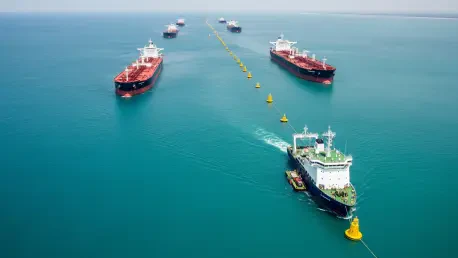

The recent diplomatic breakthrough between the United States and Iran has provided a momentary sense of relief to global energy markets, yet the restoration of the Strait of Hormuz remains a daunting logistical challenge that defies any attempt at a quick resolution. While political leaders may celebrate the signing of a deal in a single afternoon, the physical and financial infrastructure required to support safe passage through this critical waterway has been deeply compromised over the preceding months. The blockade, which began in late February, effectively choked off a corridor that handles approximately twenty percent of the world’s petroleum and liquefied natural gas. This interruption created a massive backlog of more than 1,500 vessels, many of which remain anchored in holding patterns across the region. Consequently, the transition from a state of conflict to one of functional commerce involves far more than just re-opening the gates; it requires a systematic unwinding of months of chaos that has fundamentally altered the predictable flow of global trade.
Restoring Safety: Financial and Physical Prerequisites
High Premiums: Financial Barriers to Entry
A primary hurdle preventing the immediate resumption of traffic is the astronomical cost of maritime insurance, which reflects the persistent dangers lurking in the region. Before the hostilities broke out, insuring a standard cargo vessel through the strait was a routine and relatively inexpensive expense for shipping lines. However, once the area was officially designated as a combat zone, premiums surged to as much as eight percent of a vessel’s total hull value. For a modern very large crude carrier, this translates into an additional eight million dollars for a single transit, a financial burden that can erase the profit margins of an entire voyage.
Even with a ceasefire in place, insurance syndicates like Lloyd’s of London are unlikely to lower these rates until they receive verified proof that the waters are clear. Until then, many fleet operators will choose to remain on alternative routes, prioritizing financial predictability over the shorter transit times offered by the Persian Gulf waterway. The financial architecture of global trade is built on the foundation of safety, and until that foundation is fully restored, the Strait of Hormuz will remain a high-cost environment that few are willing to gamble on without significant government-backed guarantees.
Mine Clearance: The Slow Path to Physical Safety
The physical reality of the strait is currently defined by the presence of sea mines and other unexploded ordnance that were deployed during the height of the tensions. Clearing these hazards is a meticulous and dangerous task that relies on specialized naval mine countermeasures teams and advanced underwater autonomous vehicles. Experts in maritime security suggest that even under optimal conditions, it will take at least six months to sweep the primary shipping channels and ensure they are safe for deep-draft commercial traffic. The technical difficulty of detecting modern mines means that a single sweep is rarely sufficient to guarantee safety.
Furthermore, the decommissioning of defensive barriers and the restoration of navigational aids must occur before large-scale traffic can safely pass through the narrowest points of the waterway. During the conflict, many essential buoys, lights, and radar transponders were damaged or deactivated to hinder movement. Restoring this infrastructure is not merely a matter of replacement; it requires recalibrating the entire vessel traffic service system. As a result, authorities are implementing a phased reopening strategy, ensuring that the backlog of 1,500 ships will clear at a frustratingly slow pace over several seasons.
Systemic Hurdles: Logistics and Structural Bottlenecks
Port Jams: The Moving Bottleneck Effect
Once the physical path is cleared and ships begin to move through the strait again, the logistical pressure will likely shift to the major transit hubs that serve as the connective tissue of global trade. This phenomenon, often referred to as a moving bottleneck, occurs when a massive surge of delayed vessels arrives simultaneously at key ports such as Singapore, Colombo, and Jebel Ali. These facilities are currently operating at or near their maximum capacity, meaning they lack the buffer space and labor resources to process an unexpected influx of hundreds of ships at once. When these vessels converge, the resulting congestion will lead to lengthy dwell times.
To make matters worse, the labor and equipment required to handle this surge are already strained by the previous months of rerouting. Port operators must now balance the arrival of vessels coming from the reopened strait with those still arriving from the longer Cape of Good Hope route. This dual-stream arrival creates a logistical nightmare for terminal planners who must allocate berth space and crane time months in advance. Consequently, the clearing of the Strait of Hormuz will not represent the end of the supply chain crisis, but rather the beginning of a new phase of congestion that will stress the industry for the foreseeable future.
Route Stickiness: The Challenge of Operational Inertia
A significant but often overlooked factor in the slow recovery is the phenomenon of route stickiness, where shipping lines remain on their alternative paths long after the original route has reopened. Over the last several months, major carriers have fundamentally restructured their global networks to bypass the Strait of Hormuz, opting instead for the journey around the Cape of Good Hope. These adjustments involved signing new long-term contracts for fuel procurement and establishing different crew change locations. Undoing these complex arrangements is not a task that can be accomplished overnight, especially when the reliability of the strait remains a concern for risk management.
Additionally, the operational schedules of global shipping alliances are planned many months in advance, and any sudden change to a major route can throw the entire system out of alignment. If a carrier decides to move a fleet back to the Persian Gulf, they must ensure that every subsequent port of call has the necessary capacity to receive them on a new timeline. History has shown that once a supply chain is rerouted, it often takes several quarters for it to revert to its previous configuration. Therefore, the return to the Strait of Hormuz will be a gradual and staggered process as companies weigh the benefits against the logistical friction.
Container Gaps: Solving Global Equipment Mismatches
Perhaps the most enduring impact of the blockade is the profound imbalance of shipping containers across the globe, a systemic issue that will likely take nine to twelve months to resolve. While millions of loaded containers have been effectively trapped within the Persian Gulf or on ships waiting for the strait to reopen, manufacturing hubs in Asia are currently experiencing a critical shortage of empty units. This mismatch means that even as factories in China ramp up production, they often lack the physical equipment needed to pack and ship their goods. Correcting this imbalance requires a massive and costly effort to reposition empty containers across several continents.
The complexity of this equipment repositioning is compounded by the fact that many of the containers currently stuck in the Gulf are filled with seasonal goods that may no longer be relevant by the time they reach their destination. This creates a secondary problem of orphaned cargo, where importers may refuse to take delivery of items that are now out of season, leading to further congestion at receiving ports. Until the global container pool is once again distributed in a way that aligns with manufacturing and consumption patterns, trade efficiency will remain significantly below pre-conflict levels, highlighting the deep interconnectedness of the modern global economy.
Operational Evolution: Building Long-Term Stability
Safety Verification: Integrating Risk Mitigation Technologies
The resolution of the diplomatic impasse provided a vital opportunity for stabilization, but the preceding months of disruption left a mark on the maritime industry that was not easily erased. Stakeholders discovered that political agreements were only the first step in a much longer journey toward operational normalcy. To navigate the current landscape, logistics providers began prioritizing the integration of real-time risk assessment tools and diversifying their equipment holding strategies to mitigate potential imbalances. Enhancing regional cooperation for mine clearance and navigational aid maintenance became the essential foundation for building the long-term confidence required by global insurers.
The use of satellite-based monitoring and underwater drones allowed for a more transparent verification of safety, which slowly persuaded risk syndicates to recalibrate their premium structures. This technological transition was accompanied by the establishment of joint task forces that shared intelligence on maritime threats, significantly reducing the information gap that had previously fueled high insurance rates. By centering the recovery on verifiable data rather than political rhetoric, the industry created a more stable environment for commercial passage. These advancements ensured that the transition back to the waterway was supported by a robust safety framework.
Strategic Planning: Advancing Strategic Logistical Resilience
The development of smart shipping lanes, which utilized automated monitoring and standardized communication protocols between nations, was proposed to prevent future blockades from having such a devastating impact. By addressing these structural vulnerabilities through collaborative investment in regional infrastructure, the global trade community moved to ensure that future recoveries were measured in weeks rather than months. These initiatives aimed to foster a more stable international market, providing a blueprint for how critical waterways should be managed in an increasingly volatile global environment.
Ultimately, the lessons learned from the Strait of Hormuz disruption served as a catalyst for a more robust and adaptable global logistics network, which improved the overall reliability of ocean freight. The industry embraced the necessity of diversity in transit routes, ensuring that the global economy remained less dependent on a single geographic chokepoint. This proactive stance on logistical flexibility allowed carriers to pivot more quickly when faced with regional instability, marking a shift toward a more resilient era of international commerce. By integrating these lessons into future operations, the maritime sector solidified its ability to maintain global trade flows.