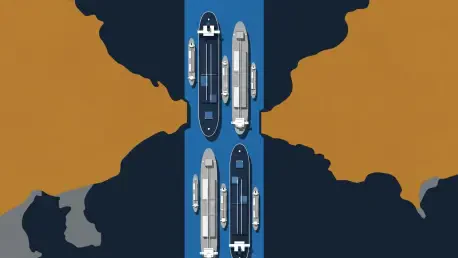

The narrow passage separating the jagged cliffs of Oman from the coast of Iran remains the most sensitive pressure point in the entire world economy. While technological advancements have streamlined how we track logistics, the physical reality of international trade remains tethered to this specific 21-mile-wide stretch of water. If this maritime corridor were to face an unexpected closure, the resulting shockwaves would instantly permeate every gas station, manufacturing plant, and corporate boardroom across the planet.
This thin blue line represents a critical bottleneck where the complexities of modern commerce meet the unyielding constraints of geography. The global supply chain, often perceived as a digital and borderless network, is actually only as resilient as its narrowest physical chokepoint. Because so much of the world’s functional energy flows through this single gate, its daily operation is not merely a regional interest but a fundamental requirement for international stability.
The Geographical Reality of Energy Dependency
Connecting the Persian Gulf to the Gulf of Oman, the Strait of Hormuz acts as the exclusive exit for the massive petroleum exports of Saudi Arabia, Iraq, Kuwait, and the United Arab Emirates. For energy-hungry nations across Asia—specifically China, Japan, India, and South Korea—this waterway is a literal lifeline that fuels their industrial engines. The concentration of vital resources in such a small geographic area creates a high-stakes environment where local stability is the primary prerequisite for global economic health.
The strategic importance of this route cannot be overstated, as it serves as the arterial connection between the world’s largest oil producers and its most voracious consumers. Without this passage, the energy infrastructure of entire continents would face immediate paralysis. This creates a unique dynamic where the internal politics of the Middle East directly dictate the cost of doing business in distant markets like New York or Tokyo.
Quantifying the Impact: The World’s Primary Oil Gateway
Roughly one-fifth of the world’s daily oil consumption—totaling approximately 20 million barrels—passes through this strait, making it the most significant transit point for liquid energy. Beyond crude oil, the waterway is the essential route for liquefied natural gas (LNG) exports from Qatar, which provide the heating and industrial power necessary for the survival of European and Asian economies. The scale of this movement is staggering, representing a concentration of value that has no equal in maritime history.
Within the 21-mile total width, the functional shipping lanes are even more restricted, consisting of two-mile-wide channels for inbound and outbound traffic. These lanes are separated by a tiny two-mile buffer zone, leaving virtually no margin for error or obstruction. When these lanes are threatened, the spike in crude prices manifests as higher costs for diesel and jet fuel, eventually inflating the price of every consumer good delivered by truck or plane.
Expert Perspectives: Geopolitical Vulnerability and Market Volatility
Supply chain analysts and maritime security experts consistently rank the Strait of Hormuz as the top global chokepoint because there are currently no viable alternatives. Unlike other trade routes where a vessel can simply take a longer path around a continent, there is no equivalent bypass for the sheer volume of fuel exiting the Persian Gulf. Economic research demonstrates that even the mere threat of a disruption causes market speculators to drive up prices before a single ship is delayed.
Case studies of regional instability have shown a direct correlation between maritime tension and domestic price hikes. For instance, recent fluctuations saw U.S. diesel prices rise by over a dollar per gallon, illustrating how a localized security issue becomes a household budgetary crisis. This volatility proves that the global market treats the strait as a barometer for total supply chain health, reacting with extreme sensitivity to any perceived risk of closure.
Strategies: Navigating Maritime Uncertainty and Supply Chain Risk
To mitigate these risks, nations and corporations are increasingly moving toward the diversification of energy sources and localized production. By investing in renewable infrastructure and domestic extraction, economies are attempting to insulate themselves from the catastrophic impact of a potential maritime blockade. Logistics managers have also shifted from “just-in-time” to “just-in-case” inventory models, maintaining larger reserves of critical materials to survive temporary disruptions.
While overland pipelines across the Arabian Peninsula offer a partial alternative, they remain insufficient to handle the total volume required by the global market. Consequently, enhanced satellite monitoring and international naval cooperation have become the primary tools for ensuring the freedom of navigation. Moving forward, the focus shifted toward building multi-modal corridors that could eventually lessen the world’s absolute reliance on this singular, vulnerable strip of water. Global leaders prioritized diplomatic frameworks and strategic fuel reserves to ensure that a localized crisis would never again threaten to bring the entire world’s commerce to a standstill.