
The long-standing dominance of the American highway system over heavy freight logistics is finally meeting a formidable challenger as railroads pivot toward aggressive network integration. While critics often view rail consolidation as a market monopoly, the strategy focuses on a much larger target: the trucking industry. By streamlining operations, Union Pacific aims to dismantle the perception that rail is a secondary choice, positioning it as a primary, high-velocity alternative for modern supply chains.
This shift toward integration stems from a fundamental need to address the flexibility gap that has historically favored highway transport. Motor carriers offer a level of point-to-point agility that fragmented rail networks have struggled to match, leading to a persistent loss of market share. To reverse this trend, the focus shifted from internal rail competition to a broader effort to capture freight currently moving on asphalt.
Beyond the Monopoly Myth: Rail’s New Competitive Edge
The strategic goal of this consolidation is to prioritize velocity and cost-efficiency above all other operational metrics. By creating a more cohesive network, the railroad can offer the kind of reliability that was once exclusive to the trucking sector. This transition is less about controlling the tracks and more about creating a service product that can compete for the high-value goods that currently bypass rail entirely.
Capturing market share from the highway requires a complete rethink of how freight moves across the continent. Instead of focusing on local dominance, the emphasis is now on how quickly a container can move from a coastal port to a midwestern distribution center. This aggressive challenge to the trucking industry is intended to force a paradigm shift in how shippers perceive the value of rail transport.
The 48-Hour Bottleneck: Why the Current Freight System Is Falling Behind
Structural fragmentation within the American rail network has created an invisible tax on the economy, manifesting as significant delays at interchange points. When a shipment moves from one carrier to another, the handoff process frequently adds a staggering 24 to 48 hours to the total transit time. These delays represent trapped capital and inefficient resource allocation that ripples through every level of the logistics chain.
The embedded costs of these network frictions are inevitably passed down to the consumer in the form of higher prices for goods. By operating as a disjointed series of local and regional segments, the industry has historically failed to provide the seamless experience that modern shippers demand. Eliminating these structural pauses is essential for any railroad seeking to provide a truly competitive logistics solution.
Scaling Efficiency Across 88,000 New Shipping Corridors
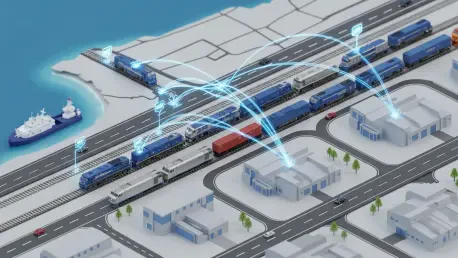
The implementation of a single-line service across the heart of the country is designed to provide a direct solution to these transit delays. By connecting previously isolated networks, the integration opens over 88,000 new county-to-county lanes that previously required complex multi-carrier coordination. This expansion creates a more robust pricing environment where the scale of the network drives down the cost per mile for a vast array of commodities.
Increased competition within these new corridors serves as a natural regulator for shipping rates. As rail becomes more efficient and cost-effective, it forces motor carriers and other logistical providers to sharpen their own pricing to remain viable. This market-wide price correction benefits shippers by providing them with a broader range of options, effectively ending the reliance on high-cost highway routes for long-distance freight.
The Science of Operational Excellence: Data-Driven Productivity Gains
Stabilizing service levels requires a rigorous adherence to the Safety, Service, and Operational Excellence Strategy, which utilizes data to remove friction from the network. A unified operating plan allows for the synchronization of schedules and equipment, ensuring that every asset is utilized to its maximum potential. Experts suggest that this streamlined approach is the only way to achieve the level of reliability required to compete with on-demand trucking.
For owners of private rail cars, the productivity gains from a more fluid network are substantial and measurable. When the network moves faster, asset turns increase, allowing companies to transport significantly more loads each year using the same amount of equipment. This reduction in the need for additional capital investment in rolling stock provides an extra layer of cost savings that further enhances the value proposition of the merged system.
A Framework for Shippers: Maximizing Value in a Unified Network
Shippers maximized their logistics budgets by identifying and transitioning their highest-volume freight to these newly established single-line routes. Utilizing high-velocity corridors allowed for more predictable delivery windows, which in turn enabled companies to optimize inventory management. Reduced lead times meant less safety stock was required on warehouse shelves, freeing up working capital that was previously tied up in the supply chain.
Maintaining open lines of communication with executive leadership became a cornerstone for ensuring transparency during this transition. Shippers who engaged directly with the sales and operations teams found that they could tailor their logistical plans to take full advantage of the network’s new capabilities. This proactive approach allowed for more accurate forecasting and provided a clear pathway for lowering total logistics spend across diverse regions.