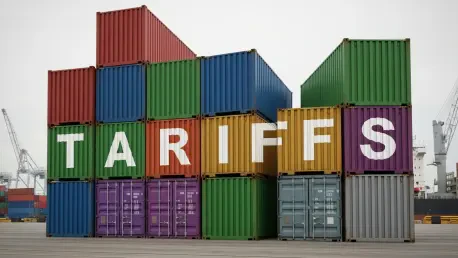

With decades of experience navigating the complexities of global logistics, Rohit Laila has a unique vantage point on the intersection of technology, supply chains, and international policy. In light of the recent, sudden announcement of a 25% tariff on countries trading with Iran, we sat down with him to understand the immediate fallout and long-term implications. Our conversation delves into the practical steps businesses should be taking amid the uncertainty, the specific vulnerabilities this “stress test” exposes in global supply chains, the legal and logistical hurdles that might prevent these tariffs from ever taking effect, and the potential chaos of a Supreme Court ruling on the President’s tariff authority.
The president announced an immediate 25% tariff on countries “doing business” with Iran, but the scope remains undefined. What are the most urgent, practical steps a company with suppliers in China or Turkey should be taking right now to mitigate potential disruption and cost?
The first thing to do is breathe, and then immediately get to work mapping your exposure. The lack of official documentation is the biggest challenge; we don’t know what “doing business” even means yet. But we do know Iran’s top partners include major manufacturing hubs like China, Turkey, and India. So, the most urgent step is a deep-dive audit of your Tier 1 and Tier 2 suppliers. You need to identify every single partner located in those key countries. From there, you begin modeling the financial impact. What does a sudden 25% cost increase on those components or finished goods do to your margins? This isn’t a time for waiting; it’s a time for proactive scenario planning, even with incomplete information.
This tariff threat has been called a “global supply chain stress test,” since Iran’s key partners include China, India, and the UAE. What specific vulnerabilities does this create for U.S. businesses, and how can they begin to quantify their immediate financial risk?
This is an incredibly insightful description because the vulnerability isn’t just about a single product or country; it’s about the interconnectedness of the entire system. When you threaten tariffs on major players like China, the UAE, and India simultaneously, you’re not just targeting one link in the chain; you’re shaking the whole foundation. The primary vulnerability for U.S. businesses is over-reliance on single-source regions that are now caught in this geopolitical net. To quantify the risk, you have to move beyond just your direct suppliers. Calculate the total value of imports your company sources from all the named countries. Then, apply that 25% figure. That number is your immediate, worst-case financial risk, a tangible figure you can take to your board to justify the cost of diversifying your supply base or exploring reshoring options.
A similar “secondary tariff” previously threatened against Venezuela’s oil partners was never implemented. Based on that precedent and the potential use of the IEEPA, what legal or logistical hurdles could prevent these new tariffs on Iran’s partners from actually taking effect?
History is our best guide here, and the Venezuela situation is a crucial precedent. A threat made on social media is not official policy. The biggest hurdle right now is the complete absence of an executive order or any formal documentation. Without that, Customs and Border Protection has no legal basis to begin collecting duties. Furthermore, the likely legal mechanism, the International Emergency Economic Powers Act (IEEPA), is itself on shaky ground. The fact that the President’s authority to use IEEPA for tariffs is already under review by the Supreme Court creates a massive legal question mark. Any attempt to push this through before that ruling would be seen as a legally dubious and highly provocative move.
The Supreme Court is expected to rule on the legality of using the IEEPA for tariffs. If the court strikes down the authority and orders refunds on past duties, how would the government practically manage those complex reimbursements, and what message would that send to businesses?
Honestly, it would be an administrative nightmare of epic proportions. The President himself called it a “complete mess” and “almost impossible,” and for once, that’s not an exaggeration. We’re talking about untangling years of complex import declarations and financial transactions across thousands of companies. The Department of Justice has confirmed it would make reimbursements available, but the sheer logistics of processing those claims would be staggering. The message this would send to businesses is profoundly destabilizing. On one hand, it’s a potential financial windfall for those who paid the duties. On the other, it signals that U.S. trade policy can be built on a legal house of cards, making long-term investment and supply chain planning feel more like a gamble than a strategy.
What is your forecast for the stability of U.S. trade policy and its impact on global supply chains over the next year?
My forecast is for continued, heightened instability. The current environment, where major policy is announced without official documentation and legal frameworks are constantly being challenged, is the new normal. We are far from a stable, predictable trade landscape. This “stress test” on supply chains isn’t a one-time event; it’s a symptom of a larger trend toward using trade policy as a rapid-response geopolitical tool. For businesses, this means the era of purely cost-optimized, just-in-time supply chains is over. The focus for the next year, and likely beyond, must be on building resilience, agility, and redundancy. Assuming things will “go back to normal” is the most dangerous assumption a supply chain leader can make right now.