
Introduction to Prime Air and its role in last-mile logistics
Drone delivery looked like science fiction until a camera caught a hexacopter clipping a cable in Waco yet still settling itself down without hurting anyone, a jarring reminder that autonomy can be both impressive and imperfect in the same breath. That tension defines Prime Air’s mission: bring sub-hour delivery for items under about five pounds while threading the needle between speed, safety, and public trust. The goal targets household essentials and small electronics, where convenience drives repeat use.
Since pilot flights started in College Station and Lockeford, the program added or announced new sites in Waco, San Antonio, Kansas City, Pontiac, Ruskin, and Richardson. Each site acts as a lab for suburban operations and airspace integration, shaped by local terrain, weather, and community norms. The effort sits inside a broader race among retailers to automate the last mile while meeting rising regulatory expectations.
System architecture and core capabilities
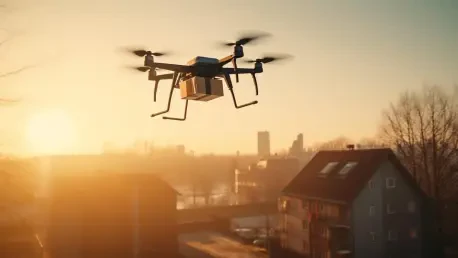
Prime Air’s current platform centers on the MK30, a smaller, lighter, and quieter hexacopter than earlier models. It trades sheer mass for efficiency, flying lower-impact missions with less noise footprint and tighter maneuvering. The airframe is built for routine wear, not showroom shine.
Reliability comes from redundancy, with multiple motors and control paths designed to absorb single-point failures. Minor airframe damage is tolerated, and protective shrouds and prop guards aim to prevent cascade failures. The design philosophy favors graceful degradation over brittle perfection.
MK30 airframe and propulsion
The hexacopter layout balances lift, stability, and energy use, enabling steadier hover and controlled descents. Lightweight materials and refined prop geometry damp sound and vibration without sacrificing thrust.
However, compactness does not erase physics. Gusts, thermal shifts, and wake effects from nearby structures still matter. The MK30 manages these forces with tuned motor controls and conservative envelopes.
Navigation, sense-and-avoid, and obstacle detection
Routing relies on a sensor suite and onboard autonomy to plan paths and steer away from conflicts. The system fuses inputs to create a live picture of the airspace and likely hazards.
Thin obstacles remain the hardest test. Cables and cranes can evade detection until too late, so maps, higher-resolution sensing, and smarter models are being pushed to catch the near-invisible.
Delivery workflow, drop-off mechanism, and contingency landing
The standard drop calls for about ten feet of clear space, with customers guided to prepare safe zones. The drone descends, completes release, then climbs out on a predefined trajectory.
If something goes wrong, contingency protocols favor controlled descents to minimize risk. The aim is predictability: contain the issue, avoid people and property, and preserve data for analysis.
Command, control, and safety assurance
Remote pilots and supervisory tools manage fleets through secure links and layered fail-safes. If communications degrade, the aircraft defaults to safe behaviors rather than improvisation.
Every mission produces logs that feed incident response and continuous improvement. These feedback loops align with regulatory compliance, turning each anomaly into training data.
Recent developments and incident timeline
On Nov. 18 in Waco, an MK30 snagged an internet cable during climb-out after a delivery. A propeller tangled, the wire severed, and the drone executed a controlled descent, sustaining minor prop damage and causing no injuries. Amazon apologized and paid for repairs as the FAA opened an investigation; the NTSB noted awareness without a separate probe.
A month earlier in Tolleson, two drones struck a construction crane, prompting a brief pause. These events did not end the program, but they shaped expansion cadence, with new site launches paced by safety reviews and oversight.
Real-world applications and deployments
Prime Air focuses on small payloads that benefit from speed: over-the-counter health items, pantry staples, and small gadgets. Sub-hour delivery here can displace quick car trips and curbside pickup, especially when timing matters.
Deployment favors suburban blocks where yards allow clear drop zones and short routes. Community outreach, signage, and education help neighbors understand flight paths, noise windows, and safety expectations. Competitors, notably Walmart with Wing and Zipline, are scaling across multiple states, including Texas, amplifying a market test of methods and adoption.
Challenges, risks, and constraints
Technical hurdles converge around perception. Thin, dynamic obstacles, cluttered neighborhoods, and variable weather stress autonomy in ways lab tests do not. Edge cases accumulate fast once flights leave the test field.
Regulatory pressure has stayed steady. Waivers and operational limits govern where and how BVLOS flights proceed, and investigations add checkpoints. Cost and reliability remain business levers, as do noise, privacy, and the simple need for clear landing space in real backyards.
Future outlook, innovation pathways, and scale-up scenarios
Progress is likely to come from multi-sensor fusion, better edge processing, and richer maps that include dynamic obstacle databases. Sharing incident learnings across sites can sharpen models and trim blind spots faster.
Operational maturity depends on deeper contingency planning and predictive risk tools that flag fragile routes before flights. Regulators increasingly ask for standardized performance metrics, and data-driven approvals point to gradual BVLOS expansion. Scaling toward high-volume delivery reshapes network design, with micro-fulfillment and launch pads stitched into retail footprints.
Conclusion and overall assessment
The Waco mishap underscored a hard truth: autonomous safety features mitigated harm but did not erase risk. Prime Air showed real strides with the MK30 and measured expansion, yet incident-driven scrutiny held sway and shaped the tempo.
The path forward rested on sharper obstacle detection, sturdier contingencies, and transparent safety data shared with communities and regulators. Competitive pressure from Walmart’s partners pushed the bar higher, turning operational discipline into a differentiator. The verdict landed near cautious optimism: the technology worked often enough to matter, and the remaining work demanded focus, candor, and steady proof under everyday complexity.