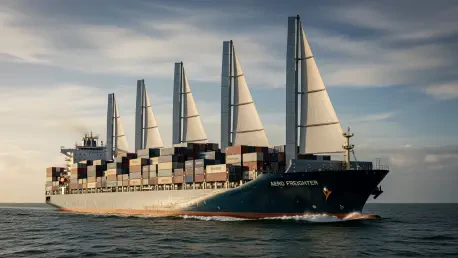

The sight of a massive steel tanker cutting through the Pacific with towering white sails would have seemed like a historical hallucination just a few years ago, but today it represents the most sophisticated response to a global energy crisis. The maritime industry is coming full circle as the world’s most massive cargo vessels look to the horizon once again to solve a multi-billion dollar fuel crisis. For over a century, heavy fuel oil has been the undisputed king of the high seas, but a new era of high-tech sails is proving that the oldest source of power in history is also the most forward-thinking. Modern shipping is no longer just about engine displacement; it is about harvesting the atmosphere to meet aggressive decarbonization targets while keeping operational costs from sinking the bottom line. This resurgence is not a retreat into the past, but a leap into a future where kinetic energy and digital algorithms work in tandem.
Navigating the Pressures of Global Decarbonization
The shift toward wind-assisted propulsion is not merely a nostalgic nod to history but a strategic response to a tightening regulatory net. International bodies and frameworks like the European Union’s Emissions Trading System (ETS) and FuelEU Maritime are making carbon emissions increasingly expensive, forcing operators to rethink their propulsion strategies. These mandates have transformed carbon from a secondary environmental concern into a primary line item on a balance sheet. Shipowners now face a reality where the cost of pollution might soon rival the cost of the fuel itself, creating a powerful financial incentive to capture every knot of “free” energy the wind provides.
For industry leaders like Odfjell, the journey toward sustainability began not with sails, but with a long-term focus on optimizing older fleets, which successfully slashed fuel bills by over 50%. This foundational efficiency involved refining hull coatings, upgrading propellers, and streamlining engine performance across existing tonnage. By first squeezing every drop of efficiency out of traditional hardware, these companies established a lean baseline. This preparatory work has set the stage for wind technology to move from experimental curiosity to a primary pillar of the global maritime energy transition, ensuring that when sails are finally added, they amplify an already efficient platform.
Economic Realities: The Technology Landscape
While the environmental benefits of wind are indisputable, the commercial viability hinges on a complex calculation of “payback periods” and technological fit. There is often a significant gap between theoretical financial models, which predict a three-year return on investment, and the practical reality of five to ten years once installation, cabling, and transport are factored in. Operators must account for the “soft costs” that rarely appear in a manufacturer’s brochure, such as the loss of cargo space or the downtime required for structural reinforcement. Consequently, the decision to go green is as much a chess match with capital expenditure as it is a commitment to the planet.
Current technologies range from suction sails and Norsepower rotor sails to massive rigid wings like those developed by BAR Technologies. Each system presents unique advantages depending on the vessel type and route, with medium-sized operators often finding that retrofitting sails during a scheduled five-year dry docking is more financially sound than fighting Asian shipyards for inclusion in expensive newbuild contracts. Many shipyards in the East remain hesitant to alter their standardized “cookie-cutter” production lines for bespoke wind installations, leading many owners to treat wind propulsion as a sophisticated aftermarket upgrade rather than a standard factory feature.
Expert Perspectives: The Human and Operational Element
Integrating wind technology involves more than just bolting hardware to a deck; it requires a complete overhaul of operational safety and crew culture. Industry experts from Union Maritime and Odfjell highlight the “human element” as a critical hurdle, noting that crews must be trained to understand the physics of wind through everything from dinghy sailing in Bergen to advanced bridge simulators. Seafarers who have spent decades relying on the steady thrum of a diesel engine must now learn to anticipate gusts and adjust for lateral drift. This shift in mindset is essential, as the most advanced sail in the world is useless if the crew is hesitant to deploy it.
Furthermore, the physical presence of massive sails creates navigation challenges, such as obstructed bridge visibility. To solve this, operators are turning to cutting-edge AI systems like Orca AI, which use infrared and visible-light cameras to provide a 360-degree digital awareness that compensates for the visual gaps created by the sails. These systems act as a digital lookout, identifying distant hazards and calculating collision risks in real-time. By merging traditional seafaring with artificial intelligence, companies are proving that the physical limitations of wind hardware can be mitigated through digital innovation, ensuring safety is never sacrificed for the sake of fuel efficiency.
A Strategic Framework: Wind Integration
For shipowners looking to adopt wind-assisted propulsion, a phased strategy was essential to manage risk and maximize efficiency. The process began with establishing a baseline of energy efficiency through cost-effective hull and propeller optimizations before investing in high-cap sails. Utilizing specialized consultancies for digital simulations allowed owners to predict performance across specific maritime corridors, ensuring the chosen technology—whether rotor or suction—aligned with the ship’s primary routes. This data-driven approach removed much of the guesswork, allowing companies to see exactly how much fuel they stood to save before a single bolt was tightened on the deck.
By ordering vessels in series rather than as one-off prototypes, owners standardized installation processes, making the technology more palatable to shipyards and reducing the overall capital expenditure of the transition. This move toward standardization signaled to the broader market that wind was no longer a boutique experiment but a scalable industrial solution. As these vessels began their routes, the industry moved closer to a hybrid reality where the engine and the atmosphere shared the load. Ultimately, the successful integration of wind power required a blend of ancient physics, modern software, and a willingness to rethink the very nature of global trade.
Future Considerations: The Path Forward
The path forward for the shipping industry required a decisive shift toward harmonized global standards for carbon pricing and technological certification. Regulators needed to provide a stable “demand signal” that encouraged long-term investment rather than short-term compliance. Moving forward, the industry sought to integrate wind-assisted propulsion with next-generation green fuels like ammonia and hydrogen, creating a truly zero-emission logistics chain. Stakeholders focused on developing modular sail designs that could be easily transferred between vessels, further lowering the barrier to entry for smaller fleet operators.
Technological advancements in material science also played a pivotal role, as researchers investigated lighter, more durable composites for sail construction that resisted the corrosive effects of salt spray. Port authorities and terminal operators contributed by redesigning loading equipment to accommodate the unique height and placement of fixed sails. By fostering a collaborative ecosystem between shipyards, tech developers, and crews, the maritime sector ensured that the return to sail was not merely a temporary trend. These coordinated efforts transformed the high seas into a laboratory for sustainable innovation, proving that the wind could once again carry the weight of the world’s economy.