
In the high-stakes environment of international travel retail, the new safety system utilizes a Vision-Language Model to differentiate between a customer bending over to tie a shoe and a genuine medical emergency or fall. This level of granular distinction is critical in the bustling atmosphere of South Korean shopping hubs, where thousands of international travelers navigate complex floor plans daily. The retailer has moved beyond the passive recording of events to a proactive stance that prioritizes human well-being through computational intelligence. By deploying these advanced algorithms at the Myeong-dong flagship and key logistics hubs, the company addresses the inherent limitations of traditional security infrastructure. These legacy systems often struggle to provide real-time intervention, relying instead on post-incident review. The current implementation represents a fundamental shift in how physical retail spaces are managed, ensuring that every movement is understood within its proper context. This technological leap allows for a safer environment while minimizing the disruption caused by false alarms.
Enhanced Accuracy: The Role of Two-Stage Video Analysis
The core of this initiative lies in a sophisticated two-stage video analysis framework designed to overcome the common pitfalls of standard CCTV monitoring. In the first stage, Vision AI serves as a primary detector, constantly scanning the environment for abnormal movements or the presence of prohibited items on escalators. If an anomaly is detected, such as a person falling or a cart entering a restricted area, the system immediately triggers a second layer of scrutiny. This is where the Vision-Language Model comes into play, interpreting the visual data through a linguistic lens to confirm the severity of the incident. This layered approach ensures that high-priority threats are addressed within seconds, while mundane activities are correctly identified and dismissed. Such precision is vital for maintaining a smooth operational flow in high-traffic zones where traditional security personnel might be overwhelmed. Moreover, this system operates continuously without the performance degradation typically associated with manual monitoring.
Mitigating Fatigue: Transitioning to Automated Surveillance
Moving beyond simple detection, the integration of automated analysis addresses the critical issue of observer fatigue, which often leads to missed incidents in large-scale retail environments. Security professionals tasked with watching dozens of screens simultaneously face a daunting cognitive load that can result in delayed reaction times. By automating the initial screening process, the retailer allows its human staff to focus on high-level decision-making and direct intervention rather than constant surveillance. The artificial intelligence acts as a tireless digital partner, maintaining a consistent level of vigilance throughout operational hours and beyond. This transition from reactive to proactive safety management is not merely a technical upgrade but a reimagining of the duty of care that modern retailers owe to their patrons. As the technology matures, it becomes an invisible but omnipresent layer of protection that operates in the background, ensuring that the luxury experience remains unmarred by safety concerns.
Targeted Protection: Safety Protocols at the Myeong-dong Flagship
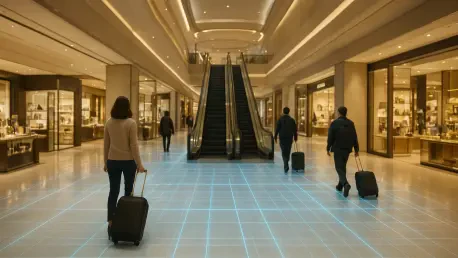
At the Myeong-dong flagship store, the AI network is specifically programmed to handle the unique challenges presented by a premier global shopping destination. Because this location attracts international travelers who often carry heavy luggage or travel with small children, the system is calibrated to monitor high-risk behaviors on escalators. It can instantly detect if customers are attempting to take strollers onto moving stairs instead of using the provided elevators, a common but dangerous practice in crowded retail settings. Furthermore, the system identifies instances where travelers might be boarding with unsecured belongings that could pose a trip hazard to others. By identifying these risks at the moment they occur, the system enables immediate corrective action, such as automated voice guidance that gently reminds the shopper of safety protocols. This tailored approach recognizes that safety in a duty-free environment requires a nuanced understanding of traveler behavior and the specific physical layout of the store.
Proactive Intervention: Crowd Density and Emergency Response
Beyond individual incident detection, the system provides a comprehensive suite of crowd management tools and rapid emergency response capabilities. The AI continuously analyzes movement patterns and occupancy levels near main entrances and elevator lobbies to prevent dangerous congestion before it reaches a critical peak. If the software identifies a density level that exceeds safe thresholds, it can automatically suggest traffic rerouting or alert staff to open additional access points. In the event of an actual accident, the system does not just alert a central control room; it can trigger localized safety measures immediately. This includes activating warning lights near the site of the incident and deploying automated voice guidance to assist the affected individual while alerting nearby shoppers to the hazard. This integrated response system significantly reduces the time required to provide assistance, ensuring that medical emergencies or structural hazards are managed with the utmost speed and coordination.
Industrial Safety: Protecting Workers in Logistics Hubs
The safety network extends its reach beyond the consumer-facing retail floor and into the company’s primary logistics center, where the focus shifts toward industrial hazards. In this high-pressure environment, the AI is configured to monitor the complex interactions between personnel and heavy machinery, particularly forklifts. For example, the system is programmed to recognize the specific safety protocol requiring a second person to serve as a signaller during forklift operations in tight spaces. If a forklift is operated without this mandatory human oversight, the AI flags the violation in real-time, allowing for immediate intervention. This level of monitoring is essential for preventing the types of industrial accidents that often occur in busy distribution hubs where speed and efficiency are high priorities. By enforcing these rigorous safety standards through automated observation, the company creates a culture of accountability that protects its workforce from avoidable risks while maintaining high operational tempo.
Digital Innovation: Collaborative Intelligent Ecosystems
This industrial application is part of a larger collaboration with LG Electronics to develop an intelligent logistics ecosystem that leverages cutting-edge technology. By monitoring vehicle driving behavior and the specific risks associated with heavy cargo handling, the system proactively protects workers while simultaneously streamlining daily operations. The integration of digital-twin technology allows managers to visualize safety data in a virtual environment, identifying potential bottlenecks or hazardous configurations before they manifest in the physical world. This data-driven approach to logistics management ensures that the high-pressure environment of a central hub remains as secure as a retail storefront. Furthermore, the continuous collection of safety data provides valuable insights into long-term trends, allowing for the periodic refinement of safety protocols and equipment placement. This partnership highlights how the fusion of retail expertise and technological innovation can redefine safety standards across the supply chain.
Institutional Integrity: Global Standards and Internal Systems
The commitment to these rigorous safety standards was eventually validated through the attainment of the ISO 45001 certification, an international benchmark for occupational health. This certification covered the company’s headquarters, its operations at Incheon International Airport, and its flagship store, signifying a comprehensive approach to safety management. Moving forward, the focus shifted toward the continuous optimization of these AI models to adapt to changing consumer behaviors and emerging logistical challenges. Organizations seeking to replicate this success were encouraged to consider a phased rollout of Vision AI that prioritizes high-risk areas before expanding to broader operational contexts. The integration of digital-twin technology was also recommended to simulate various emergency scenarios, allowing for the refinement of response protocols without disrupting actual operations. By maintaining this proactive stance, the industry established a new standard where technological innovation and human safety were linked.