
Rohit Laila is a seasoned expert in the logistics and supply chain sector, bringing decades of experience in navigating the complexities of global delivery systems. His career is defined by a passion for how emerging technologies can reshape traditional warehouses into efficient, future-ready hubs. In this conversation, we explore how data-driven simulations and objective investment analyses are helping companies overcome the uncertainty of adopting autonomous mobile robots.
With autonomous mobile robot shipments projected to grow significantly by 2026, what are the primary barriers preventing companies from adopting this technology? How do concerns regarding return on investment and throughput impact the initial decision-making process for warehouse managers?
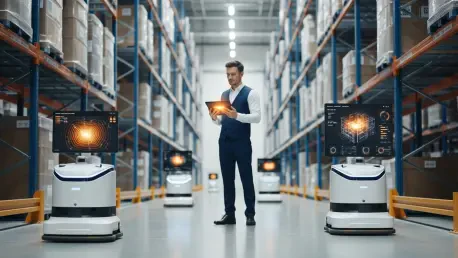
While the industry anticipates annual shipment growth for AMRs of 20.1% by 2026, reaching 259,000 units worldwide, the primary barrier remains the “black box” nature of automation. Managers often feel a heavy weight of responsibility when justifying large capital spends without a clear picture of the final outcome. They worry about the tangible impact on throughput and whether the ROI will actually materialize or if they will be left with expensive, underutilized hardware. By using simulation to address these specific doubts, companies can visualize a path toward lower cost-per-pick and improved service levels before any physical deployment begins.
When using real-world data like warehouse layouts and order profiles for simulation, what specific operational metrics are most critical to track? How does this granular approach help in determining the optimal balance between human workers and robotic units during peak seasons?
To understand a facility’s true potential, we must track granular metrics such as cost per pick and dwell times within the context of a specific warehouse layout. This data-driven approach allows us to stress-test various scenarios, ensuring that we find the exact ratio of robots to humans needed for different shifts. It is a massive relief for managers to see a simulation that proves they can handle a surge by adjusting their resource mix rather than just guessing. This precision transforms a chaotic peak season into a choreographed dance of efficiency where every movement is accounted for and optimized.
Estimating a solid business case often requires comparing various design alternatives and picking costs. What specific factors usually lead to the highest robot utilization rates, and how can a data-driven analysis reveal hidden costs that a standard ROI estimate might overlook?
Achieving high robot utilization rates depends on the intelligent orchestration of tasks so that no machine is idling or moving through suboptimal paths. A data-driven analysis compares design alternatives to see which layout maximizes uptime while minimizing overall picking costs. Standard ROI estimates often miss “hidden” friction points, such as time lost to operational assumptions that don’t hold up in reality. By uncovering these invisible drains on the budget, we provide an honest look at the total cost of ownership, giving stakeholders the confidence to build a business case on hard facts.
Implementing a deep-dive analysis typically takes weeks and requires significant operational assumptions. What steps can a facility take to ensure their data is ready for such a review, and how does a vendor-independent perspective change the final deployment strategy?
Preparing for an analysis, which typically takes 2 to 3 weeks, requires a facility to organize its historical order profiles and facility maps into a clean, accessible format. It involves gathering the messy details of daily operations—from aisle constraints to labor costs—so the simulation is grounded in the actual environment. A vendor-independent perspective is a total game-changer because it removes sales pressure and focuses purely on what is best for the operation’s bottom line. Instead of being pushed toward a specific brand, the facility receives an objective roadmap that prioritizes long-term efficiency and validated projections.
What is your forecast for warehouse robotics?
I forecast that we are entering an era where the “wait and see” approach will become a major competitive liability as adoption rates skyrocket. By 2026, the gap between market leaders and laggards will be defined by who used data to de-risk their investments today. We will see a shift where warehouse robotics is no longer viewed as an experimental luxury but as a foundational utility. The future belongs to those who embrace independent analysis to create resilient, flexible supply chains that can withstand any market volatility.