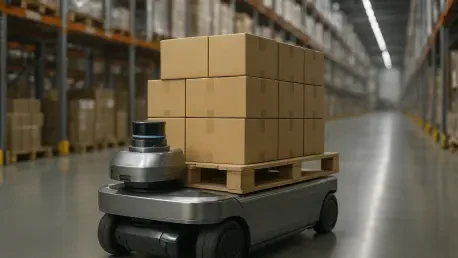

The manufacturing landscape has reached a point where traditional manual transport cannot keep pace with the hyper-accelerated demands of global logistics and large-scale distribution centers. The MP2000 functions as an objective-driven solution designed to streamline the movement of oversized payloads in high-volume plants. This autonomous mobile robot represents a significant leap for Pudu Robotics, as it transitions from its well-known service-oriented robots into the heavy-duty industrial sector. By integrating sophisticated artificial intelligence with robust hardware, the unit addresses the persistent bottlenecks found in warehouse operations, specifically the safe and efficient transfer of heavy pallets. Industrial environments often struggle with labor shortages and the inherent risks of human-operated forklifts in tight spaces. This new system offers a reliable alternative that ensures consistent throughput while reducing the margin for error in complex logistical workflows. It signals a new era for floor-level automation where precision and power are harmonized seamlessly.
Advanced Navigation: The Role of Hybrid Sensing
Central to the performance of the MP2000 is the implementation of the proprietary PUDU VSLAM+ technology, which combines laser and visual SLAM for superior spatial awareness. This hybrid navigation system allows the robot to operate in environments that would typically confuse standard lidar-only systems, such as vast, open warehouses with few structural landmarks or areas with highly reflective surfaces. By utilizing a high-resolution camera array alongside 3D lidar sensors, the machine constructs a real-time, three-dimensional map of its surroundings, enabling it to pinpoint its location with millimeter-level accuracy. This capability is critical for docking procedures where the robot must align itself perfectly with pallet racks or conveyer systems. Furthermore, the AI-driven processing unit analyzes environmental changes instantly, allowing the robot to adjust its path if new obstacles appear or if the warehouse layout is temporarily modified. This adaptability ensures that operations remain uninterrupted, even in the most dynamic and unpredictable industrial settings.
Safety remains a paramount concern in any facility where autonomous machines operate alongside human personnel, and the MP2000 incorporates a multi-layered safety architecture to mitigate risks. The robot is equipped with a 360-degree sensing field that utilizes ultra-wide-angle lidar and proximity sensors to detect even the smallest obstructions in its path. Beyond mere detection, the AI algorithms categorize objects in real-time, distinguishing between static machinery and moving pedestrians to determine the safest possible reaction, whether that involves slowing down or executing an immediate stop. This level of environmental perception is complemented by redundant mechanical safety features, including emergency stop buttons and tactile bumpers, ensuring compliance with rigorous international safety standards. By maintaining a high level of situational awareness, the system fosters a collaborative environment where humans and robots can interact without the constant threat of collisions. This focus on safety does not come at the expense of productivity; it allows for higher operational speeds.
Industrial Integration: Scaling Performance and Power
To meet the grueling demands of 24-hour production cycles, the MP2000 is engineered with a focus on durability and high-capacity power management. With a maximum load capacity of 2,000 kilograms, the machine is capable of handling the heaviest standard pallets used in automotive, electronics, and food processing industries. The structural chassis is built from reinforced steel, designed to withstand the stresses of constant heavy-duty lifting and long-distance transport across varied floor surfaces. Powering this massive capability is a high-density lithium iron phosphate battery system that supports rapid charging, allowing the robot to return to full operational capacity in a fraction of the time required by traditional lead-acid alternatives. Automated charging stations ensure that the fleet manages its own energy levels, moving to charge during periods of low activity to maximize uptime. This intelligent energy management system minimizes the need for human intervention, allowing warehouse managers to focus on high-level logistics strategy rather than minute maintenance tasks.
Effective automation requires more than just capable hardware; it necessitates a comprehensive software ecosystem that allows for seamless integration into existing Enterprise Resource Planning and Warehouse Management Systems. The PUDU Link platform serves as the central nervous system for the MP2000, providing a unified interface for fleet monitoring, task assignment, and performance analytics. Managers can utilize this software to visualize the entire material flow within a facility, identifying bottlenecks and optimizing routes in real-time to enhance overall efficiency. The platform also facilitates over-the-air updates, ensuring that the robots always operate with the latest AI models and security patches without requiring physical maintenance. This connectivity allows for sophisticated multi-machine coordination, where a fleet of MP2000 units can work in synchronization, communicating with each other to prevent traffic congestion in narrow aisles. By providing a data-driven overview of pallet movements, the system enables businesses to make informed decisions regarding their supply chain operations.
Strategic Implementation: Driving Operational Resilience
Organizations that adopted the MP2000 found that the transition to autonomous pallet handling provided a clear path toward long-term operational resilience. The decision to move away from manual material handling addressed the critical challenges of rising labor costs and the need for higher safety standards in the workplace. Decision-makers evaluated their current infrastructure and recognized that integrating AI-driven robotics was no longer an optional luxury but a fundamental necessity for maintaining a competitive edge. To achieve the best results, it was recommended that facilities conduct a thorough assessment of their floor layouts and network connectivity to ensure the robotic fleet operated at peak performance. Technical teams focused on training staff to interact effectively with the new systems, shifting human labor toward more complex, value-added tasks. By prioritizing the deployment of scalable robotic solutions, companies secured their logistics pipelines against future disruptions. The implementation of this technology served as a benchmark for industrial modernization.