
With decades of experience spanning the intricacies of logistics and delivery, Rohit Laila has become a leading voice in the evolution of supply chain technology. His career is defined by a deep passion for innovation, specifically in how robotics and human ingenuity intersect to solve the industry’s most persistent bottlenecks. Today, we sit down with him to discuss the emergence of integrated voice technology in warehouse automation and how these advancements are reshaping everything from worker safety in cold storage to the sheer volume of goods moving through global distribution centers.
CaseFlow Voice integrates voice commands with pallet-handling robots to orchestrate human and machine movement. How do these dynamic zones minimize worker travel, and what specific step-by-step logic does the system use to balance robot availability with real-time order priorities?
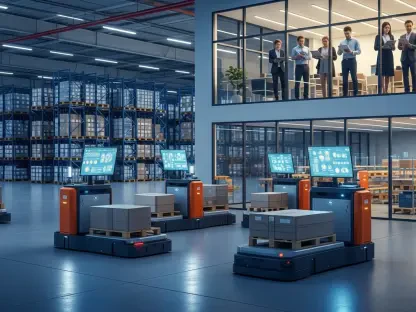
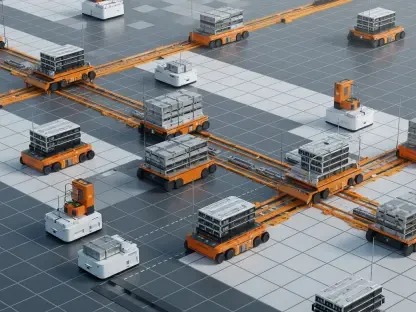
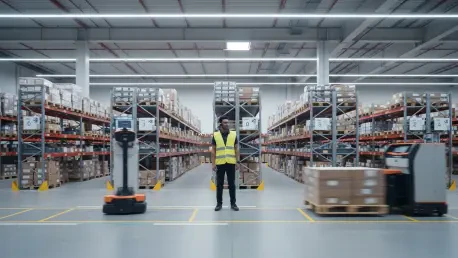
The logic behind dynamic zones is all about decoupling the picker from the long-haul transport. In a traditional setup, a picker spends over half their shift just walking or driving a pallet jack to a shipping dock, which is incredibly inefficient. With this system, the worker stays within a concentrated “picking zone,” while the CPJ Co-bot Pallet Jacks act as the circulatory system of the warehouse. The software uses a real-time orchestration engine that first looks at order priority—identifying which pallets need to get on a truck immediately—and then cross-references that with the physical location of the nearest available robot and the human picker. By keeping the humans focused on the high-value task of picking and the robots focused on the repetitive task of moving, we eliminate those long, empty miles that usually exhaust a workforce.
Cold storage environments present challenges like condensation and heavy gloves that make touchscreens and scanners impractical. How does hands-free voice technology improve safety in these settings, and can you share metrics regarding how this shift impacts accuracy compared to traditional handheld devices?
Cold storage is a brutal environment for technology; when you’re wearing thick thermal gloves, trying to hit a tiny button on a touchscreen is an exercise in frustration, and scanners often fail when frost or condensation builds up on the lens. Moving to a hands-free voice system like Jennifer allows workers to keep their eyes on the racks and their hands on the product, which is a massive safety win when you’re handling heavy cases in slippery conditions. By removing the “stop-and-look” rhythm of handheld devices, we’ve seen accuracy rates soar because the system requires verbal confirmation of the pick. While specific error rates vary by facility, the integration of voice across 112 billion picks globally shows that removing the physical distraction of a screen leads to a much more focused and precise operation.
Training times can drop by half when using voice-guided workflows that support dozens of languages. How does this linguistic flexibility assist in managing a diverse workforce, and what anecdotes illustrate the process of getting a new picker up to full speed during periods of peak demand?
The beauty of supporting 37 different languages is that it removes the “language tax” on productivity; a worker who receives instructions in their native tongue is naturally more confident and less prone to misunderstandings. I’ve seen warehouses during peak seasons where they bring in a dozen temporary workers who have never stepped foot in a distribution center before. Instead of a week-long shadowing process, these workers put on a headset and are guided step-by-step by a voice that tells them exactly where to go and what to grab. We’ve seen training times slashed by 50% because the system acts as a constant, invisible coach, allowing a person who started at 8:00 AM to be hitting near-standard pick rates by the afternoon.
Throughput can double when workers focus solely on picking while autonomous co-bot pallet jacks handle long-distance transport. What operational changes are required to achieve these gains, and how do you measure the reduction in non-value-added travel for a typical warehouse associate?
To achieve a 2x throughput improvement, you have to move away from the “one person, one pallet” mentality. Operationally, this means reconfiguring the warehouse flow so that the robots are timed to arrive just as a picker is finishing a task. We measure the reduction in non-value-added travel by tracking “feet per pick”; in a manual warehouse, that number is often shockingly high. By implementing CaseFlow, we can see those travel metrics drop significantly because the associate is no longer “chasing” the workflow—the work is brought to them. It turns the warehouse from a chaotic scramble into a synchronized dance where the pallet moves to the dock autonomously, and the picker simply pivots to the next robot waiting in their zone.
Combining speech recognition with robotic orchestration represents a shift toward more human-centric automation. What are the primary technical hurdles when syncing voice-directed tasks with autonomous vehicle paths, and how does the system ensure workers and robots collaborate without causing floor congestion?
The biggest hurdle is latency—the robot and the voice system must be perfectly synced so the worker isn’t standing around waiting for a bot to arrive or, conversely, getting crowded by three robots at once. The system uses sophisticated AI to manage “traffic” in real-time, ensuring that autonomous vehicle paths are optimized to avoid the very picking zones where humans are active. It’s a human-centric approach because the technology adapts to the person, not the other way around. By using dynamic zone logic, the system ensures that robots are staged at the periphery of the picking area, entering only when a hand-off is required, which prevents the floor congestion that usually plagues less intelligent automation attempts.
What is your forecast for case picking automation?
I believe the future of case picking lies in the total “invisibility” of the technology. We are moving toward a world where the distinction between a “robot task” and a “human task” is completely blurred by seamless communication layers like CaseFlow Voice. In the next few years, I expect to see warehouses achieving even higher volumes with smaller physical footprints because the orchestration will be so tight that “dead time” is virtually eliminated. We will see a shift where automation is no longer viewed as a replacement for labor, but as an essential tool that makes the warehouse a safer, more intuitive, and significantly more productive place for the human beings who keep our global supply chains moving.