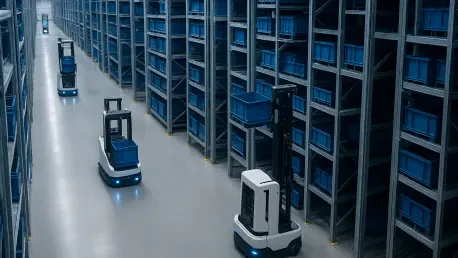

The relentless evolution of global supply chains has pushed traditional sorting methods to their absolute limits as consumer expectations for instant delivery continue to rise across every major market. In response, modern logistics centers have transitioned away from manual labor toward a reality where sophisticated robotic fleets manage thousands of requests per minute. This shift is particularly evident in high-throughput sectors like B2C e-commerce and fresh-food cold chains, where speed is non-negotiable. Market leaders such as Geekplus are now leveraging hardware engineering to solve persistent storage bottlenecks, ensuring that every square inch of a facility is used effectively.
The Evolution of High-Density Fulfillment in the Global Logistics Landscape
The shift from manual sorting to next-generation Autonomous Mobile Robots (AMRs) represents a significant leap in operational capability. In the current market, the significance of high-throughput systems cannot be overstated, especially as micro-fulfillment centers become a standard for urban logistics. By focusing on vertical space optimization, companies are overcoming the traditional horizontal limits of the warehouse floor.
Moreover, the adoption of robotics-as-a-service (RaaS) has lowered the barrier to entry for many firms, allowing for scalable automation without prohibitive upfront costs. This flexible financial model, combined with advanced engineering, has allowed businesses to maximize their storage density while maintaining the agility required to pivot during seasonal demand spikes.
Navigating the Shift Toward Intelligent Tote-to-Person Automation
Technological Catalysts: The Rise of Operational Concurrency
Traditional warehouse systems often suffered from inefficiencies caused by rack-locking, where one robot’s movement would halt others in the same vicinity. In contrast, the emergence of hyper-concurrent robot movements allows multiple units to operate within restricted spaces by requiring only two rack columns for retrieval. This design philosophy utilizes bidirectional retrieval and dual-robot operations to ensure that no single machine becomes a bottleneck for the entire system.
Furthermore, these advancements are supported by sophisticated motion-control algorithms and impressive mechanical capabilities. Robots now achieve climbing speeds of 1.5 m/s, which significantly drives fulfillment velocity. By increasing the speed of retrieval and the number of active units, facilities can maintain a high-frequency workflow that keeps pace with the most demanding e-commerce schedules.
Growth Projections: The Global Warehouse Automation Market
The demand for tote-to-person solutions is expected to see a statistical surge from 2026 to 2030 as global trade volumes grow. Performance indicators already suggest that these systems can output up to 6,000 totes per hour, setting a new benchmark for the logistics industry. This throughput level is essential for businesses operating in high-density urban hubs where space is at a premium and time is the most valuable commodity.
Overcoming Structural and Operational Constraints in Modern Warehousing
Modernizing older facilities often presents challenges such as uneven flooring and restricted aisle space, which can hinder traditional automation. Engineering resilience is now achieved through column-rail integration, which mitigates mechanical misalignment even in less-than-perfect environments. This allows companies to deploy advanced robotics without the need for a total floor reconstruction.
Additionally, managing high-volume surges requires systems that remain active around the clock. A 1:10 charge-to-discharge ratio has emerged as a vital solution, ensuring that robots spend minimal time at charging stations and maximum time fulfilling orders. This level of uptime is critical for maintaining 24/7 operations in the global supply chain.
Safety Standards and Regulatory Compliance in Human-Robot Collaboration
As humans and robots work closer together, safety protocols like the RoboSafe vest have become essential for regulatory compliance. These solutions ensure that the workspace remains safe for collaborative tasks while adhering to global machinery safety standards. Multi-layer fall protection systems further enhance security by limiting potential drops to less than 50 mm, protecting both the inventory and the equipment.
Data security and fleet management also play a role in maintaining operational integrity. Large-scale software scheduling now coordinates over 5,000 robots simultaneously, requiring robust cybersecurity measures and precise algorithmic control. This level of oversight ensures that even the largest fleets operate without collisions or software-induced delays.
The Future of End-to-End Automation and the Humanoid Integration
The roadmap toward fully autonomous ecosystems involves the integration of specialized AMRs with humanoid robots like Gino 1. By combining the strengths of various robotic models—such as the Hyper, Air, and Flex versions—businesses can match their automation strategy to specific SKU needs and facility layouts. This tiered portfolio approach ensures that the right machine is used for the right task, whether it is high-speed climbing or moving diverse payloads.
Emerging trends also highlight the increasing role of robotic picking arms in creating a touchless fulfillment process. As these arms become more adept at handling various shapes and weights, the need for human intervention in the picking process continues to diminish. This synergy between mobility and manipulation is the next frontier for logistics providers.
Synthesizing the Impact of RoboShuttle Hyper on Industrial Throughput
The implementation of high-density automation demonstrated how maximized concurrency and density redefined the return on investment for large-scale operations. It was observed that the scalability of intelligent scheduling software allowed businesses to grow their fleets in alignment with market demand. Strategic recommendations suggested that investing in versatile micro-fulfillment models helped organizations stay competitive during rapid shifts in consumer behavior. Ultimately, the integration of these advanced systems provided a blueprint for future-proofing industrial throughput in an increasingly automated world.