
Introduction
The long-held vision of a single, universal intelligence capable of operating any machine it encounters is rapidly transitioning from science fiction to a tangible reality in the world of commercial robotics. As industries from logistics to manufacturing increasingly rely on automation, the challenge has shifted from building a robot for every task to developing a single, adaptable software brain that can command a diverse fleet of hardware. This approach promises to dramatically accelerate the deployment of automation and unlock new levels of efficiency.
This article explores the feasibility and mechanics behind a universal AI for commercial robots. It will answer key questions about how such a system can overcome hardware diversity and what makes this new generation of AI fundamentally different from traditional robotics programming. Readers will gain an understanding of the core technologies driving this innovation and the profound impact it has on the future of physical AI solutions.
Key Questions and Topics
How Can a Single AI Platform Adapt to Different Robots
The primary obstacle to a universal robotic intelligence has always been the immense diversity in hardware. Each robot model possesses unique physical specifications, sensors, and movement capabilities, making a one-size-fits-all software solution seem impractical. This fragmentation has historically required bespoke programming for each new piece of equipment, a costly and time-consuming process that hinders widespread adoption.
The solution lies in a sophisticated software architecture designed to create a layer of abstraction between the AI and the physical machine. A specialized operating system, such as Ambi Robotics’ AmbiOS, functions as a universal translator. It manages the hardware-specific complexities, allowing the core AI to issue high-level commands without needing to understand the intricate details of each robot’s construction. This enables the central intelligence to focus on perception and decision-making rather than low-level motor control.
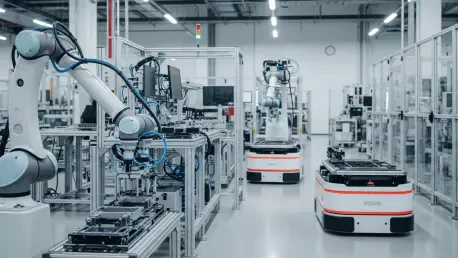
Moreover, this architecture ensures industrial-grade reliability and seamless integration with essential support and safety infrastructure. By standardizing the interface between the AI “brain” and the robotic “body,” the system becomes hardware-agnostic. This modularity is crucial, as it allows the same advanced intelligence and its associated skills to be deployed across a wide range of third-party robotic forms, from articulated arms to mobile platforms, without extensive redevelopment.
What Makes This AI More Than Just Software
Distinguishing this advanced platform from conventional robotics software requires looking beyond mere programming to the core of its intelligence. The system’s power originates from a vertically-integrated AI foundation model, which functions as the central cognitive engine. This model utilizes advanced 3D reasoning to achieve what can be described as superhuman performance, boasting exceptional uptime and accuracy in complex, real-world environments.
This level of performance is not achieved through simulation alone but is the direct result of being “production-hardened.” The AI is trained on an immense repository of real-world operational data gathered from a nationwide fleet of robots operating over hundreds of thousands of production hours. This constant stream of telemetry from processing millions of items allows the AI to learn from an unparalleled variety of scenarios, far exceeding what could be replicated in a lab. This real-world grounding makes the system robust and reliable enough for mission-critical commercial applications.
How Does the System Improve Itself Over Time
The continuous improvement of a universal AI platform is driven by a powerful data feedback loop, often described as a “flywheel effect.” Unlike static software, the system becomes more intelligent and capable as its deployment network expands. Every robot in the field, regardless of its physical form or location, acts as a sensor, constantly collecting operational data and feeding it back into the central foundation model.
This influx of diverse, real-world data is used to continuously refine and enhance the underlying AI, improving its ability to generalize across new tasks, items, and environments. This accelerated learning cycle has a tangible impact on product development. For instance, leveraging an existing AI Skill Suite, built upon this ever-growing data repository, has been shown to bring subsequent robotic systems to market significantly faster than their predecessors. By licensing this technology, partners gain access not just to the software itself but to this unrivaled repository of operational intelligence, fast-tracking their ability to deploy reliable, commercial-scale solutions.
Summary
The concept of a single AI brain for any robot is being realized through advanced software operating systems that abstract hardware complexities. This allows a central AI foundation model, trained on massive volumes of real-world data, to power a diverse range of robotic forms. This “production-hardened intelligence” gives the system exceptional reliability and performance, far surpassing traditional robotics programming. Furthermore, the system is designed to improve continuously through a data flywheel effect, where an expanding network of deployed robots feeds more information back to the core AI, accelerating its learning and the development of new capabilities.
Final Thoughts
The strategic shift from building bespoke robot-and-software combinations to licensing a universal AI brain marked a pivotal moment in the automation industry. This model not only democratized access to top-tier physical AI but also created a collaborative ecosystem where operational data from many sources contributed to a single, ever-improving intelligence. It demonstrated that the future of robotics may depend less on the mechanics of the machine and more on the adaptability and accumulated wisdom of the mind that guides it.