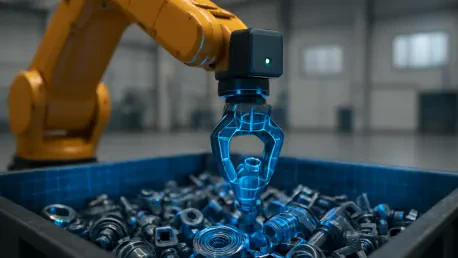

Modern robotics development is shifting toward high-efficiency designs where integrated vision and control systems must operate while consuming fewer than 50 watts of power. This technical threshold represents a significant barrier for companies attempting to deploy sophisticated artificial intelligence at the industrial edge without bulky, heat-intensive external processing units. Kle Robotics addressed this challenge head-on after being selected for the prestigious Global TIPS R&D project, a move backed by a substantial $4.6 million investment aimed at perfecting the elusive bin-picking process. Historically, the inability of robots to reliably identify and grasp objects in a disorganized pile was the single greatest bottleneck in automated fulfillment centers. By focusing on a lean, high-performance architecture, the company seeks to transform static manufacturing robots into cognitive workers capable of navigating the chaotic demands of modern global logistics networks. This shift is expected to redefine the standards of material handling by reducing energy overhead and increasing accuracy.
Bridging the Gap in Industrial Perception
Precision Imaging: The Power of Structured Light
The core of this research initiative centers on a 3D vision camera that utilizes multiscale structured light to circumvent the traditional failures of industrial imaging. Standard optical sensors often falter when faced with reflective metallic surfaces or the confusing overlap of items in a bin, leading to dropped parts or system halts. To solve this, the new hardware projects intricate light patterns across the workspace, allowing the system to calculate precise depth and height data with a target measurement accuracy of 0.1 millimeters. This level of granularity is essential for achieving a picking success rate of at least 99%, a metric that has long been considered the “holy grail” of automated sorting. By consolidating both the imaging hardware and the AI processing logic into a single, compact unit, the architecture maintains high-speed data throughput while adhering to strict energy constraints. This eliminates the latency issues typically associated with cloud-based or remote server processing units in large facilities.
Beyond the raw hardware capabilities, the integration of advanced perception software allows the system to distinguish between overlapping objects that possess similar color profiles or textures. Conventional vision systems frequently struggle to identify where one object ends and another begins when items are tightly packed in a chaotic arrangement. The multiscale approach effectively zooms into specific features of an item, enabling the AI to determine the most stable grasp point for a robotic gripper. This technological leap ensures that the system does not merely “see” a pile of objects but understands the spatial relationship between them in three dimensions. As industrial environments become increasingly crowded and fast-paced, the ability to process these complex visual datasets in real-time becomes a decisive factor in maintaining operational flow. The goal is to provide a seamless solution where hardware and software are essentially indistinguishable, allowing for rapid deployment across various manufacturing lines without specialized calibration.
Operational Scalability: From Automotive to Logistics
Transitioning from the highly structured environments of automotive assembly lines to the unpredictable nature of logistics hubs represents a significant shift in operational logic. Kle Robotics demonstrated substantial success within the automotive sector, providing vision systems for industry leaders such as Hyundai and Kia. In those settings, the parts are generally uniform, rigid, and arrive in predictable orientations, making automation relatively straightforward. However, the logistics industry presents a much more difficult challenge, as robots must handle everything from heavy cardboard boxes to thin, flexible polybags and padded envelopes. The new platform is specifically designed to navigate this inherent chaos, employing a dynamic decision-making engine that calculates the optimal approach for each unique item. By analyzing the structural integrity of the object, the robot can adjust its grip strength and movement speed to avoid damaging fragile packages during the sorting process, ensuring a higher standard of safety for diverse consumer goods.
To ensure these machines can operate autonomously without constant human intervention, the R&D team focused on advanced work sequence planning. It is not enough for a robot to simply pick an item; it must also plan a path that avoids collisions with the bin walls or other robotic arms working in close proximity. This involves complex geometric calculations performed in fractions of a second to ensure that the entire cycle time remains competitive with manual labor. The system utilizes predictive modeling to anticipate how a pile of items might shift once a single package is removed, allowing the AI to adjust its next move before the physical environment even changes. This proactive approach significantly reduces the risk of dropped items, which is a major cause of downtime in automated warehouses. By mastering the transition from predictable automotive components to the random assortment of goods found in global trade, the company is positioning itself as a primary architect of the next generation of intelligent material handling systems worldwide.
The Strategic Path toward Autonomous Systems
Software Accessibility: Democratizing Robotic Integration
One of the primary obstacles to widespread robotic adoption has been the high technical barrier required to program and maintain these systems. To counter this, the Clevis platform utilized a low-code workflow engine designed to empower non-specialists within the industrial workforce. This software allowed plant managers and warehouse supervisors to configure complex machine vision logic through a visual interface rather than through thousands of lines of manual code. By democratizing access to AI, the company drastically reduced the time and expense associated with setting up a new automation cell on the factory floor. Users quickly defined parameters for new items using the Fine Localizer and Fine Inspector modules, which guaranteed that once an object was retrieved, it was placed with pinpoint precision in its final destination. This focus on usability ensured that companies did not need to hire a team of dedicated robotics engineers just to handle basic operational changes, making the overall automation process much more agile.
Furthermore, the software ecosystem was built on an open architecture that facilitated easy integration with existing warehouse management systems and enterprise resource planning software. This connectivity allowed for a holistic view of the production line, where the vision system reported real-time data on picking accuracy and throughput directly to the central management hub. The Fine Inspector module played a crucial role here, as it performed a high-speed quality check during the transition phase of the pick-and-place movement. If an item was found to be damaged or if the wrong SKU was retrieved, the system automatically diverted the package to a secondary bin for human review. This automated quality control layer added a significant value proposition for logistics companies looking to reduce return rates and improve customer satisfaction. By providing a comprehensive suite of tools that managed everything from initial perception to final placement, the platform offered a complete end-to-end solution for modern logistics facilities.
Future Roadmap: Achieving Universal Cognitive Autonomy
The ultimate objective for the roadmap through 2030 was to establish a plug-and-play standard for cognitive automation that eliminated the need for extensive retraining when switching between different industrial tasks. Most robotic systems required a lengthy period of supervised learning or manual programming whenever a new product was introduced to the line. Kle Robotics envisioned a future where the AI vision system autonomously identified the physical properties of a new object and determined the best handling method without human guidance. This zero-shot learning capability allowed for unprecedented flexibility in high-mix, low-volume manufacturing and varied logistics operations. Achieving this level of autonomy marked a departure from the era of rigid, hard-coded robotic movements toward a paradigm where machines possessed a genuine understanding of their environment. This transition was critical for the development of dark warehouses where human intervention was no longer a requirement for achieving high-volume operational success.
Stakeholders in the logistics and manufacturing sectors took decisive steps to integrate these vision-centric solutions into their long-term infrastructure plans. The industry moved away from fragmented hardware setups and adopted the unified, low-power sensing models pioneered by this research. By prioritizing the 50-watt power limit, engineers ensured that massive robotic fleets remained sustainable and cost-effective over years of continuous operation. The focus shifted toward creating modular systems that were easily updated via software, allowing facilities to maintain peak performance as AI models became more sophisticated. Organizations that embraced this shift early saw a significant reduction in picking errors and a marked increase in overall facility throughput. Future considerations for the industry involved the standardization of 3D data formats to ensure that different robotic platforms shared visual knowledge in a collective learning network. These insights laid the groundwork for a global ecosystem where cognitive machines functioned as a cohesive workforce.