
Rohit Laila is a seasoned veteran in the logistics space, having spent decades navigating the complexities of global supply chains and delivery networks. His passion for marrying technology with operational efficiency makes him a leading voice on how autonomous systems are reshaping the final stages of the shipping process. In this conversation, we explore the strategic nuances of “last-meter” automation and how innovative robotics are being integrated into the daily routines of human workers. We dive into the mechanics of wheel-legged robotics and their ability to navigate urban terrain that stumped previous generations of delivery bots. The discussion also covers the strategic pivot from fully autonomous sidewalk crawlers to collaborative systems that empower drivers and the economics of reducing dependency on third-party carriers.
How do wheel-legged robots specifically overcome obstacles like stairs or curbs compared to previous sidewalk robots, and what technical challenges arise when integrating these machines into a driver’s daily workflow?
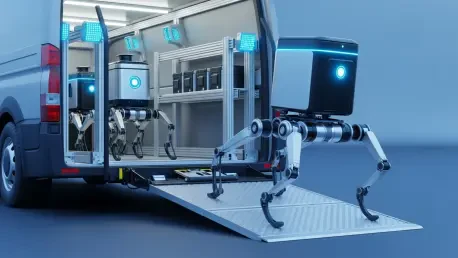
The magic of the Rivr technology lies in its hybrid design that bridges the gap between traditional wheels and articulated legs. Previous sidewalk robots, like the Scout, often struggled with anything beyond a standard flat pavement, making curbs and steep stairs insurmountable barriers for their small, rigid frames. By utilizing these wheel-legged configurations, the robot can lock its wheels to step up a flight of stairs or roll smoothly along a sidewalk, effectively tackling the “last meter” that has long been a bottleneck. Integrating this into a driver’s workflow is the real hurdle, as we must ensure the machine can autonomously exit the van and return without the driver having to micromanage every movement. It’s about creating a seamless hand-off where the human focuses on navigating the route while the robot handles the repetitive, physically taxing trek to the front door.
The “last meter” of delivery remains one of the most expensive and labor-intensive segments of the supply chain. How will deploying robots to carry packages from vans to doorsteps change the role of the delivery associate, and what specific metrics will determine if this human-robot collaboration is successful?
When you look at the sheer volume of a daily route, a driver might make hundreds of individual stops, each requiring them to park, find the package, and walk to the door. By offloading that final walk to a robot, the delivery associate transforms into a sort of mobile hub manager who oversees the logistics of the van rather than performing the manual labor. Success won’t just be measured by speed, but by the reduction in seconds per delivery across those hundreds of stops. We will also be looking closely at the reduction in physical fatigue for the workforce and how much we can increase the density of a route without adding more hours to the shift. It’s a shift from pure physical endurance to higher-level coordination between man and machine.
Amazon previously shut down its Scout autonomous sidewalk robot program in 2022. What strategic shifts led to moving away from fully autonomous delivery bots toward technology that supports drivers on dense routes, and how does this impact long-term operational costs?
The pivot from Scout to Rivr represents a move from idealistic automation to practical, assisted technology. Scout was designed to operate entirely on its own, which sounds great in theory but fails quickly in the chaotic, unpredictable environment of a residential neighborhood. By focusing on technology that supports drivers rather than replacing them, the system can leverage human intuition for complex driving and navigation while the robot handles high-frequency tasks. This hybrid approach significantly lowers long-term operational costs because it eliminates the need for a massive, expensive infrastructure to monitor fully autonomous bots remotely. Instead, you have a professional on-site to handle exceptions, ensuring the “last meter” is completed efficiently every single time.
With the expansion of one-hour and three-hour delivery windows in U.S. cities, the pressure on logistics networks is increasing. How does bringing robotics technology in-house help a company take control of the delivery process away from external carriers like the U.S. Postal Service?
Owning the entire stack of technology, from the AI in the fulfillment center to the robot on the sidewalk, allows for a level of precision that external carriers simply can’t match. When you rely on the U.S. Postal Service or other third parties, you are subject to their schedules and operational constraints, which makes tight one-hour windows nearly impossible to guarantee. By bringing companies like Rivr into the fold, a logistics giant can standardize the speed and quality of that final interaction at the doorstep. This vertical integration means every data point is captured internally, allowing for constant optimization and a reduction in the hand-off friction that usually slows down the process. Ultimately, it’s about becoming a self-contained ecosystem that doesn’t have to wait on anyone else to meet customer expectations.
Artificial intelligence is being integrated deeper into manufacturing and logistics to improve speed and efficiency. What are the practical steps for scaling these AI-driven robotics programs across hundreds of locations, and what are the primary trade-offs between automation and human oversight in residential neighborhoods?
Scaling these programs across hundreds of locations requires a robust strategy where the AI can learn from every delivery made in every city simultaneously. You start by testing in pilot programs, gathering data on everything from uneven terrain to weather conditions, and then you push those updates to the entire fleet via the cloud. The biggest trade-off is the balance between the efficiency of a machine and the social presence of a human. While a robot is perfect for carrying a heavy box up a driveway, it lacks the ability to navigate social nuances, like a neighbor’s loose dog or a package that needs to be hidden behind a specific pillar. Keeping a human associate in the loop ensures that we don’t sacrifice the “neighborhood trust” for the sake of a few saved seconds.
What is your forecast for the future of last-mile delivery automation?
I believe we are entering an era of “co-delivery” where the delivery van becomes a sophisticated mobile hangar. Within the next decade, we will see these wheel-legged robots becoming a standard feature in urban delivery fleets, handling the majority of the physical footwork on dense city routes. This will not only slash the operational costs of the last meter by a significant margin but also enable nearly instantaneous delivery as a standard service rather than a premium one. We will move away from the idea of robots replacing people and instead see them as essential tools that make the grueling work of logistics safer, faster, and much more predictable for everyone involved.