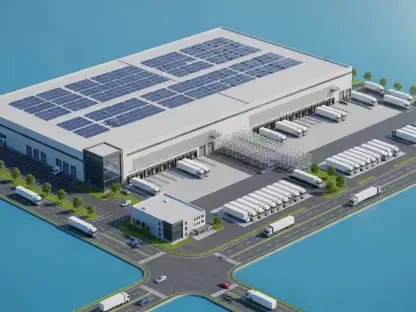

Industrial automation is currently undergoing a significant shift as the lines between traditional Automated Guided Vehicles (AGVs) and more flexible Autonomous Mobile Robots (AMRs) begin to blur. Rohit Laila, a veteran of the logistics and supply chain sector with decades of hands-on experience, has witnessed firsthand how technological bottlenecks can stall even the most advanced warehouses. His expertise lies in bridging the gap between rigid efficiency and adaptive intelligence, ensuring that automation serves the bottom line rather than complicating it. Today, we explore how the next generation of navigation software is solving the age-old problem of obstacle avoidance while maintaining the strict discipline required for industrial-scale throughput.
The discussion focuses on the transition from reactive navigation to a more structured “virtual path” approach, highlighting how configurable parameters and integrated fleet management can eliminate the chaos of roaming robots. We delve into the mechanics of minimizing traffic deadlocks, the integration of multi-tasking during avoidance maneuvers, and the strategic importance of “no-pass” zones to maintain precision in high-stakes environments.
AGVs often trigger alarms when blocked, while AMRs may take inefficient routes that cause traffic deadlocks. How does integrating a virtual path follower with smart avoidance solve these conflicting issues, and what specific operational metrics improve when vehicles return immediately to their pre-defined routes?
By utilizing a virtual path follower as the default mode, we maintain the repeatability and discipline of a traditional AGV while allowing for pragmatic maneuvers. When an obstacle is detected, the system calculates a detour within very strict, pre-configured limits rather than allowing the robot to roam freely. This approach ensures that once the obstacle is cleared, the vehicle returns immediately to its “golden” path, which preserves the predictability of the entire fleet. In terms of metrics, this significantly reduces the “Mean Time to Intervene” because operators aren’t constantly clearing alarms for minor blockages. Furthermore, the overall cycle time remains stable because the vehicle isn’t taking an uncontrolled, three-minute detour for a thirty-second blockage.
Traditional AMRs sometimes cause congestion by roaming freely around one another. Since advanced fleet managers now restrict vehicles from moving around other robots, what logic determines when a detour is safe, and how does this coordination prevent gridlock in high-traffic industrial environments?
The logic is built from the ground up on a centralized fleet management server, which acts as the “brain” for every vehicle in the facility. Unlike basic AMRs that react individually, this system ensures that robots only move around stationary objects and never around other moving vehicles, which is the primary cause of industrial gridlock. The server cross-references the proposed detour with the real-time coordinates and intended paths of every other robot in the fleet. If a detour would infringe on another vehicle’s right-of-way or create a bottleneck in a narrow aisle, the maneuver is blocked. This prudent approach ensures that a single robot’s attempt to be “flexible” doesn’t cascade into a facility-wide traffic jam.
Sequential operations, such as stopping before moving forks or communicating with equipment, can slow down throughput. In what ways does performing these tasks during an avoidance maneuver change the workflow, and how do optimized travel speeds on virtual paths compare to reactive speeds used during detours?
In traditional setups, a robot often behaves like a novice driver—it stops, thinks, moves its forks, and then continues, which wastes seconds that add up over a 24-hour shift. By integrating these actions into the avoidance maneuver itself, the robot performs “parallel processing,” such as adjusting fork height while it is mid-detour. This ensures that when it arrives back on its virtual path or at its destination, it is already physically prepared for the next task. Speed management is also tiered; the robots travel at their maximum optimized speeds and acceleration while on the virtual path, where the environment is known and safe. They only switch to slower, more cautious “reactive” speeds during the actual avoidance maneuver, ensuring that safety never comes at the expense of unnecessary sluggishness across the entire site.
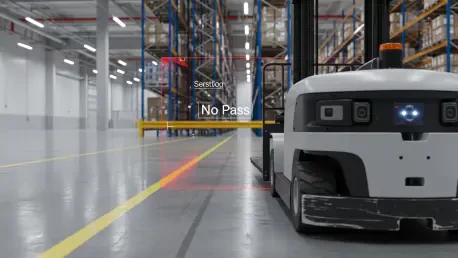
Industrial sites have zones where precision is more critical than flexibility, such as pick and drop points. How do you determine the specific distance limits a vehicle can stray from its path, and what criteria are used to designate “no-pass” zones where obstacle avoidance must be disabled?
The determination of stray limits is a collaborative process between the system integrator and the site manager, based on the physical dimensions of the aisles and the tolerances of the cargo. For instance, in a wide main corridor, a vehicle might be allowed a one-meter detour, but in a tighter storage lane, that limit might drop to 20 centimeters to prevent collisions with racking. “No-pass” zones are typically designated around high-precision areas like conveyor hand-offs or narrow docking stations where even a five-millimeter deviation could cause a mechanical failure. In these zones, SmartPass is disabled entirely, forcing the vehicle to stop and wait for a clear path, which guarantees that the robot always hits its mark with surgical accuracy. It’s about being smart enough to know when flexibility is actually a liability.
Safety and predictability are paramount for staff working alongside mobile robots. When implementing these configurable avoidance parameters, what steps should site managers take to balance robot autonomy with human safety, and how do you ensure that maneuvers remain prudent rather than erratic?
Site managers should start by defining “prudent” boundaries that mirror the natural expectations of the human workforce; a robot that suddenly swerves three meters off-course is terrifying to a nearby worker. We implement configurable stopping distances, where the robot maintains a respectful gap before even attempting a detour, which signals its intent to the human observer. By keeping maneuvers predictable and limited to the shortest possible route around an object, the robot’s behavior feels less like a “wild” AMR and more like a professional driver. Staff training is also streamlined because the robots follow the same virtual paths most of the time, making their movement patterns easy for humans to learn and anticipate.
What is your forecast for the evolution of obstacle avoidance in autonomous industrial vehicles?
I believe we are moving away from the “total autonomy” hype and toward a more sophisticated “governed autonomy” where software like SmartPass becomes the industry standard. In the next five years, I expect obstacle avoidance to become even more context-aware, perhaps using AI to distinguish between a temporary blockage like a fallen box and a permanent structural change. However, the core philosophy will remain the same: efficiency is found in the path of least resistance, not the path of most freedom. The ultimate goal is a “dark warehouse” or a high-traffic plant where vehicles move with the synchronized grace of a Swiss watch, bypassing obstacles without ever breaking their rhythm or requiring human intervention.