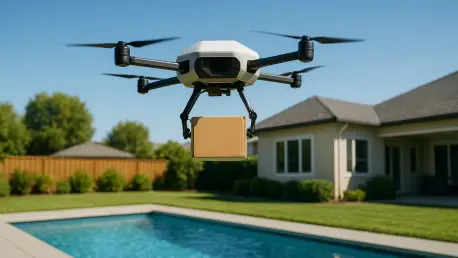

Technical malfunctions in autonomous hardware remain a hurdle for Amazon as it seeks to convince the public of the safety and accuracy of its Prime Air delivery fleet. Recently, a specific incident in a California residential neighborhood saw a MK30 drone release its cargo prematurely, resulting in a customer’s package splashing directly into a backyard swimming pool instead of landing on the designated turf marker. While the company has touted its sophisticated obstacle avoidance sensors and thermal imaging capabilities, this mishap serves as a vivid reminder that the last mile of delivery is often the most unpredictable. Neighbors captured the event on security cameras, showing the drone hovering momentarily before its mechanical grippers disengaged over the water. This event comes at a sensitive time as the retail giant attempts to scale its aerial operations across more complex suburban landscapes. Every public error in the field requires a deep dive into the telemetry and logic that governs these machines.
Operational Reliability: Addressing the Challenges of Urban Flight
The technological foundation of the MK30 drone relies on a sophisticated suite of LIDAR, thermal sensors, and computer vision to identify safe drop zones in real time. In the instance of the pool delivery, engineers suspect that the drone’s perception algorithms may have failed to distinguish the surface of the water from a solid, flat landing area due to specific lighting conditions or water clarity. Suburban environments present a unique set of challenges compared to the controlled testing grounds used during the early development phases. Variables like backyard furniture, swimming pools, and even overhanging power lines require the onboard AI to make split-second decisions with a high degree of confidence. To combat these issues, the flight software is undergoing continuous updates to improve its object classification capabilities. By incorporating larger datasets of residential topography, the system is designed to better recognize water-based hazards and abort deliveries if a safe landing is not entirely certain.
Moreover, the reliability of the mechanical release system is just as critical as the software’s navigational intelligence. In previous iterations, package drops were managed with more basic tethering systems, but the current generation uses a more streamlined gripper mechanism intended to increase delivery speed and reduce noise. If a mechanical glitch occurs or if the sensor suite provides conflicting data, the default safety protocol should ideally prevent the release of the payload. The fact that the package was dropped into the water suggests a potential disconnect between the navigation unit and the delivery actuation system. Amazon has maintained that its drones are equipped with multiple levels of redundancy to prevent such occurrences, including the ability to return to base autonomously if any critical system reports an error. This incident has prompted a localized pause in operations to perform hardware audits and ensure that safety margins meet the rigorous standards needed for thousands of daily flights.
Operational adjustments prioritized the implementation of multi-modal sensor fusion to enhance landing zone verification. Moving forward, the project emphasized a strategy of gradual expansion combined with increased transparency regarding flight safety data. Stakeholders focused on refining the MK30’s ability to operate in light rain and high-temperature conditions, which expanded the operational window in regions like Tolleson, Arizona. The introduction of international service hubs in Italy and the United Kingdom required navigating complex aviation rules, where the emphasis remained on protecting ground-level inhabitants and minimizing noise pollution. Future considerations involved the integration of more advanced machine learning models that predicted environmental changes before they impacted flight stability. Ultimately, the industry learned that maintaining transparency with the public and refining the physical hardware were essential steps in moving past the experimental phase for modern autonomous logistics.