
Amidst a backdrop of escalating industrial pressures, where thinning labor pools and tightening safety mandates intersect with an insatiable demand for greater operational efficiency, the announcement of an $8.2 million funding round for Hungarian drone manufacturer ABZ Innovation signals a pivotal moment for European heavy industry. This strategic capital infusion, led by the deep-tech investors at Vsquared Ventures with significant participation from Day One Capital and Assembly Ventures, is much more than a corporate milestone; it represents a calculated response to a market urgently seeking secure, reliable, and sovereign autonomous solutions. ABZ Innovation is now positioned to aggressively scale its production of heavy-duty drones, tools designed not as futuristic novelties but as essential equipment for the modern agricultural and industrial sectors. The investment will directly fuel the expansion of manufacturing capabilities, accelerate crucial research and development, and support a strategic push into critical global markets, including the United States, thereby challenging the established order in aerial robotics. This funding is the bedrock upon which the company intends to build a new standard for industrial autonomy, one rooted in European engineering, supply chain security, and a profound understanding of the real-world problems that keep operational managers awake at night.
When Solutions to Industrial Crises Are No Longer on the Ground
The operational realities of heavy industry have reached a critical inflection point where conventional, ground-based methods are increasingly proving inadequate. A confluence of persistent labor shortages, particularly for skilled and physically demanding roles, has created significant bottlenecks in sectors from agriculture to infrastructure maintenance. This human capital deficit is compounded by a regulatory environment that rightly places a higher premium on workplace safety, making tasks that involve working at heights, handling hazardous materials, or operating in confined spaces more complex and costly than ever before. Simultaneously, global competition exerts relentless pressure on businesses to maximize efficiency, reduce costly operational downtime, and increase productivity without compromising on quality or safety standards.
This trifecta of challenges—labor scarcity, safety imperatives, and efficiency demands—has compelled industry leaders to look skyward for viable solutions. The promise of aerial robotics is no longer a distant concept but an immediate and practical answer to these pressing issues. Heavy-duty drones offer a direct mechanism to augment human labor, taking over tasks that are dangerous, repetitive, or require a level of precision that is difficult to sustain manually. By deploying autonomous systems, companies can reallocate their valuable human workforce to higher-value activities, mitigate the risks associated with hazardous jobs, and achieve a new echelon of operational performance. The technology serves as a powerful lever to break through existing productivity ceilings and build more resilient, safe, and efficient industrial workflows.
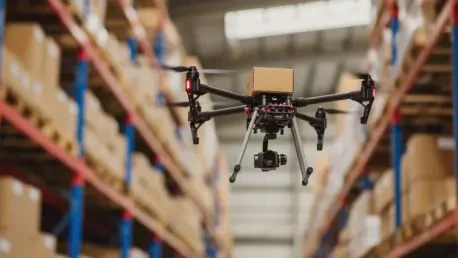
The tangible benefits of this aerial transition are becoming increasingly clear across a spectrum of applications. In precision agriculture, drones can cover vast and difficult terrains that are inaccessible to traditional machinery, delivering targeted treatments that boost crop yields while minimizing environmental impact. For infrastructure management, they can perform detailed inspections of bridges, power lines, and industrial facilities without the need for expensive scaffolding or the inherent risks of human inspection crews. In manufacturing and logistics, drones are being deployed for high-risk cleaning and maintenance tasks, drastically reducing accident rates and minimizing the costly downtime associated with these essential but hazardous activities. This shift represents a fundamental rethinking of industrial operations, where the solution is not about working harder on the ground but smarter from the air.
The Shifting Landscape and Why This Investment Matters Now
The evolution of drones from consumer gadgets and photographic tools into indispensable industrial workhorses marks a profound technological maturation. Early perceptions of unmanned aerial vehicles were largely shaped by their use in hobbyist circles and media production, but today’s industrial drones bear little resemblance to their predecessors. These are robust, heavy-lift platforms engineered for reliability in harsh environments, capable of carrying sophisticated sensor arrays and significant payloads. For sectors like agriculture, construction, and infrastructure maintenance, these machines are now being integrated as core operational assets. Their value is measured not in aesthetic video quality but in quantifiable metrics: increased crop yields per hectare, reduced inspection times for critical assets, lower incident rates in hazardous work environments, and significant cost savings from minimized downtime.
This technological shift is unfolding within a rapidly changing geopolitical context that imbues ABZ Innovation’s European origins with immense strategic importance. Growing concerns over data sovereignty and supply chain security have created an urgent and expanding market for a trusted, non-Chinese drone alternative. As drones become more deeply integrated into the management of critical national infrastructure, agricultural food supplies, and sensitive industrial processes, Western governments and corporations are becoming increasingly unwilling to accept the potential risks associated with data vulnerabilities or reliance on supply chains susceptible to geopolitical friction. ABZ Innovation’s positioning as a “full-stack European autonomy platform”—encompassing hardware, software, and data management—directly addresses this demand for a secure, sovereign capability that aligns with Western strategic interests.
Moreover, this investment highlights the emergence of Central and Eastern Europe, with Hungary at its forefront, as a formidable new hub for deep-tech innovation and advanced manufacturing. For decades, the narrative of European technology was dominated by hubs in the West, but a new dynamic is taking hold. The region now boasts a highly skilled engineering talent pool, a competitive cost base, and a burgeoning ecosystem of ambitious startups and supportive venture capital. ABZ Innovation is a prime example of this trend, demonstrating that world-class robotics and autonomous systems can be designed, engineered, and manufactured within the European Union, creating a resilient and competitive industrial base. This rise diversifies Europe’s technological landscape and signals a more distributed and robust innovation engine capable of competing on a global scale.
Inside the Deal and ABZ Innovation’s Strategy
At its core, ABZ Innovation was founded with a clear and focused mission: to automate the dangerous, repetitive, and high-precision tasks that place humans in harm’s way and limit industrial productivity. The company has engineered a suite of heavy-duty aerial robotics designed specifically for the demanding environments of modern agriculture and industry. Its platforms are not general-purpose drones but specialized tools built to solve specific, high-stakes problems. This problem-centric approach ensures that the technology delivers a compelling and immediate return on investment for its customers, moving beyond proof-of-concept demonstrations to become an integral and reliable part of their daily operations.
The $8.2 million capital infusion, co-led by Vsquared Ventures, Day One Capital, and Assembly Ventures, provides the essential fuel for ABZ Innovation to execute the next phase of its ambitious growth strategy. The funding is earmarked for a multi-pronged expansion plan designed to solidify the company’s market position. A significant portion of the capital will be used to scale manufacturing operations to meet the surging demand for its products, transitioning from bespoke production to a streamlined, industrialized process. Simultaneously, the investment will accelerate research and development, allowing the company to enhance its existing platforms and develop next-generation technologies that maintain its competitive edge. Finally, the funds will drive a targeted global expansion, enabling ABZ to build a robust sales and support presence in key international markets.
ABZ Innovation’s market strategy is a dual-pronged attack on inefficiency, targeting two sectors where its technology can create transformative value. In agriculture, the company is deploying its precision spraying drones to revolutionize the management of high-value crops, particularly in complex terrains like vineyards and orchards where traditional ground machinery is impractical. These drones enable farmers to overcome persistent labor gaps, apply treatments with pinpoint accuracy to boost yields, and reduce the use of chemicals, promoting more sustainable farming practices. In the industrial realm, ABZ’s drones are utilized for high-risk cleaning and maintenance operations. By automating tasks like cleaning large industrial tanks or inspecting structures at height, the company helps its clients dramatically reduce workplace accidents, cut costly operational downtime associated with manual preparation, and ultimately lower their overall operational expenditures.
The Voices Behind the Vision and Investor Confidence
The consortium of venture firms backing ABZ Innovation shares a unified and compelling thesis: the global industrial drone market is ripe for disruption. Leading investors like Vsquared Ventures, with its deep expertise in nurturing European deep-tech champions, see a market-defining opportunity emerging from the mounting regulatory and security-related restrictions being placed on incumbent, non-Western drone manufacturers. This shifting landscape has created a significant vacuum in the market for a secure, high-performance, and fully integrated platform. The investors view ABZ’s full-stack European autonomy platform not merely as a viable alternative but as a superior proposition for customers in critical sectors who can no longer compromise on data security and supply chain reliability.
This investor confidence is rooted in ABZ’s ability to offer a complete, end-to-end solution that goes far beyond the hardware itself. The company’s integrated approach, which combines robustly engineered aircraft, proprietary flight control software, and a comprehensive after-sales support network, provides the reliability and trustworthiness that industrial clients demand. This holistic platform ensures that customers are not just buying a machine but investing in a dependable operational capability. The investors recognize that in the industrial world, long-term success is determined by serviceability, support, and the assurance of a secure and resilient technology partner—qualities that are central to ABZ’s corporate DNA and market strategy.
Karoly Ludvigh, the CEO and co-founder of ABZ Innovation, articulates a vision that extends beyond commercial success to a fundamental mission of improving human lives. He emphasizes that the core purpose of the company is to systematically remove human workers from harm’s way, leveraging technology to handle the tasks that are too dangerous, dull, or dirty for people. This mission to enhance workplace safety is intrinsically linked to the goal of unlocking new levels of productivity. By automating hazardous and repetitive processes, ABZ’s drones free up human talent for more creative, strategic, and value-added work, ultimately creating a safer and more efficient industrial ecosystem. This founder’s mission resonates powerfully with both customers and investors, providing a clear moral and economic compass for the company’s future growth.
From Blueprint to a Global Industrial Standard
The journey from a successful prototype to an industrialized, globally distributed product presented a formidable set of challenges that ABZ Innovation was now capitalized to overcome. Scaling a hardware company involves a different order of complexity than scaling software, demanding mastery over intricate physical supply chains, the implementation of rigorous quality control protocols for every unit produced, and the establishment of a global logistics network to ensure the timely availability of parts and components. The successful execution of this industrialization phase was critical to transforming ABZ’s promising technology into a reliable, industry-standard piece of equipment that customers could depend on day in and day out.
This ambition was further defined by the company’s commitment to building more than just a machine. The strategic vision was centered on delivering a complete “full-stack European autonomy platform,” an ecosystem designed to ensure unparalleled reliability and performance. This meant guaranteeing that the robust hardware was seamlessly integrated with sophisticated and secure software, and that both were supported by a world-class after-sales service and maintenance program. This comprehensive approach acknowledged a core truth of the industrial market: for a new technology to be adopted at scale, it must be as dependable, serviceable, and predictable as any other critical asset on the factory floor or in the field.
A cornerstone of ABZ’s global strategy was the methodical development of a robust service and distribution network. The company understood that its long-term success hinged not only on the quality of its drones but also on the strength of its partners on the ground. The strategy focused on empowering a global network of distributors to build their own sustainable, revenue-generating service businesses around the ABZ platform. This involved providing them with extensive training, technical support, and a reliable supply of spare parts, enabling them to offer localized maintenance, repair, and operational support. This model was designed to create a virtuous cycle, where the success of ABZ’s partners would directly fuel the platform’s global adoption and solidify its reputation as the new standard for industrial aerial robotics.