
Rohit Laila brings decades of specialized experience to the logistics and supply chain sector, having witnessed firsthand the evolution from manual labor to high-speed automation. His deep-seated passion for technology and innovation has made him a leading voice in sustainable industrial solutions, particularly as global markets shift away from plastics. With a career rooted in optimizing delivery efficiency, Laila offers a unique perspective on how modern packaging systems like the Smart Fill range are bridging the gap between ecological responsibility and operational speed.
The Smart Fill range offers everything from basic pull-and-tear boxes to high-speed electronic dispensers. How should a business evaluate its current throughput to decide between a manual fanfold converter and a 60m/min electronic system, and what specific space requirements should they consider for integrated bench or floor-stand setups?
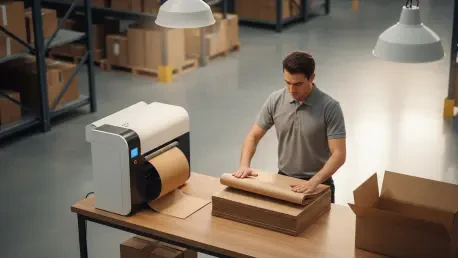
When a business reaches a tipping point where manual packing starts to create a bottleneck, it is time to look at the data behind the movement. If your team is struggling with low-to-medium volumes, the manual fanfold converter is a maintenance-free workhorse that offers incredible flexibility because it can be clamped to a workbench or moved on a rolling floor stand. However, once you need to scale, the electronic system’s 60m/min speed becomes essential to prevent jams and downtime that eat into your margins. Space is always at a premium in a busy warehouse, so we look at the footprint: a mobile stand allows the dispenser to glide between stations, while bench-mounting clears the floor entirely for heavy foot traffic. Transitioning to an electronic unit isn’t just about speed; it’s about creating a seamless flow where the machine keeps pace with the packer’s rhythm without taking up more than a few square feet of the station.
Transitioning from plastic to 100% recyclable and compostable paper can impact shipping logistics. Beyond the environmental benefits, what are the specific ways that lower shipping weights and reduced product movement within the box affect a company’s bottom line and overall return rates for fragile goods?
One of the most satisfying sounds in a warehouse is the silence of a perfectly packed box where nothing shifts or rattles during transit. By utilizing dense paper cushioning, we can significantly reduce product movement, which is the primary culprit behind high return rates for fragile items. The financial impact is immediate because lower shipping weights translate directly to reduced fuel surcharges and carrier fees, often providing a more favorable bottom line than bulky plastic alternatives. When a customer receives a package that is securely held by paper that is 100% recyclable and compostable, the brand’s perceived value increases, and the cost of replacing damaged goods plummets. It is a rare win-win where the lighter, greener material actually provides a more robust protective barrier than traditional void fill.
The Smart Cushion system uses a unique gear design to create dense pads directly from a pallet. Can you walk us through the technical process of how this machine maintains consistency over 7,600m of continuous cushioning and how a foot-pedal control improves the ergonomic workflow for high-volume packers?
The technical magic of the Smart Cushion system lies in its specialized gear design, which transforms raw paper into thick, shock-absorbing pads at a rate of 30 meters per minute. To maintain consistency over a massive 7,600m run of continuous cushioning, the machine utilizes an automated paper intake system and an intuitive touchscreen that monitors every segment. For the person on the line, the optional foot-pedal control is a game-changer because it frees up both hands to manipulate the product and the box simultaneously. You can feel the efficiency gain when a packer no longer has to stop to tear or press buttons, allowing them to maintain a steady, ergonomic flow that prevents fatigue over an eight-hour shift. This level of automation ensures that the last pad produced from the pallet is just as dense and protective as the very first one.
Compact workstations often struggle with bulky packaging materials. For those using the mini version of the manual dispenser or clamp-on workbench models, how does the adjustable dispensing angle help prevent physical strain on staff while maintaining a fast, fuss-free packing pace?
In a cramped packing environment, every inch of movement counts, and repetitive reaching can lead to significant physical strain on a team over time. The mini version of our manual dispenser and the clamp-on models are specifically designed to address this by allowing for a fully adjustable dispensing angle and height. This means the packer can position the paper exactly where their hands naturally fall, eliminating the need to overextend or twist their torso throughout the day. When the paper flows at a natural angle, the “pull-and-tear” motion becomes a fluid, effortless part of the packing cycle. By prioritizing these small ergonomic adjustments, a facility can maintain a fast, fuss-free pace without sacrificing the long-term health and comfort of its workforce.
Retailers are increasingly focused on improving the “unboxing” experience for the consumer at the kerbside. How does switching to biodegradable paper simplify the end-of-life messaging for a brand, and what feedback have you seen regarding the ease of disposal compared to traditional plastic void fill?
The unboxing experience is the final touchpoint a brand has with its customer, and nothing ruins that moment like a box full of messy, non-recyclable plastic film. Switching to biodegradable paper simplifies the brand’s message because the instructions for the consumer are incredibly straightforward: just put it in the kerbside recycling bin. We have seen overwhelmingly positive feedback from retailers who report that their customers appreciate the “guilt-free” disposal of materials that can be composted or biodegraded. Instead of forcing a consumer to drive to a specialized plastic drop-off point, the paper system integrates into their existing daily habits. It turns the act of disposal into a positive extension of the brand’s commitment to the environment, making the entire lifecycle of the package feel intentional and clean.
Automation is often viewed as a way to increase speed, but it also impacts material waste. In what ways do the manual, refill, and continuous dispensing modes on electronic units prevent over-packing, and how does this precision help a facility scale its operations without a proportional increase in costs?
Precision is the hidden hero of cost-effective scaling, as automation allows us to dictate exactly how much material is used for every single order. With the electronic units, operators can switch between manual, refill, and continuous modes, setting adjustable lengths and segments that match the specific box sizes they are filling. This eliminates the “handful-and-a-half” habit where packers over-stuff boxes out of caution, which leads to massive material waste over thousands of shipments. By ensuring every box is filled evenly and accurately, a facility can scale its output while keeping material costs predictable and low. It is this ability to produce consistent results at 60m/min that allows a growing business to increase its volume without seeing a proportional, runaway spike in their packaging spend.
What is your forecast for the paper-based protective packaging industry?
I believe we are entering an era where paper-based protective packaging will no longer be seen as an alternative, but as the gold standard for global fulfillment. As automation technology continues to advance, we will see even more integration where dispensers “talk” to warehouse management systems to prep-fill material before the box even arrives at the station. The drive for sustainability is no longer just a trend; it is a fundamental shift in consumer demand that is forcing innovation in how we manufacture dense, shock-absorbent fibers. My forecast is that within the next few years, the cost and performance gap between plastic and paper will vanish entirely, making the transition to 100% recyclable materials an easy, logical choice for every logistics leader. The future of the industry is one where we don’t have to choose between protecting the product and protecting the planet.