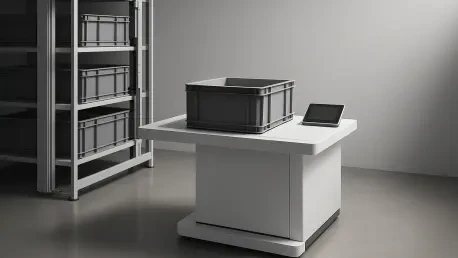

Achieving absolute precision in a high-speed warehouse environment often feels like chasing a moving target while the clock is ticking against tight delivery windows. Kardex recently signaled its commitment to this challenge by introducing the PortScale precision weighing technology to the Australian and New Zealand markets. This launch represents a significant proprietary enhancement specifically engineered to augment the AutoStore system, the global leader in cube-based storage. By integrating high-precision weight measurement directly into the pick station, the system allows warehouse operators to verify order accuracy in real time, transforming the way inventory integrity is maintained in the region.
The Evolution of Automated Intralogistics and Cube-Based Storage Solutions
The global logistics landscape has shifted away from traditional manual pallet-picking toward high-density, goods-to-person automation. This transition is driven by the need for faster fulfillment and the limitations of conventional shelving systems. AutoStore has emerged as a dominant framework in this modern warehouse execution model, providing a grid-based structure that maximizes vertical space. However, as the core robotic infrastructure matures, the focus is turning to how secondary innovators can enhance these systems.
Innovators like Kardex are now providing specialized add-ons that solve specific operational bottlenecks at the workstation level. The Australian and New Zealand logistics sectors have become particularly significant in the global supply chain, serving as proving grounds for these advanced integrations. As regional hubs face unique geographic and logistical hurdles, the adoption of high-performance robotic enhancements is no longer optional but essential for staying competitive in a globalized economy.
Driving Operational Excellence Through Integrated Precision and Source-Level Verification
The physical structure of a storage cube provides the foundation for efficiency, but the real competitive edge lies in how data is managed at the point of interaction. Modern fulfillment centers are moving beyond traditional downstream quality control, where errors are caught only after an order has left the picking station. Instead, the industry is pivoting toward real-time, source-level verification that identifies discrepancies at the exact moment an item is handled.
Shift Toward Integrated Precision and Source-Level Verification
This transition from standardized hardware to customized, software-driven workstation solutions represents a major leap in operational maturity. By integrating multiple sensors into the port shelf, systems like PortScale enable a multi-layered verification strategy that combines weighing with barcode scanning and computer vision. This ensures that every movement is cross-referenced against the digital inventory record, providing an immediate feedback loop for the human operator.
The integration of these technologies allows for a seamless workflow where verification does not come at the expense of speed. Software-driven workstations can now guide pickers through complex tasks while simultaneously capturing data for track-and-trace purposes. This level of integrated precision reduces the cognitive load on warehouse staff and minimizes the risk of human error in high-volume environments.
The Economic Impact and Scaling of Advanced Warehouse Automation
The growth trajectory of specialized automation providers reflects the global demand for these advanced storage and retrieval systems. By 2026, the market for intralogistics in the Asia-Pacific region is expected to see a significant rise in investment as consumer delivery expectations continue to escalate. Facilities that utilize workstation-level enhancements are reporting higher performance indicators, specifically in terms of throughput and accuracy per square meter.
As organizations scale their operations from 2026 to 2030, the ability to maintain data integrity becomes a primary driver of profitability. High-throughput facilities that incorporate automated weighing see a direct reduction in the need for manual exception handling. This scaling capability is vital for businesses looking to expand their footprint without a proportional increase in labor costs or space requirements.
Addressing the Logistics Labor Crisis and the High Cost of Inaccuracy
Warehouse operators in Australia are currently navigating a perfect storm of labor shortages and escalating operational wages. This environment makes every picking error a significant financial liability. The economics of error extend far beyond the cost of the misplaced item, encompassing the expensive process of returns, repeat shipping, and the potential loss of customer loyalty.
Mitigating inventory distortions within a Warehouse Management System is critical for maintaining a reliable supply chain. When a mis-pick occurs, it creates a ripple effect that leads to stockouts and inaccurate forecasting. Automated recounts and weight-based verification at the source help overcome these issues, while the use of cube-based density allows companies to bypass the physical limitations of existing warehouse footprints.
Standardizing Quality Control and Ensuring Data Integrity in Fulfillment
Regulatory requirements in sectors such as healthcare and high-value retail have increased the pressure for robust track-and-trace capabilities. Maintaining compliance requires an automated audit trail that records every transaction with precision. Real-time weight verification provides an objective data point that reinforces the security of the inventory, ensuring that high-value goods are accounted for at every stage.
The role of ScaleManager software is central to securing this data integrity. By centralizing the management of weight data and item counts, it reduces the need for manual checks that often slow down the fulfillment process. This creates a balance between high-volume speed and strict security protocols, allowing distribution centers to meet rigorous quality standards without sacrificing productivity.
The Next Frontier of Smart Warehousing and Autonomous Exception Handling
Emerging roles for AI-based bin induction and computer vision are set to redefine the picking process. These technologies allow robots and humans to work more harmoniously by identifying items based on visual and physical characteristics simultaneously. The future of lights-out warehousing depends on these integrated maintenance and cleaning technologies to ensure that automated grids remain operational without constant human intervention.
Shifts in consumer preferences toward hyper-local and same-day fulfillment models are forcing a rethink of traditional distribution networks. Proprietary innovations that offer high-density storage and extreme accuracy will become the benchmark for these new facilities. As the industry moves forward, the synthesis of autonomous exception handling and smart hardware will be the primary differentiator for market leaders.
Transforming Modern Distribution through Strategic Technological Enhancements
The implementation of PortScale across regional networks provided a clear path toward greater supply chain resilience. It allowed operators to reconcile the need for high-speed output with the necessity of absolute inventory accuracy. The system established a new standard for how workstation-level enhancements could solve complex logistical challenges.
Strategic investments in at-the-source error prevention offered a sustainable solution for facilities facing labor volatility. The integration of hardware precision and software intelligence proved to be the most effective way to optimize existing AutoStore deployments. Ultimately, these technological enhancements secured a long-term value proposition for warehouse managers who prioritized reliability as a cornerstone of their growth strategy.