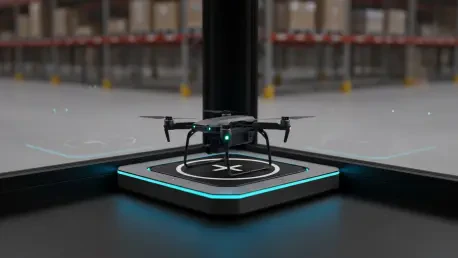

The persistent hum of an autonomous drone gliding silently through the vast, empty aisles of a warehouse after dark represents one of the most significant yet misunderstood advancements in modern logistics. While the concept of aerial inventory management has been discussed for years, the technology has quietly matured far beyond its initial reputation as a futuristic novelty. A significant gap has formed between the common perception of these devices and their actual, present-day capabilities. What if the biggest barrier to adopting this transformative technology isn’t the technology itself, but the outdated myths surrounding it? For many operations managers, these misconceptions create a powerful, yet unfounded, hesitation toward embracing a solution poised to redefine inventory accuracy and operational efficiency.
From the Floor to the Rafters: The Ascent of Aerial Automation
Warehouse automation has historically been a ground-level affair. Autonomous Mobile Robots (AMRs) revolutionized how goods are transported across the facility floor, while Automated Storage and Retrieval Systems (AS/RS) mastered the art of dense, high-speed storage. Drones represent the logical next frontier in this evolution, taking automation into the third dimension. Their unique advantage lies in leveraging vertical airspace, allowing them to capture comprehensive inventory data from above without disrupting the constant flow of people, pallets, and machinery on the ground. This capability moves data collection from a disruptive, manual task to a seamless, background process.
The journey of this technology from eye-catching trade show demonstrations to fully implemented, practical solutions has been remarkably swift. A decade ago, concepts shown at events like ProMat were viewed as intriguing possibilities; now, in 2026, they are deployed realities driving value in warehouses globally. However, this rapid maturation has created a persistent knowledge gap. The memories of early, clunkier prototypes and pilot programs still shape today’s perceptions, fueling myths that are no longer aligned with the sophisticated, autonomous systems available on the market.
Separating Fact from Science Fiction: The Top Five Drone Myths Debunked
Myth 1: “Implementation is a long, disruptive infrastructure project.” The reality is that modern drone systems require no physical alterations to the warehouse. Gone are the days of installing beacons, reflective markers, or QR codes throughout the facility. Today’s deployments are streamlined, software-centric processes that can be completed in as little as one week. The drones rely on advanced AI and machine vision to map and navigate the environment dynamically, making the setup more akin to onboarding a new software platform than undertaking a construction project.
Myth 2: “Flying drones will interfere with our daily workflow.” A primary concern for any warehouse manager is the potential for new technology to disrupt existing operations. However, autonomous drone systems are designed specifically to be non-disruptive. Inventory flights are strategically scheduled to run during off-hours, such as overnight or on weekends, when the facility is quiet. This intelligent scheduling ensures that the drones perform their data-capture tasks without ever conflicting with human workers, forklifts, or other machinery, allowing the warehouse to maintain full productivity.
Myth 3: “Autonomous drones are unsafe around people and equipment.” Safety concerns are paramount, but fears about autonomous drones are often based on less sophisticated automation. Equipped with advanced AI, LiDAR, and an array of sensors, modern drones dynamically perceive their environment in real time. They can identify and avoid both stationary and moving obstacles, including personnel and machinery, by instantly rerouting their flight path or ascending to a safe altitude until the path is clear. This responsive intelligence makes them fundamentally safer and more adaptable than systems that follow rigid, pre-programmed paths.
Myth 4: “Drones are only useful in perfectly organized, racked aisles.” This belief limits the perceived utility of drones to only one part of the warehouse. In truth, today’s versatile navigation systems allow drones to operate effectively in a wide range of environments, including non-racked and bulk storage areas. They can fly overhead to scan floor-stacked inventory, capturing data in chaotic or hard-to-reach zones that are often the most challenging to count manually. This flexibility extends their value far beyond the structured pallet rack, providing a comprehensive inventory picture across the entire facility.
Myth 5: “We’ll need a dedicated IT team to ‘babysit’ the drones.” The operational model for current-generation drones is “set it and forget it.” These systems are fully autonomous, managing their own pre-set schedules to launch, conduct scans, and return to their charging stations without any human intervention required per flight. The need for constant IT oversight or a dedicated drone pilot is a relic of earlier, less advanced systems. Today’s platforms are designed for reliability and self-sufficiency, freeing up valuable human resources for higher-level tasks.
The Leap to True Autonomy: An Expert’s Perspective
The key differentiator between early-generation drones and today’s solutions is the achievement of true autonomy. This technological leap has been central to making them a practical and scalable tool. Jackie Wu, CEO of Corvus Robotics, emphasizes this shift: “The conversation has moved from systems that required constant human supervision to truly autonomous platforms that manage their own missions from start to finish. This level of ‘set it and forget it’ operation is what eliminates the need for ongoing IT involvement and makes the technology accessible to a wider range of facilities.”
This advanced autonomy is not merely about self-navigation; it encompasses the entire workflow, from mission planning and data capture to battery management and data processing. First-generation systems often offloaded these tasks to human operators, creating a hidden labor cost. The solutions available today have integrated these functions into a seamless, automated loop, which is the cornerstone of their value proposition. This is the critical distinction that separates a remotely operated tool from a truly intelligent inventory management asset.
A Practical Framework for Evaluating Modern Drone Solutions
To cut through the noise and make an informed decision, it helps to approach the evaluation of drone technology with a clear framework. This process begins with a realistic assessment of the specific challenges within the facility. Look beyond the neatly organized pallet racks and consider the bulk storage areas, hard-to-reach locations, and other zones where manual counting is most inefficient and error-prone. These are often the areas where drones can provide the most significant and immediate return on investment.
Next, prioritize a non-disruptive integration path. When engaging with vendors, ask critical questions about the deployment process. How long does it take from signing to the first autonomous flight? What, if any, infrastructure changes are required? Crucially, verify that the system can be scheduled to operate entirely outside of standard operational hours to ensure zero impact on productivity. A truly modern solution should adapt to the warehouse’s schedule, not the other way around.
Finally, it was vital to verify the level of autonomy being offered. A clear distinction was made between a remotely piloted drone, which simply shifted labor from the floor to a control station, and a truly autonomous system. The latter managed its own missions, data capture, and charging cycles without requiring daily human input. By confirming that a system met this high standard of self-sufficiency, decision-makers ensured they were investing in a low-maintenance, high-impact technology that delivered on the promise of modern, automated inventory management.