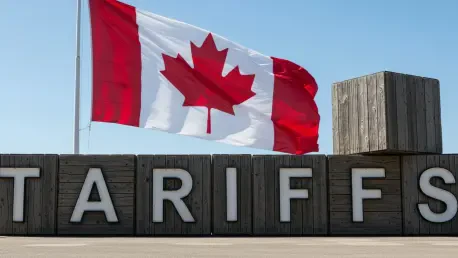

A stark ultimatum delivered via a late-night social media post has sent shockwaves through the deeply integrated North American economy, raising urgent questions about the future of the United States’ relationship with its closest trading partner. President Donald Trump’s threat to impose a crippling 100% tariff on all Canadian goods has thrust the two nations into a familiar but intensified state of economic uncertainty. The declaration, aimed at derailing a new trade pact between Canada and China, forces businesses and policymakers to once again navigate the volatile intersection of trade policy and geopolitical maneuvering, weighing the credibility of the threat against the catastrophic consequences of its implementation.
The Billion-Dollar Question: What if Everything from Canada Doubled in Price Overnight?
The prospect of a 100% tariff is not merely a diplomatic issue; it represents a direct and immediate challenge to the stability of American supply chains and consumer wallets. Such a policy would effectively double the cost of every Canadian product entering the United States, from the crude oil that fuels American vehicles to the lumber used in home construction. This sudden price shock would ripple through countless industries, as American manufacturers reliant on Canadian raw materials and components would face an abrupt and unsustainable surge in their operational costs, forcing them to either absorb the losses or pass them on to consumers.
The impact would extend far beyond industrial goods, permeating the everyday lives of American households. The grocery store aisles would reflect the new reality, with the prices of Canadian food exports like canola oil, beef, and seafood potentially soaring. The integrated North American auto industry, a cornerstone of the United States-Mexico-Canada Agreement (USMCA), would be thrown into disarray as cars and auto parts, which flow seamlessly across the border, would suddenly face prohibitive costs. The economic model that has defined North American trade for decades would be fundamentally broken, creating an environment of inflation and disruption.
The Spark in the North: Understanding the Canada-China Pact That Angered the White House
The catalyst for this drastic ultimatum is a “preliminary agreement in-principle” forged between Ottawa and Beijing earlier this month, designed to expand mutual market access. The proposed pact includes provisions for China to lower duties on Canadian agricultural exports, with a specific focus on products like canola seed. In return, Canada has agreed to reduce levies on an annual quota of 49,000 Chinese-manufactured electric vehicles, signaling a strategic alignment that the White House views with deep suspicion. With many terms of the deal set to take effect by March, the timing of the presidential threat introduces significant ambiguity as to whether it targets the preliminary agreement or is intended to prevent its final ratification.
President Trump’s rationale, articulated in his Truth Social post, is to prevent Canada from becoming a “drop off port” for Chinese goods destined for the American market. He painted a dire picture of the potential consequences of the pact, arguing it would lead to China’s complete domination of its northern neighbor and the destruction of Canada’s “businesses, social fabric, and general way of life.” This framing transforms the trade dispute into a matter of national and economic security, reflecting a broader administration strategy to counter China’s growing global influence by pressuring key American allies.
Deconstructing the Doomsday Scenario: The Real-World Impact of a 100% Tariff
A full-scale implementation of a 100% tariff would be less of a targeted economic tool and more of a blunt instrument causing immense self-inflicted damage. The United States heavily relies on Canada for critical resources, most notably energy. Crude oil stands as one of Canada’s top exports to the U.S., and doubling its import cost would have an immediate and severe effect on gasoline prices and industrial energy expenses across the country. This economic interdependence makes the tariff a double-edged sword, punishing American industries just as much, if not more, than Canadian ones.
Beyond energy, the automotive sector provides a clear example of the integrated nature of the two economies. Auto parts and fully assembled vehicles cross the border multiple times during the manufacturing process. A 100% tariff would shatter this efficient system, leading to production halts, layoffs, and a dramatic increase in vehicle prices for American consumers. The intricate supply chains that have been built over decades under free trade agreements cannot be easily rerouted, meaning the immediate effect would be chaos rather than a strategic shift in sourcing.
Absolutely No Chance: An Expert Weighs in on the Threat’s Credibility
Despite the severity of the language, economic experts have expressed profound skepticism about the likelihood of the threat being fully realized. Jason Miller, a professor of supply chain management at Michigan State University, projects that if the administration were to follow through, it “would result in a significant inflationary spike” for the U.S. economy. He argues that the economic blowback would be too damaging for the policy to be politically or economically viable, especially given the existing inflationary pressures.
Miller offered a blunt assessment of the situation, stating there is “absolutely no chance” that a 100% tariff would be broadly implemented, particularly on essential commodities like energy products. His analysis suggests that the threat should be interpreted more as a high-stakes negotiating tactic than a literal policy blueprint. The sheer scale of economic disruption, affecting everything from consumer goods to critical industrial inputs, creates a powerful disincentive for the administration to move beyond the realm of rhetoric.
More Bark Than Bite: Examining Trump’s History of Tariff Threats as a Political Tool
This latest tariff threat aligns with a well-established pattern of President Trump using aggressive economic rhetoric as a primary tool of foreign policy and negotiation. While the administration did previously install a 35% levy on certain Canadian goods, exemptions built into the USMCA ensured the actual impact was far more moderate. As of October 2025, the effective tariff rate on Canadian imports remained low, at just 3.89%, demonstrating a history of bold proclamations followed by more measured, or at least diluted, action.
This approach is not limited to Canada. Recently, the administration threatened new levies against eight European nations over their opposition to a proposal to annex Greenland. That threat was later retracted, reinforcing the perception that such pronouncements are often designed to test the resolve of allies and adversaries alike, creating leverage that can be used in subsequent negotiations. The 100% tariff threat on Canada is seen by many analysts as the latest chapter in this playbook, a maximalist opening gambit intended to force Ottawa to reconsider its growing economic ties with Beijing. The true test will be whether this high-pressure strategy yields the desired diplomatic outcome or further strains a critical alliance.
The analysis of President Trump’s ultimatum revealed it as more of a strategic political maneuver than a concrete policy initiative. Experts highlighted the catastrophic economic consequences that a 100% tariff would inflict on the United States itself, making its full implementation highly improbable. Historical precedent, including past tariff threats that were either moderated or retracted, further suggested that this was a negotiating tactic aimed at pressuring Canada over its trade relations with China. Ultimately, the episode underscored the inherent instability that such rhetoric introduces into international trade, leaving allies and markets to navigate a landscape shaped by political posturing as much as by economic reality.