
Navigating Geopolitical Turbulence in Global Maritime Trade
Global commerce relies on the seamless movement of cargo through narrow straits, yet the current instability in the Middle East has compelled major carriers to prioritize safety over speed. Cosco Shipping Holdings, a titan in the maritime sector, recently confirmed its decision to bypass the Strait of Hormuz to protect its assets and personnel. This move signals a significant shift in how global logistics giants respond to localized volatility, emphasizing the need for adaptable supply chain strategies. By examining these operational shifts, the analysis provides insight into the resilience of modern shipping and the growing necessity for flexible logistics in an era of persistent geopolitical friction.
The Evolution of Risk in the Middle Eastern Waterways
Historically, the Strait of Hormuz acted as a predictable conduit for energy and consumer goods, but recent escalations have transformed it into a zone of heightened risk. Carriers once viewed these tensions as fleeting disruptions; however, the persistent nature of current conflicts has made permanent route adjustments a standard operational requirement. This transition reflects a broader trend where geopolitical friction dictates the flow of global trade more than traditional cost-efficiency metrics. Understanding this background is essential, as it explains why industry leaders no longer view these disruptions as temporary anomalies, but as defining factors for current logistics.
Strategic Adaptation and Operational Resilience
Implementing Multimodal Solutions and Routing Flexibility
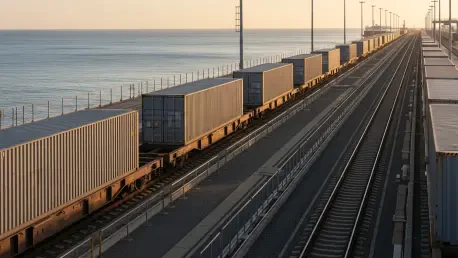
To bypass the blockaded maritime paths, Cosco transitioned toward a multimodal transport framework that integrates land and rail connections. By utilizing sea-to-land links, the firm continues to reach markets in the UAE, Saudi Arabia, and Iraq despite avoiding direct transit through the Gulf. Monitoring data showed that vessels like the CSCL Indian Ocean successfully navigated these adjustments by shifting schedules in real time, proving that modern logistics can circumvent physical barriers through tactical flexibility. This proactive management demonstrates that the flow of commerce can be maintained through sophisticated maneuvering and a willingness to abandon rigid schedules.
Financial Insulation Through Global Diversification
The financial impact of these disruptions is mitigated by the massive scale of Cosco’s global operations, which spans over 590 vessels. Leadership recently clarified that the Middle East constitutes only a small portion of total revenue, allowing the group to absorb the costs of rerouting without significant fiscal damage. With a capacity exceeding 3.6 million TEU, the company leverages its geographic spread to maintain profitability while specific corridors remain restricted. This structural resilience ensures that the group remains operationally sound even when forced to suspend bookings or alter transit paths in high-tension zones.
Managing Logistics Complexity and Market Demand Recovery
Despite the logistical hurdles, there are signs of a recovery in market demand that require careful management of over 300 international routes. The company maintains high vigilance, adjusting sailing schedules to capture rebounding trade volumes while keeping safety protocols fluid. This approach avoids the trap of total trade paralysis, demonstrating that a well-diversified carrier can manage 654 ports globally even when major chokepoints are compromised. By maintaining a stance of high vigilance, the company ensures it can pivot back to direct routes if conditions stabilize or tighten restrictions if tensions escalate further.
The Future of Maritime Security and Technological Integration
Future industry shifts will likely focus on integrating advanced predictive analytics to manage real-time risks in unpredictable waters. As regional tensions persist, the reliance on multimodal “plan B” options will transition from a temporary fix to a permanent component of global trade. Furthermore, international cooperation for maritime security is expected to increase, providing a more robust framework for protecting commercial interests against non-state actors. Technological integration will become a permanent fixture, providing a buffer that minimizes dependence on any single maritime chokepoint or vulnerable transit corridor.
Strategic Takeaways for the Global Supply Chain
The primary lesson for logistics professionals is the absolute necessity of maintaining diverse carrier options and alternative transport modes. Stakeholders should conduct thorough audits of their supply chain vulnerabilities to identify secondary routes before a crisis occurs. Staying informed through real-time maritime intelligence and maintaining a buffer of flexible logistics solutions are now considered best practices for preventing localized issues from causing global failures. Applying these insights requires a shift from a reactive mindset to a proactive strategy that anticipates regional instability as a constant variable in trade.
Balancing Stability with Constant Change
Cosco Shipping’s decision provided a clear case study in modern risk management by illustrating how global stability was maintained through operational flexibility. The firm successfully demonstrated that while physical routes changed, the demand for global connectivity ensured that trade found its destination. Ultimately, the resilience observed in the maritime sector proved that adapting to constant change remained the most significant factor in long-term commercial success. Industry players discovered that while the paths might have shifted, the necessity of maintaining global flow remained the ultimate priority for every stakeholder involved.