
Rohit Laila brings decades of expertise to the logistics and supply chain sector, with a career defined by navigating the complexities of international delivery and a deep-seated passion for technological innovation. His perspective is shaped by years of operational leadership across Africa, where he has witnessed the continent’s rapid transformation into a critical node of global trade. In this conversation, he explores how shifting trade lanes, fleet modernization, and regional integration are redefining the future of African air cargo.
The discussion centers on the explosive growth of the Africa-Asia trade corridor and the logistical demands of handling diverse cargo, from perishable seafood to high-tech semiconductors. Laila highlights the emergence of major e-commerce hubs in Johannesburg and Lagos, the transition toward widebody freighter fleets, and the ongoing efforts to harmonize trade through the African Continental Free Trade Area (AfCFTA). He also addresses the significant financial and regulatory hurdles, such as blocked funds and uneven policy implementation, that continue to test the resilience of regional operators.
With the Africa-Asia trade lane recently seeing growth exceeding 40%, what specific operational hurdles do you face when transporting perishables like seafood and flowers? How are you balancing this export demand with the influx of semiconductors and renewable energy components coming back from Asia?
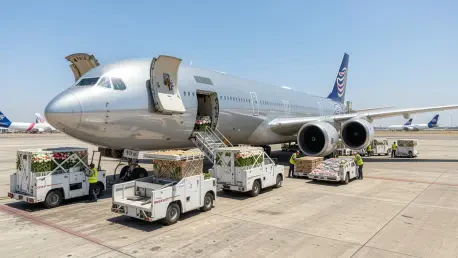
The primary challenge with perishables is maintaining a flawless cold chain in a region where infrastructure can be inconsistent. When we move seafood or flowers, we are racing against a clock that dictates the product’s market value; any delay in temperature-controlled handling during the 41.6% growth surge we’ve seen in the Asia lane can lead to total loss. Balancing this with the return flow of semiconductors and renewable energy components requires a highly sophisticated “triangulation” of capacity. We are essentially managing two different worlds: the delicate, sensory-heavy requirements of fresh produce and the high-security, precision-handling needs of technological infrastructure. This imbalance is why we are seeing a consecutive seven-month growth streak, as we must ensure that the widebody freighters are utilized efficiently in both directions to remain profitable.
Johannesburg and Lagos have emerged as dominant e-commerce redistribution hubs. What specific infrastructure investments are required at these locations to handle high-velocity flows, and how do you coordinate the “middle mile” to ensure these time-sensitive packages reach underserved regional markets efficiently?
To sustain the momentum in Johannesburg and Lagos, we must invest heavily in automated sorting facilities and dedicated e-commerce handling zones that can bypass traditional general cargo bottlenecks. At our Nairobi hub, for instance, we are adjusting capacity selectively to funnel China-sourced goods into these two major consumption markets. The “middle mile” is often the most difficult segment, requiring us to leverage smaller feeder aircraft and interline partnerships to reach inland regions where road networks remain unreliable. By focusing on faster processing and digital tracking, we can ensure that a package arriving from the Middle East doesn’t sit in a warehouse but moves immediately toward its final destination.
Many operators are transitioning from older narrowbody aircraft to widebody platforms like the Boeing 767-300F or 777F. Given the delays in obtaining Supplemental Type Certificates (STCs), how are you managing capacity gaps in the interim, and what metrics determine when a route justifies a long-haul freighter?
The delay in STCs for the 777-300ERSF and other platforms has definitely forced a tactical pivot, leading many of us to rely on 767-300Fs as a reliable “bridge” for regional and long-haul growth. We justify a long-haul freighter when we see consistent, high-volume demand exceeding 50 tons per flight, particularly on routes connecting to Guangzhou or Hong Kong. In the interim, we manage the gap by increasing frequencies with our existing 737-800P2Fs and utilizing interline agreements with partners like Qatar Airways to maintain connectivity. It is a calculated dance where we weigh the high operating costs of older airframes against the critical need to maintain market presence while we wait for more efficient widebody availability.
The African Continental Free Trade Area aims to streamline customs and shorten lead times for manufacturers. What practical steps are still needed to overcome the uneven implementation of the Single African Air Transport Market (SAATM), and how are you navigating the protectionist concerns of individual national carriers?
While 38 countries have signed onto SAATM, the practical reality is that we still face fragmented regulations that act as “invisible” barriers to trade. To overcome this, we need a unified regulatory framework that ensures fair competition while strictly adhering to international safety and security compliances to satisfy skeptical national governments. We navigate protectionist concerns by emphasizing that a liberalized sky benefits everyone; it allows for just-in-time supply chains that help local SMEs avoid the delays of weak rail and road networks. Practical steps must include the harmonization of ground handling standards and the removal of discriminatory taxes that currently make intra-African routes more expensive than flights to Europe.
Airlines in the region face significant financial pressure from over $1 billion in blocked repatriation funds and rising jet fuel costs. How are these liquidity constraints impacting your ability to modernize ground facilities, and what specific strategies are you using to maintain profitability despite high regional taxes?
The fact that 93% of the world’s blocked funds are trapped in the Africa and Middle East region is a staggering hurdle that directly stifles our ability to reinvest in modernizing ground facilities. When $1.2 billion is inaccessible, we are forced to be extremely disciplined with our capital, often prioritizing fleet maintenance over the construction of new temperature-controlled warehouses. To maintain profitability, we focus on high-yield verticals like pharmaceuticals and specialized energy cargo, which can better absorb the high costs of jet fuel and regional taxes. We also engage in aggressive cost-sharing through strategic partnerships, ensuring that every pallet of cargo contributes to a sustainable margin despite the liquidity squeeze.
Global production is diversifying through “China Plus One” strategies, positioning Africa as a strategic link between Mediterranean and Asian markets. What specific logistical advantages does a gateway like Algeria offer for temperature-controlled pharma, and how are you preparing for more complex, multi-stop intra-African trade corridors?
Algeria is perfectly positioned as a gateway because its geographic proximity to Europe and its growing local pharmaceutical production create a natural hub for temperature-sensitive logistics. Last year, the 10% rise in demand there showed us that the Mediterranean link is vital for moving fresh produce north and high-value pharma south. To prepare for multi-stop corridors, we are investing in digital tracking and scalable infrastructure that allows for “plug-and-play” handling across different jurisdictions. This diversification strengthens our resilience, allowing us to pivot operations quickly if one specific trade lane faces geopolitical or economic disruptions.
What is your forecast for the African air cargo industry?
I anticipate a period of steady, resilient growth, likely moderating around 2% for the current year after the initial surge, but with a strong upward trajectory through 2030. The industry will be defined by the successful integration of the AfCFTA, which will turn intra-African routes from secondary options into primary trade arteries. As we see more widebody freighters like the 777F enter the market, Africa will transition from being a destination for finished goods to a sophisticated logistical bridge connecting Asia, the Middle East, and the West. Despite the financial headwinds of blocked funds, the sheer demand for our perishables and the rise of our e-commerce markets will make this region one of the most promising growth stories in global aviation.