
As a seasoned leader in the logistics and supply chain sector, Rohit Laila brings a wealth of knowledge to the table regarding how infrastructure shapes economic destiny. With decades of hands-on experience navigating the complexities of freight movement and technological innovation, he understands that a rail network is more than just tracks—it is the backbone of regional commerce. Today, we explore the strategic implications of New Mexico’s finalized 2026 State Rail Plan, a document that outlines a transformative vision for the state’s connectivity and industrial competitiveness over the coming decades.
The new rail plan outlines $283.1 million in prioritized investments over the next four years. How do these immediate financial commitments specifically bridge the gap toward the 2045 long-term vision, and what specific metrics will be used to measure early success in economic growth and freight mobility?
The $283.1 million commitment serves as the foundational catalyst for a multi-decade transformation, ensuring that the state isn’t just reacting to current needs but actively building for the future. By front-loading these investments, New Mexico is establishing the “critical path” required to reach the 2045 goals of modernized, high-capacity rail transit. We measure early success through very tangible metrics: the reduction in transit times for freight, a measurable uptick in the volume of goods moved per mile, and the overall improvement in public safety at crossings. When you see these hundreds of millions being deployed, you are witnessing the conversion of a static vision into a dynamic economic driver that enhances the state’s competitiveness on a national scale.
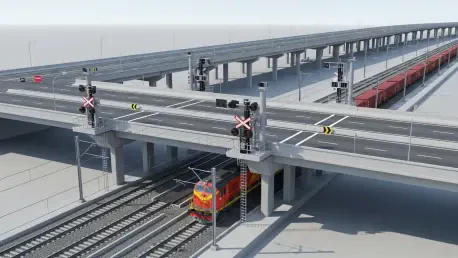
With $44.89 million allocated for Gallup and $73 million for the Texico project in partnership with Texas, grade separation is a clear priority. What are the primary engineering hurdles when coordinating such large-scale separations, and how do these projects fundamentally change local roadway congestion and safety for residents?
Engineering grade separations like the $44.89 million project in Gallup requires a delicate dance between structural integrity and maintaining active rail traffic, which can be incredibly complex. You are essentially performing surgery on a living system, often needing to reroute utilities and manage massive soil displacements without interrupting the flow of thousands of tons of freight. For the $73 million Texico project, the coordination doubles in complexity as you must align the regulatory and engineering standards of both New Mexico and Texas. Once completed, these projects eliminate the “bottleneck” effect where cars sit idling at crossings, drastically reducing local emissions and, more importantly, removing the risk of vehicle-train collisions entirely.
The Santa Teresa project has secured $37 million for design and construction while Clovis is currently in the $1 million design phase. Can you walk through the step-by-step transition from design to full-scale construction, and what challenges typically arise when seeking the remaining construction funding for sites like Clovis?
The transition begins with a rigorous design phase, where that $1 million in Clovis is used to map every bolt, drainage pipe, and signal relay to ensure the project is “shovel-ready.” Once the blueprints are finalized and the environmental impact is assessed, the state must pivot to the highly competitive “funding hunt” to secure the tens of millions needed for the actual heavy lifting. The challenge for Clovis is that without identified construction funding, it remains in a state of readiness but lacks the momentum of Santa Teresa’s $37 million secured pot. We often see a “chicken and egg” scenario where you need a perfect design to prove the project’s value, yet the sheer scale of the costs can make federal grantors hesitant until every economic benefit is proven.
Planning continues for a proposed new freight rail link connecting Farmington to the national rail network. What are the unique logistical requirements for establishing an entirely new connection in this region, and how would this link alter the competitive landscape for local industries trying to reach national markets?
Establishing a completely new link in the Farmington area is a massive undertaking that requires securing hundreds of miles of right-of-way and conducting extensive geological surveys to ensure the terrain can support heavy freight. Logistically, this isn’t just about laying track; it’s about integrating New Mexico’s northwestern industries directly into the national supply chain heartbeat. For local producers, this link changes everything by slashing drayage costs—the expensive process of trucking goods to the nearest railhead—and making their products significantly cheaper for buyers in Chicago or Los Angeles. It essentially levels the playing field, allowing a local Farmington business to compete with global suppliers by having a direct, low-cost “on-ramp” to the national economy.
Public safety and railroad crossing improvements are central themes of the current modernization strategy. What specific infrastructure technologies are being prioritized at these crossings to reduce accidents, and how does the state balance these safety upgrades with the need for increased freight efficiency and higher train volumes?
Modernization today involves much more than just a wooden arm and a flashing light; we are seeing a push toward “intelligent” crossings that use sensors and automated signaling to communicate directly with locomotives. By prioritizing grade separation and advanced warning systems, we can actually increase train speeds and volumes because the risk of a “fouled” track is mitigated. The balance is achieved by recognizing that safety and efficiency are two sides of the same coin; a safe crossing is a fast crossing. When you invest in these technologies, you are effectively removing the friction that slows down the entire logistics network, allowing for a more fluid movement of goods even as traffic density increases.
Securing federal funding from the Federal Railroad Administration is vital for these multi-million dollar projects. What specific criteria must a project meet to remain eligible for these national grants, and how does the state ensure that long-term projects stay aligned with evolving federal investment priorities?
To remain eligible for Federal Railroad Administration grants, projects must demonstrate a clear “benefit-cost ratio” that proves the investment will yield significant public good, such as carbon reduction or job creation. New Mexico ensures alignment by embedding these projects directly into the State Rail Plan, which acts as a formal commitment that matches federal goals for safety and economic resilience. It’s a rigorous process where you must constantly update your data to show that a project planned in 2026 will still be relevant and necessary by the time construction starts in 2030. Essentially, the state must speak the “language of the FRA,” focusing on intermodal connectivity and regional impact to keep the federal checkbook open.
What is your forecast for New Mexico’s rail infrastructure over the next decade?
I anticipate that over the next ten years, New Mexico will emerge as the premier inland logistics hub of the Southwest, specifically due to the completion of these strategic grade separations and the expansion of the Santa Teresa gateway. We will likely see a 20% to 30% increase in freight throughput as these bottlenecks are cleared, which will attract major new manufacturing and distribution centers to the state. The integration of “smart” rail technology will make the network one of the safest in the country, shifting the state from a transit corridor into a destination for global industry. By 2035, the groundwork we are laying today with the $283.1 million investment will have transformed the state’s economic landscape, making rail the undisputed driver of New Mexico’s prosperity.