
With decades of experience navigating the complex world of logistics, supply chain management, and delivery, Rohit Laila has developed a keen eye for the innovations shaping how people and goods move. His passion for technology and efficiency has made him a leading voice in public transportation, particularly in the intricate operations and forward-thinking projects of North America’s passenger rail systems. Today, he joins us to discuss a series of transformative developments, from crime reduction strategies on the West Coast to major infrastructure investments in the East. We’ll explore how agencies are de-risking massive projects, the synergy between human presence and physical security in enhancing rider safety, the rise of flexible transit services, and the logistical hurdles of maintaining aging fleets while planning for the next generation of passenger rail.
Regarding the Foothill Gold Line’s CMAR delivery method, how does splitting the design and construction contracts de-risk such a major project? Could you walk us through the key milestones Parsons must hit to ensure a seamless transition to the construction phase in late 2027?
The Construction Manager at Risk, or CMAR, method is a wonderfully pragmatic approach for a project of this scale. By splitting the design and construction contracts, the Authority essentially insulates itself from the massive financial risks that come with unforeseen conditions. Traditionally, you might bid out a project with a 30% complete design, leaving a lot of expensive guesswork for the construction firm. Here, Parsons, with their 25-year history on this very project, has been brought in on a $60 million contract to take the design from that 30% level all the way to “Approved for Construction.” Simultaneously, a construction manager will be brought on board in May to provide real-world input on constructability and cost estimates as the design matures. This collaborative process, getting the design to 85% or 90% completion before locking in a final construction price, squeezes out the uncertainty and dramatically reduces the likelihood of costly change orders down the line. For Parsons, the key milestone is delivering those final, buildable drawings on schedule. Their six-year contract isn’t just about drawing lines on a page; it’s about creating a perfect blueprint that allows the construction team to hit the ground running in late 2027 without any surprises.
BART achieved a 41% drop in crime by combining sworn officers with unarmed ambassadors and infrastructure upgrades like new fare gates. Can you detail how these different elements work together and what metrics best show the specific impact of unarmed personnel versus the physical security improvements?
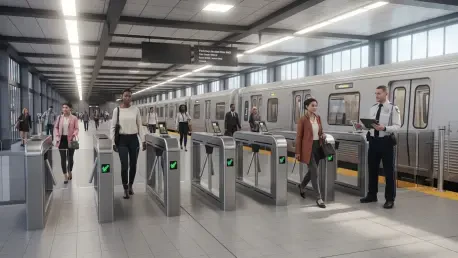
What BART has accomplished is a masterclass in layered security. It’s not about one single solution; it’s about creating an environment where safety is the default. You start with presence. They doubled the number of sworn officers riding trains, which is a powerful visual deterrent. But then you layer on the unarmed ambassadors, crisis intervention specialists, and fare inspectors. These teams create a constant, helpful presence that feels less like enforcement and more like customer support, which de-escalates situations before they begin and makes riders feel more comfortable. This human element is then fortified by the physical infrastructure. The 715 new, taller fare gates are a game-changer. They aren’t just a barrier; they send a clear message that the system is controlled and secure. The best metric we have for the specific impact of that physical change is the stunning 59% drop in riders reporting they’ve witnessed fare evasion. That directly ties the infrastructure to a tangible change in behavior. While it’s difficult to isolate the exact impact of the unarmed teams with a single number, the overall 41% crime reduction, including a 60% drop in robberies, is the ultimate metric. It proves the synergy of the entire strategy is what truly works.
Utah Transit Authority’s ridership growth was notably strong in flexible services like Vanpool and On Demand. What specific commuter needs do these services address that traditional fixed routes might not, and how does UTA plan to integrate these popular microtransit options with its core rail system?
UTA’s success with its flexible services really gets to the heart of modern commuting challenges. Fixed-route systems like TRAX light rail and FrontRunner commuter rail are the strong backbone, moving large numbers of people efficiently along dense corridors. But what about the first and last mile? What about commuters in lower-density suburbs or those with unconventional work schedules? That’s where services like Vanpool and UTA On Demand shine. Vanpool, which saw a nearly 16% surge in ridership, is perfect for groups of commuters with similar origins and destinations, offering a cost-effective, car-like experience. UTA On Demand, with its 13.6% growth, acts like a dynamic shuttle service, solving that crucial first-mile/last-mile problem by connecting neighborhoods directly to the main transit hubs. These services offer the adaptability that fixed routes simply can’t. The plan for integration isn’t just about coexistence; it’s about creating a seamless ecosystem where a rider can use an app to book an On Demand vehicle to their nearest TRAX station as easily as they would tap their card to board the train, making the entire public transit network accessible and convenient for everyone.
Phoenix Valley Metro was recognized for significant ridership growth, partly driven by new light rail extensions. Beyond simply adding track, what operational changes or marketing strategies were implemented to attract and retain new riders on these specific extensions, like the one to South Central?
It’s one thing to build new track; it’s another to turn that investment into a thriving ridership artery, and Valley Metro has done that exceptionally well. The 7.3% system-wide ridership increase is impressive on its own. When you look at the new extensions, you see the real story. The South Central extension, for example, accounted for an average of 20% of all boardings since it opened last June. This doesn’t happen by accident. Beyond the ribbon-cutting, success here is about reliability and rider experience. The agency has focused on delivering more dependable service across the board, which builds trust. When a new extension opens, that reputation precedes it. For a community that hasn’t had light rail access before, the initial marketing is about awareness—showing them how this new service connects them to jobs, education, and entertainment. But retention comes from the experience. Clean trains, safe stations, and, most importantly, on-time performance. The 32.1% ridership jump on the Northwest Extension Phase II from 2024 to 2025 shows that once people try the service and find it reliable, they don’t just become regular riders—they become advocates.
SEPTA is leasing MARC railcars to manage service while its 50-year-old Silverliner IV fleet undergoes federally mandated repairs. Can you explain the logistical challenges of integrating another agency’s railcars into your system and describe the new, step-by-step inspection protocols now in place for the existing fleet?
Bringing another agency’s railcars into your system is like having a houseguest who uses different electrical plugs and speaks a slightly different dialect. It’s incredibly complex. First, there’s the mechanical and electrical compatibility. You have to ensure the MARC cars can draw power from SEPTA’s overhead lines correctly and that their couplers are compatible with your existing fleet. Then there’s the operational side. Your train operators and mechanics need to be fully trained on the specifics of the MARC cars—their braking systems, door controls, and emergency procedures. It’s a huge undertaking, but a necessary one to ease the crowding caused by pulling the Silverliner IVs from service. As for the Silverliners themselves, the new inspection protocols are exhaustive and built on a foundation of redundancy. Following the FRA’s Emergency Order, they’ve implemented in-person inspectors at Center City stations to conduct safety checks as trains pass through, added mid-run inspections of critical systems, and are even using live video monitoring to check indicator lights in real time from the control center. Every inspection, repair, and follow-up is now meticulously logged and reported directly to the FRA, creating a new culture of safety and documentation for a fleet that is, frankly, long overdue for replacement.
With an $80 million contract approved for the next environmental study phase, what are the most significant technical and regulatory hurdles the Coachella Valley Rail project must overcome? Please elaborate on how getting into the federal Corridor ID program practically helps in navigating these challenges.
The Coachella Valley Rail project is a fantastic vision, but the path from vision to reality is filled with hurdles. The biggest technical challenge is that this 144-mile corridor isn’t a blank slate. It involves negotiating track usage and operational windows with multiple freight and passenger rail owners, including BNSF, Union Pacific, and Metrolink. Integrating a new daily passenger service onto an active, mixed-use rail corridor without disrupting existing freight traffic requires incredibly detailed engineering and sophisticated signaling solutions. On the regulatory side, satisfying both state and federal environmental requirements for a project of this length is a monumental task, involving extensive studies on everything from air quality to wildlife impacts. This is where getting into the Federal Railroad Administration’s Corridor ID program last year becomes so critical. It’s not just a title; it’s a formal recognition that puts the project on a clear, federally-guided path. This designation streamlines the process, provides a structured framework for planning and development, and, most importantly, positions CV Rail to be highly competitive for the federal funding needed to overcome these technical hurdles and move into final design and construction. It’s like getting a fast pass through a very long and complicated line.
What is your forecast for the future of intercity passenger rail projects in the United States?
My forecast for intercity passenger rail is one of cautious but accelerating optimism. For decades, we treated rail as a relic, but we’re now seeing a fundamental shift in thinking at both the federal and state levels. Projects like Coachella Valley Rail are no longer just lines on a map; they are being recognized as vital economic and environmental investments. The key change is the availability of dedicated federal funding and structured programs like Corridor ID, which provide the long-term support needed to get these complex, multi-billion-dollar projects off the ground. We are moving past the era of endless studies and into an era of tangible progress. The next decade will be defined by critical milestones—securing rights-of-way, finalizing designs, and breaking ground. It will be a challenging, incremental process, but the momentum is undeniable. We are on the cusp of a passenger rail renaissance in America, connecting our cities and regions in a way that is more sustainable, efficient, and long overdue.