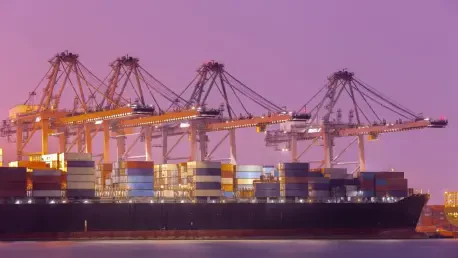

The delicate equilibrium that underpins global trade is showing signs of fracturing, as the container shipping industry sails from a turbulent 2025 directly into the path of an unprecedented convergence of destabilizing forces. After a period of recalibration following the supply chain chaos of the pandemic years, a fragile stability is once again under threat. This time, the challenge is not a singular crisis but a multifaceted storm brewing on three distinct fronts: a dramatic deterioration of market fundamentals, a potential strategic reversal at the Suez Canal, and a monumental regulatory decision that will shape the industry’s future for decades. The confluence of these factors poses a direct and serious threat to freight rate stability, logistical predictability, and the strategic planning of businesses worldwide that depend on the seamless movement of goods.
The Unraveling of Post-Pandemic Stability
The transition from 2025 into a highly uncertain 2026 marks a critical inflection point for the maritime sector. The core of the impending crisis lies in a severe and worsening imbalance between vessel supply and cargo demand. This overcapacity, a chronic industry ailment, is on the verge of being acutely exacerbated by the relentless delivery of large, newly built container ships ordered during the pandemic-era boom. This influx of tonnage alone would be enough to pressure freight rates downward, but it is now combined with a far more potent and immediate catalyst for disruption.
At the heart of the issue is the looming possibility that major shipping lines will orchestrate a large-scale return to the Suez Canal. For months, carriers have been forced to reroute vessels around Africa’s Cape of Good Hope to avoid regional conflicts, a longer journey that has effectively absorbed a significant amount of excess vessel capacity. A reversion to the shorter Suez route would instantly unleash this absorbed capacity back into the global market, creating a supply shock that could send the industry spiraling. This operational shift, coupled with volatile demand patterns and a looming regulatory schism, sets the stage for a period of profound instability.
Anatomy of the Storm Three Converging Fronts
The most immediate catalyst for disruption is the Suez Canal conundrum, which represents a ticking capacity time bomb. Evidence of an imminent shift is mounting. CMA CGM has already successfully navigated the waterway with its INDAMEX service, and Hapag-Lloyd has openly admitted to having a “contingency plan on the shelf” for a return. Perhaps most significantly, Maersk recently completed a landmark westward passage of the 6,500 TEU Maersk Sebarok through the critical Bab el-Mandeb Strait. While a full network change has not been announced, these trial runs are widely interpreted as precursors to a broader operational pivot.
The quantitative impact of such a move would be staggering. Industry analysts estimate that a full return to the Suez Canal would release approximately 2 million TEU of vessel capacity into a market that is already saturated. The immediate logistical fallout would be chaos, as the sudden change in transit times would lead to a “bunching” of vessels at major European and Asian ports. Ships taking the newly reopened shortcut would arrive out of sync with those still completing the longer journey around Africa, overwhelming port infrastructure and wrecking shipping schedules for months.
Compounding the supply-side shock is a persistent and unpredictable see-saw in demand, driven largely by geopolitical gamesmanship and tariff policies. The vital Asia to U.S. trade lane serves as a prime case study for this volatility. Shippers have repeatedly rushed to front-load cargo and fill inventories during periods of tariff suspensions, creating artificial demand spikes. These surges have been consistently followed by a collapse in demand once the duties were reintroduced. This erratic pattern is widely expected to repeat when tariffs on Chinese goods are reapplied after the current moratorium, making it nearly impossible for carriers to forecast demand and manage their fleets effectively. The uncertainty is further amplified by the political pressures of the 2026 U.S. mid-term elections, which could influence trade policy and add another layer of unpredictability to global trade flows.
The third front of this perfect storm is a regulatory moment of truth that could permanently alter the industry’s operational landscape. In October 2026, the International Maritime Organization (IMO) is set to vote on its sweeping Net Zero Framework (NZF), a global mandate for decarbonization. A successful vote would create a unified, predictable regulatory environment, establishing a level playing field for all shipping lines as they invest in greener technologies. However, failure to pass the framework would likely lead to a fragmented patchwork of regional and national climate regulations. This “Path B” scenario is viewed by many as an administrative nightmare, creating immense compliance burdens and operational inefficiencies that would ripple through the entire supply chain.
Voices from the Helm Expert Warnings and Industry Fractures
Industry experts are sounding the alarm about the potential consequences of these converging pressures. On the issue of the capacity glut, Stijn Rubens of the consultancy Drewry warns that a full return to Suez routing would be “catastrophic” for freight rates, particularly on regional trades that have recently shown signs of strength. Analyst Darron Wadey of Dynamar echoes this concern, noting that while a return may be gradual, it will exert relentless downward pressure on both freight and charter rates, forcing the industry to confront the difficult question: “what to do with all this freed up capacity?”
The debate over decarbonization has exposed a deep and growing schism within the maritime world, largely splitting the industry based on proximity to the end consumer. For container lines, which serve major retailers and manufacturers facing intense pressure to report on and reduce their Scope 3 emissions, a single global standard is paramount. Semiramis Paliou, CEO of Diana Shipping, minced no words, stating that a patchwork of regional rules would be a “disaster for shipping.” She argues it would create a massive administrative burden and undermine the transparency of emissions-related funds.
In sharp contrast, many operators in the tanker and bulk carrier sectors remain deeply skeptical of aggressive mandates. These carriers often transport raw materials for a single charterer and lack the fixed routes that would simplify bunkering with new alternative fuels. George Procopiou, chairman of Dynacom Tankers, has bluntly labeled ambitious net-zero targets as “Jules Verne ideas,” citing the simple fact that the necessary green fuels are not yet available at the scale required to power the global fleet. This fundamental disagreement highlights the immense challenge the IMO faces in forging a consensus.
Strategic Scenarios Charting a Course Through the Uncertainty
Looking ahead, the industry faces several potential scenarios, the most severe of which is the “perfect storm.” In this outcome, a large-scale return to the Suez Canal collides with the continued delivery of newbuild vessels and a tariff-induced slump in demand. This confluence would trigger critical overcapacity, sending freight rates plummeting and likely pushing most carriers into a deeply loss-making environment, undoing the financial gains of recent years.
The industry’s primary defense mechanism against such a catastrophic market crash would be a swift and significant ramp-up in vessel demolitions. The practice of scrapping older, less efficient ships, which nearly came to a halt in 2025, would be reactivated on a massive scale as the only viable tool to remove excess tonnage from the water and restore some semblance of market balance.
Ultimately, the biggest wildcard remains the Net Zero Framework vote. The outcome will set the industry on one of two radically different paths. A successful vote offers a clear, albeit challenging, route forward. However, a failure would introduce unprecedented structural uncertainty. Should a severe market crash coincide with the chaos of regulatory fragmentation, the industry would face a crisis with too many variables to reliably forecast. The convergence of a cyclical market downturn with a permanent structural shift in regulation presented a future that was, for many, profoundly and disturbingly unpredictable.