
The global supply chain is currently grappling with a persistent labor deficit that threatens to throttle the momentum of digital commerce and industrial throughput. As distribution centers evolve into high-density hubs, the transition from fixed automation to dynamic, intelligent robotics has become the definitive benchmark for operational survival. This review examines the shift from isolated mechanical tasks toward a unified ecosystem where machines possess the cognitive flexibility to navigate, perceive, and collaborate within unpredictable human environments.
Introduction to Modern Warehouse Robotics
The emergence of modern warehouse robotics represents a departure from the rigid, cage-enclosed systems of the previous decade. Traditionally, automation relied on fixed conveyors and stationary arms that executed repetitive motions in structured environments. However, the current landscape demands systems that can interpret a disorganized floor plan. This evolution is driven by the integration of high-performance computing, modular hardware, and real-of-the-moment data processing, allowing robots to function as active participants in the logistics chain rather than mere tools.
This technological surge is not merely a response to labor shortages but a strategic move toward hyper-efficiency. In the broader technological landscape, warehouse robotics serves as a proving ground for edge computing and low-latency communication. By decentralizing intelligence—moving decision-making from a distant server to the robot itself—the industry has unlocked the ability for machines to respond to obstacles in milliseconds. This pivot ensures that automation remains resilient even when the surrounding facility logic fluctuates.
Core Technical Components and Key Features
Mobile Manipulation and AMR Integration
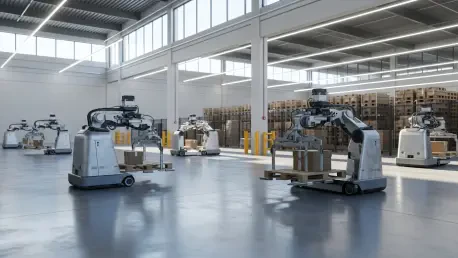
One of the most significant leaps in recent years is the birth of the mobile manipulator, a hybrid system that marries the dexterity of a multi-axis robotic arm with the mobility of an Autonomous Mobile Robot (AMR). Unlike standard AMRs that only transport goods, or stationary robots that only pick them, these integrated units can traverse a facility to perform tasks at multiple workstations. This capability eliminates the “dead time” associated with transporting materials between fixed automation cells, effectively turning the entire warehouse floor into a productive zone.
The performance of these systems hinges on sophisticated safety architectures. By utilizing advanced area scanners and intelligent speed modulation, these robots maintain high velocity in open aisles but transition to a cautious, collaborative mode when detecting human presence. This “fenceless” operation is a critical differentiator from traditional industrial robots, as it allows for a shared workspace without the prohibitive cost and footprint of physical safety barriers. The result is a more fluid floor plan where human and machine roles overlap seamlessly.
AI-Driven Perception and Vision Systems
Beyond physical movement, the true intelligence of modern robotics lies in perception. AI-enhanced vision systems now allow robots to handle “mixed workloads”—totes and pallets containing items of varying shapes, sizes, and reflective properties. By employing payload estimation and 3D sensors, robots can now calculate the optimal grip for a fragile electronics box just as easily as they handle a heavy industrial component. This level of adaptability is what separates contemporary systems from legacy vision tools that struggled with overlapping items or complex patterns.
These vision systems function by creating a real-time digital twin of the robot’s immediate surroundings. This allows for precise depalletizing and palletizing logic that accounts for shifts in product layers or the presence of slip sheets. For a business, this translates to a massive reduction in error rates and mechanical downtime. Instead of requiring a human operator to reset a machine after a picking error, the AI identifies the discrepancy and recalculates the approach on the fly, maintaining the rhythm of the fulfillment cycle.
Current Trends and Technological Innovations
The most pressing trend in the sector is the democratization of robotic programming through intuitive, “low-code” interfaces. Historically, deploying a fleet of robots required a specialized team of engineers. Today, tablet-based interfaces and drag-and-drop logic allow warehouse staff to reconfigure tasks in minutes. This shift is vital for businesses dealing with seasonal fluctuations, as it enables the rapid deployment of robots to new areas of the facility without deep technical overhead.
Furthermore, there is a clear trajectory toward multi-SKU picking environments where robots use RFID and barcode logic to sort diverse products into organized totes. This innovation addresses the complexity of modern e-commerce, where a single order might contain five disparate items. By syncing robotic vision with inventory management software, these machines don’t just move boxes; they verify contents, update databases, and optimize the packing sequence to reduce shipping volumes.
Real-World Applications in Logistics and Fulfillment
In the realm of high-volume logistics, these technologies are being deployed to manage the grueling physical labor of palletization and heavy lifting. Large-scale distribution centers now utilize mobile manipulators to handle the transition from small-scale quarter pallets to full shipping containers. This application is particularly transformative in the food and beverage industry, where high turnover and heavy payloads often lead to worker fatigue and injury. By automating these ergonomic “pain points,” companies are seeing a simultaneous rise in safety metrics and throughput.
Notable implementations also exist in the pharmaceutical and electronics sectors, where precision is paramount. In these environments, robots are tasked with picking tiny components and applying labels with sub-millimeter accuracy. The ability to combine this precision with mobile platforms means that a single robot can service multiple clean-room stations. This flexibility allows for a “modular” warehouse design, where the facility can be expanded or reorganized without ripping out permanent infrastructure.
Challenges and Barriers to Implementation
Despite these advancements, the path to full automation is hindered by high initial capital requirements and the complexity of legacy system integration. Many warehouses still operate on older software architectures that do not speak the same language as modern AI-driven robots. Bridging this gap requires significant investment in middleware and network upgrades. Additionally, while the technology is robust, navigating high-traffic areas with unpredictable human movement remains a technical hurdle that necessitates constant sensor calibration.
Regulatory frameworks also lag behind the pace of innovation. Standardizing safety protocols for mobile, high-payload robots in collaborative spaces is an ongoing process that varies by region. Companies must navigate a patchwork of certifications to ensure compliance, which can delay deployment. However, development efforts are currently focusing on standardized communication protocols that would allow robots from different manufacturers to share traffic data, potentially solving the gridlock issues currently seen in dense robotic fleets.
Future Outlook and Industry Trajectory
The future of warehouse robotics is moving toward a state of total intralogistics synchronization. We are approaching an era where “swarm intelligence” will allow hundreds of mobile units to coordinate their movements with the precision of a choreographed performance, eliminating bottlenecks before they occur. The integration of 5G and future 6G networks will likely provide the bandwidth necessary for these machines to share massive amounts of visual data in real-time, further enhancing their collective perception.
Looking ahead, the role of the human worker will continue to shift toward high-level supervision and maintenance. As robots become more autonomous, the focus of innovation will likely move toward energy efficiency and sustainability. Future breakthroughs in battery technology and lightweight composite materials will allow robots to operate for longer periods with less power, reducing the carbon footprint of the entire logistics sector. The ultimate goal is a self-healing supply chain that can adapt to global disruptions without manual intervention.
Final Assessment of Robotic Automation
The evaluation of warehouse robotics revealed a technology that has transitioned from a luxury for tech giants to an essential infrastructure component for the global economy. These systems demonstrated a remarkable capacity to absorb the physical and cognitive load of modern fulfillment, providing a scalable solution to the labor crises that previously hampered growth. By prioritizing flexibility and human-centric safety, the industry successfully lowered the barriers to entry for smaller enterprises, ensuring that high-efficiency automation was no longer confined to a few specialized sectors.
The shift toward mobile, AI-aware platforms proved to be the most decisive factor in this evolution. This transition moved the industry away from the inefficiency of static machines and toward a dynamic, adaptable workforce. As companies continue to refine these systems, the next logical step involves the development of cross-platform standards that will enable a truly interoperable global logistics network. The integration of these advanced robotics has not only redefined warehouse productivity but has also fundamentally altered the trajectory of industrial labor and supply chain resilience.