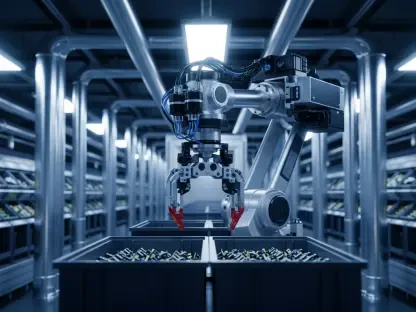

The rapid transition of artificial intelligence from digital screens to the physical world has fundamentally altered the trajectory of global industrial development. As 2026 unfolds, NVIDIA has effectively positioned its platform as the primary nervous system for this “Physical AI” revolution, moving beyond mere hardware to offer a complete, integrated stack for autonomous machines. This ecosystem is not just about making robots move; it is about providing them with the cognitive architecture to understand, predict, and interact with complex human environments. By bridging the gap between high-fidelity simulation and real-world execution, the company has addressed the long-standing “reality gap” that previously stalled large-scale robotic deployment.
The Foundation of NVIDIA Physical AI
At the heart of this technological shift lies a fundamental move away from rigid, pre-programmed automation toward flexible, learning-based intelligence. Traditional robotics relied on precise mathematical models of the environment, which inevitably failed when faced with the unpredictability of a warehouse floor or a construction site. NVIDIA’s Physical AI framework replaces these limitations with a foundation of generative models and neural networks that allow machines to perceive their surroundings with a depth previously reserved for biological organisms. This approach leverages the massive compute power of modern GPUs to process multimodal data, enabling robots to “see” and “think” simultaneously.
The relevance of this technology extends far beyond simple task automation; it represents a complete reimagining of industrial productivity. In the current landscape, the ability to deploy intelligent agents that can adapt to new workflows without months of manual coding is a critical competitive advantage. By establishing a unified environment where software and hardware are inextricably linked, the ecosystem allows for a seamless flow of intelligence from the cloud to the extreme edge. This foundational layer serves as the catalyst for a broader shift where every physical asset, from a delivery drone to a heavy excavator, becomes an autonomous participant in the global economy.
Core Architectural Pillars of the Robotics Ecosystem
Cosmos 3 World Foundation Model
The Cosmos 3 world foundation model represents a massive leap in how machines internalize the laws of physics and spatial relationships. Unlike traditional vision models that merely label objects, Cosmos 3 functions as a predictive engine, simulating potential future states of the environment based on current sensory input. This capability allows a robot to “rehearse” an action internally before executing it, significantly reducing the risk of collisions or errors. By unifying synthetic data generation with vision reasoning, the model provides a consistent logical framework that helps robots handle edge cases that were never explicitly programmed into their training sets.
What sets Cosmos 3 apart from competing models is its ability to synthesize action and perception into a single, cohesive stream of thought. For developers, this means that training a robot no longer requires millions of hours of physical trial and error; instead, the model provides a sophisticated “common sense” that speeds up the learning process for new tasks. This efficiency is vital for industries where operational environments change daily. Consequently, robots are becoming less like tools and more like partners capable of navigating the nuances of a messy, physical world.
Isaac Lab 3.0 and the Newton Physics Engine
The introduction of Isaac Lab 3.0, underpinned by the Newton physics engine, provides the high-performance sandbox necessary for reinforcement learning at an unprecedented scale. This engine is designed to simulate complex physical interactions, such as friction, fluid dynamics, and soft-body manipulation, with extreme precision. Because the simulation is physically accurate, the behaviors learned by a robot in the virtual world transfer to the real world with minimal degradation. This “sim-to-real” pipeline is the secret weapon for scaling fleet operations, as it allows for the parallel training of thousands of virtual robots simultaneously.
Moreover, the Newton engine handles the intricate mathematics of dexterous manipulation, which has historically been a bottleneck for robotic systems. Whether it is a robotic arm sorting delicate electronics or a humanoid climbing a ladder, the engine ensures that the physics of the interaction are respected. This level of detail is what differentiates this ecosystem from generic simulation platforms. By optimizing the software to run on specialized hardware, NVIDIA has created a feedback loop where the speed of simulation directly accelerates the speed of innovation in the physical realm.
Isaac GR00T General-Purpose Humanoid Models
NVIDIA’s focus on the humanoid form factor is realized through the GR00T foundation models, specifically the N1.7 and the advanced N2 versions. These models are designed to give bipedal robots the reasoning capabilities required to function in spaces built for humans. The N2 model, in particular, demonstrates a remarkable ability to interpret natural language commands and translate them into complex physical maneuvers. This adaptability is crucial because humanoids must navigate stairs, open doors, and use tools that were never designed for automated interfaces.
The significance of the N1.7 and N2 models lies in their general-purpose nature, moving the industry away from “single-task” machines. While competitors often struggle with the instability of bipedal locomotion, GR00T leverages massive datasets to maintain balance and coordination even in unfamiliar terrain. This makes the technology highly attractive to companies like Boston Dynamics and Agility, who require a robust “brain” to match their sophisticated “bodies.” By providing a standardized AI architecture for humanoids, NVIDIA is effectively lowering the barrier to entry for the next generation of labor-saving machines.
Recent Innovations and Industry Shifts
The most striking development in the field is the rapid convergence of large language models (LLMs) and physical actuators. We are currently witnessing a shift where robots are no longer just “seeing” their environment but are “understanding” the context of their missions. Recent innovations have introduced the concept of “spatial intelligence,” where a robot can deduce that a misplaced box needs to be moved because it is blocking a fire exit, rather than just recognizing it as an obstacle. This transition from reactive to proactive intelligence is fundamentally changing how humans interact with automated systems on the factory floor.
Furthermore, there is a visible trend toward the democratization of robot training through open-source collaboration and shared model weights. Industry giants are increasingly moving away from proprietary, siloed software in favor of integrated frameworks that allow for faster iteration. This collective shift has accelerated the adoption of standardized protocols for robot communication and data sharing. As a result, the industry is moving toward an “app store” model for robotics, where specific skills can be downloaded and deployed across different hardware platforms, drastically reducing the time-to-market for specialized industrial solutions.
Real-World Applications and Industrial Deployment
Digital Twins and Omniverse in Manufacturing
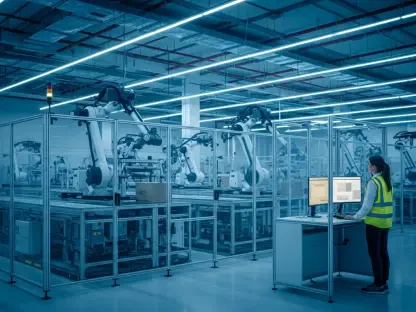
In the manufacturing sector, the deployment of digital twins via the Omniverse platform has revolutionized how production lines are conceived and managed. Companies like KUKA and FANUC are using these physically accurate virtual replicas to test every movement of a robotic arm before a single bolt is turned in the real factory. This process allows for the optimization of energy consumption, cycle times, and safety protocols in a risk-free environment. By synchronizing the digital twin with real-time sensor data, operators can predict maintenance needs and prevent costly downtime before a mechanical failure occurs.
Beyond simple monitoring, these digital twins serve as a “flight simulator” for entire industrial ecosystems. In complex manufacturing setups where hundreds of robots must work in tight coordination, the ability to simulate the entire choreography prevents the “deadlocks” that often plague automated systems. This implementation is unique because it treats the factory itself as a single, giant robot. This holistic view enables a level of operational efficiency that was previously impossible, turning the manufacturing floor into a dynamic, software-defined environment that can be reconfigured at the touch of a button.
Edge AI and Autonomous Logistics
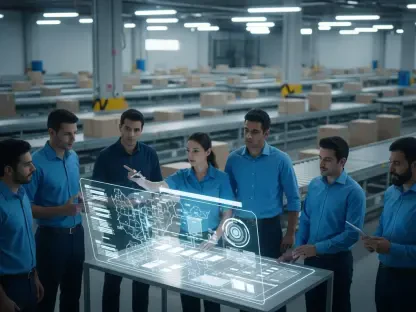
The integration of Jetson modules into autonomous mobile robots (AMRs) has turned logistics fleets into decentralized intelligent networks. In modern fulfillment centers, these robots use real-time inference to navigate through crowded aisles, avoiding human workers and other machinery with split-second precision. Unlike older systems that required magnetic strips or fixed beacons, these Jetson-powered units utilize “Slam” (Simultaneous Localization and Mapping) to build and update their own maps on the fly. This autonomy allows logistics providers to scale their operations horizontally without expensive infrastructure upgrades.
The impact on the supply chain is profound, as edge AI enables robots to handle the “last-mile” of internal logistics with high reliability. Because the processing happens locally on the robot rather than in a distant cloud, latency is virtually eliminated, which is essential for safety-critical maneuvers. These machines are also beginning to communicate with each other to optimize traffic flow, much like a hive mind. This shift toward edge-based intelligence ensures that even if a facility’s primary network goes down, the robotic workforce remains operational and safe.
Technical Hurdles and Market Obstacles
Despite the impressive progress, the path to universal robotic adoption is fraught with significant technical hurdles, particularly regarding power efficiency and long-term durability. Training a model like GR00T requires immense computational resources, and running these models on-board a mobile robot places a heavy strain on battery life. For a humanoid to be truly useful, it needs to operate for a full shift, yet current energy densities often limit high-performance AI robots to just a few hours of intensive labor. Solving this “energy-to-intelligence” ratio remains a primary focus for researchers as they look toward the next generation of hardware.
Market obstacles also persist in the form of regulatory uncertainty and the high initial cost of deployment. Standardizing safety protocols for machines that can think and act autonomously is a complex task for global regulators, often leading to a fragmented legal landscape. Additionally, while the long-term ROI of Physical AI is clear, the upfront investment in hardware and specialized software talent can be prohibitive for smaller enterprises. To overcome these barriers, the industry must continue to push for more modular, affordable hardware designs and clearer international safety standards that account for the unpredictable nature of AI-driven behavior.
The Future of Autonomous Machines
Looking ahead, the evolution of autonomous machines will likely move toward “generalist” capabilities where a single robot can perform a wide array of tasks across different industries. We are approaching a point where the distinction between “software” and “robot” will blur entirely, as machines become physical embodiments of the internet’s collective knowledge. Future breakthroughs in tactile sensing and “e-skin” will allow robots to handle objects with a level of grace and sensitivity that rivals human touch, opening up applications in healthcare, delicate assembly, and domestic assistance.
The long-term impact on society will be a fundamental decoupling of labor from human physical presence. As machines take over hazardous and repetitive tasks, the human workforce will shift toward supervisory and creative roles, managing fleets of intelligent agents. This transition will require a massive overhaul of our educational and economic systems to accommodate a world where physical labor is largely automated. The ultimate goal is the creation of a “post-scarcity” industrial model, where autonomous machines work around the clock to provide goods and services with minimal environmental impact and maximum efficiency.
Conclusion and Assessment
The review of NVIDIA’s Physical AI ecosystem revealed a sophisticated convergence of simulation, generative modeling, and edge computing that has effectively moved robotics from niche applications into the industrial mainstream. By providing the essential “brain” through models like Cosmos 3 and GR00T, the platform solved the problem of adaptability that had previously limited robotic utility. The strategic integration of digital twins and real-time physics engines transformed the factory floor into a programmable environment, significantly reducing the risks and costs associated with automation. These advancements established a new standard for how machines interact with the physical world, emphasizing that the future of robotics is defined more by software intelligence than by mechanical hardware.
The verdict on this technology was clear: it successfully transitioned from a collection of experimental tools to a foundational infrastructure for global industry. The move toward general-purpose humanoids and autonomous logistics indicated that the era of task-specific machinery reached its end. While challenges regarding energy consumption and regulatory frameworks remained, the momentum behind this full-stack approach appeared unstoppable. Ultimately, the shift toward Physical AI empowered industries to scale their operations with a level of flexibility and precision that was once considered science fiction, marking the beginning of a new chapter in human-machine collaboration.