
With billions of dollars being invested in onshoring pharmaceutical manufacturing by 2030, companies are facing the immense challenge of building and scaling domestic operations efficiently. To explore how technology is meeting this moment, we spoke with Rohit Laila, an expert with decades of experience in logistics and supply chain innovation. We delved into how warehouse automation is becoming the critical link between new production lines and inventory management. Our conversation covered the practical workflows that eliminate bottlenecks, the systems that ensure stringent regulatory compliance, and the modular designs that provide the flexibility needed to future-proof these massive investments.
With many pharmaceutical companies onshoring manufacturing and investing heavily in domestic capacity, how does warehouse automation provide a distinct production advantage? Could you share a specific example of how it helps a company ramp up operations efficiently?
It’s a game-changer, especially now. We’re seeing this massive push to bring manufacturing back to the U.S., which means companies are building or expanding facilities at an incredible pace. The risk is that you can build a state-of-the-art production line, but if you can’t feed it materials or clear finished goods reliably, you’ve just built a very expensive bottleneck. Warehouse automation provides the backbone for these new ecosystems. Instead of a chaotic manual ramp-up with inconsistent material flow, you install an integrated system from day one. This means that as soon as your production line is ready to go, the automation is there to deliver a steady, predictable stream of raw goods and take away finished products. It turns what could be a period of painful adjustment into a smooth, efficient launch, allowing these new facilities to hit their production targets much, much faster.
Can you walk me through a typical automated workflow that connects a production line with a warehouse? What specific technologies, such as AS/RS or AMRs, are used at each stage, from raw material intake to finished goods distribution?
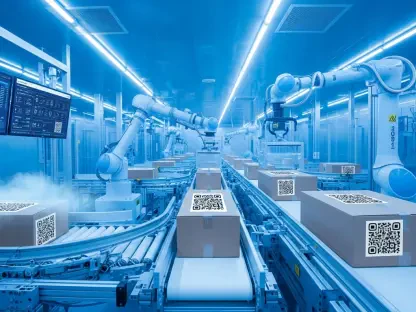
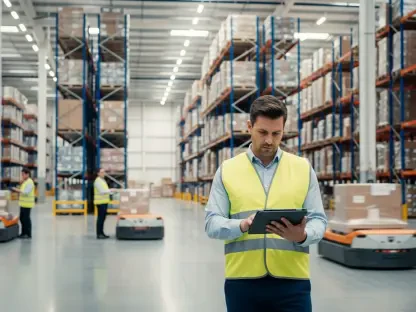
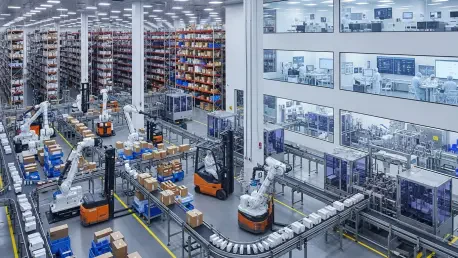
Absolutely. Picture a pallet of raw materials arriving at the loading dock. It’s immediately scanned and inducted into the system. From there, a stacker crane might lift it into a high-bay automated storage and retrieval system, or AS/RS, for dense, organized storage. When the production line signals a need for that material, the whole system comes to life. The software platform, something like Swisslog’s SynQ, orchestrates everything. It directs the AS/RS to retrieve the correct pallet, which is then placed on an automated pallet conveyor. From there, autonomous mobile robots (AMRs) might take over, quietly navigating the facility floor to deliver the precise quantity of materials directly to the line side, exactly when needed. Once the product is finished and packaged, the reverse happens—AMRs transport it back to a finished goods warehouse, where it’s stored and eventually conveyed to the shipping docks for distribution. It’s a seamless, almost silent, digital and physical flow from end to end.
The pharmaceutical industry faces strict regulations like the Drug Supply Chain Security Act for product traceability. How does an integrated automation platform simplify compliance and reporting? What specific data points are captured to ensure end-to-end product integrity for regulators?
This is one of the most powerful benefits. Complying with regulations like the DSCSA and adhering to Good Manufacturing Practice guidelines is incredibly complex and non-negotiable. Manually tracking every single item through every step is a monumental task, prone to gaps and errors. An integrated automation platform essentially builds compliance into the physical workflow. Every time a product is moved, stored, or picked, the system logs it. We’re capturing time stamps, batch numbers, specific locations within the warehouse, and operator IDs if there’s any human interaction. The software unifies all this data, creating a complete, unbroken digital chain of custody from the moment a raw material enters the facility to the second a finished drug leaves. When a regulator asks for a report, you’re not scrambling through paperwork for weeks. You’re generating a validated, transparent history in minutes. It turns a massive compliance headache into a streamlined, automated process.
Manual material handling in pharma carries risks of human error and product contamination. Beyond just improving pick-and-place accuracy, how does warehouse automation specifically mitigate these operational risks? Please share a metric that illustrates the typical reduction in handling errors.
The risks in a pharmaceutical environment are immense; a simple mix-up isn’t just a financial loss, it can be a public health issue. Automation addresses this on a fundamental level. First, it dramatically reduces the number of times a product is touched by human hands. Every touchpoint is a potential vector for contamination, and by using enclosed conveyors or robotic arms, we create a far more controlled environment. Second, machines don’t get distracted or fatigued. They follow programmed instructions with relentless precision, eliminating the variability that leads to errors. We see this in the accuracy rates. While a highly efficient manual operation might aspire to 99% accuracy, automated systems consistently achieve 99.9% or higher. That might sound like a small difference, but over millions of picks, it translates into a massive reduction in errors, preventing mix-ups and ensuring product integrity.
Automated systems can utilize vertical storage up to 150 feet, far beyond manual capabilities. How does this increased storage density provide greater operational flexibility? Explain how the modular nature of these systems helps manufacturers adapt to changing product lines or order volumes.
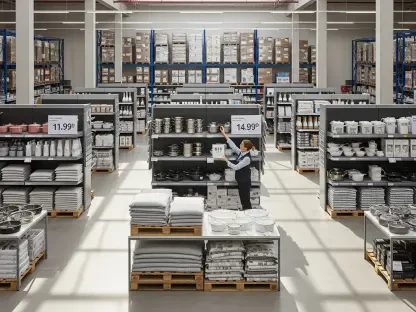
The ability to build up is transformative. A typical manual warehouse is limited to about 40 feet in height—as high as a forklift can safely operate. An AS/RS, however, can soar up to 150 feet, essentially quadrupling your storage capacity without needing a larger building footprint. This density gives manufacturers incredible flexibility. You can store more raw materials to buffer against supply chain disruptions or hold more finished goods to respond to market demand, all within your existing facility. Furthermore, these systems are designed to be modular. They are like building blocks. If your order volumes suddenly increase or you introduce a new product line with different packaging, you don’t have to rip everything out. You can add another aisle to your AS/RS or introduce a new fleet of AMRs. This modularity allows the facility to evolve with the business, ensuring that the investment you make today will continue to serve you well into the future.
Production bottlenecks can significantly impact output and reliability. How does connecting manufacturing and inventory management with automation create a more consistent flow of materials? Could you detail how this integration helps eliminate idle time on the production line?
Bottlenecks are the enemy of efficiency, and they almost always happen at the handoff points—like when materials need to get to the production line. In a manual system, a line might sit idle, waiting for a forklift operator to find and deliver the next batch of raw goods. This stop-and-start process kills throughput. By integrating the warehouse and production floor with automation, you create a synchronized, continuous flow. The warehouse management software is in constant communication with the manufacturing execution system. It knows what the production schedule is and what materials will be needed, and when. It then pro-actively dispatches the automation to deliver those materials just in time, so the line never has to wait. This eliminates idle time, smooths out the entire production cycle, and creates a highly predictable and reliable output. You move from a reactive, “pull” system to a proactive, “push” system, which keeps the entire operation running at its peak potential.
What is your forecast for warehouse automation in the pharmaceutical industry over the next five to ten years?
I believe we’re at a tipping point. The adoption we’re seeing now, driven by onshoring and the need for resilient supply chains, is just the beginning. Over the next five to ten years, I forecast that fully integrated, wall-to-wall automation will become the industry standard for any new pharmaceutical manufacturing facility. We’ll move beyond automating isolated tasks to creating truly intelligent, interconnected ecosystems. The software will become even more predictive, using AI and machine learning to anticipate production needs, optimize inventory levels, and even flag potential maintenance issues before they cause downtime. We will also see a rise in more sophisticated robotics for delicate handling tasks. Ultimately, the “lights-out” pharma warehouse—one that operates almost entirely autonomously—will move from a futuristic concept to an operational reality for many, ensuring unparalleled levels of efficiency, accuracy, and compliance.