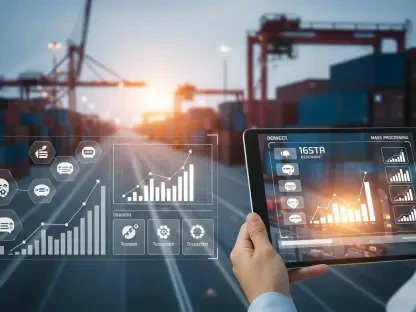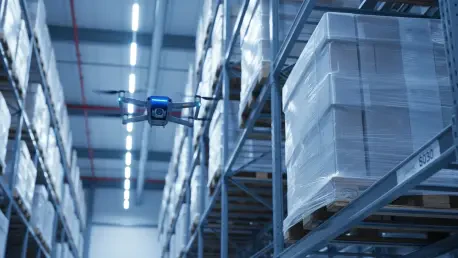

The global supply chain is grappling with a multi-billion dollar problem: a persistent gap between digital records and physical reality. Today, we’re speaking with an industry veteran at the forefront of a new solution known as Physical AI, a technology that promises to bridge this divide. We’ll explore how this approach is transforming warehouse operations from the ground up, moving beyond simple inventory counts to create a foundational intelligence layer. We’ll discuss the strategic use of consumer-grade hardware, the critical role of proprietary data in training robust AI models, and the evolution from real-time visibility to the ultimate goal of autonomous orchestration, all while delivering a remarkable return on investment.
Operators often describe a costly “physical digital divide” between system data and what’s on the warehouse floor. Could you walk me through how your continuous intelligence layer bridges this gap and what specific metrics, like accuracy or labor efficiency, improve as a result?
That “physical digital divide” is a source of constant frustration and immense cost for logistics operators. It’s that sinking feeling you get when your Warehouse Management System says a pallet is in a specific location, but your team on the floor can’t find it, and an outbound truck is waiting. Our continuous intelligence layer closes this gap by essentially giving the digital systems eyes on the physical world. Instead of relying on manual scans or periodic cycle counts that are outdated the moment they’re completed, we use AI-powered vision on devices like drones to constantly observe and verify what’s happening. The impact is immediate and dramatic. We see customers achieve inventory accuracy levels of 99.9%, which is almost unheard of. This means manual counting efforts plummet by up to 80%, freeing up skilled labor for more valuable tasks. The most telling metric, though, is the productivity improvement of up to five times—that’s the real game-changer.
Your platform leverages consumer-grade hardware like drones instead of fixed infrastructure. Can you explain the strategic advantages of this choice for scalability and cost? Please share an example of how this approach simplifies deployment for a new customer in a complex warehouse environment.
This is a core part of our philosophy. Historically, automation meant massive capital expenditure on fixed infrastructure—conveyors, sensors, and bespoke hardware that was incredibly rigid. If you wanted to change your warehouse layout, you were facing a nightmare. By using consumer-grade hardware, we completely sidestep that problem. The strategic advantage is threefold: lower cost, incredible flexibility, and speed of deployment. Think about a new customer with a massive distribution center that has multiple temperature zones and constantly shifting layouts. Installing a fixed sensor system would take months and a huge budget. With our approach, we can deploy a fleet of drones in a fraction of the time. They learn the environment and can adapt to changes on the fly. We’re not tied to the building’s physical structure; we’re an intelligent layer that operates within it, which makes enterprise-wide rollouts not just possible, but practical.
Your lead investor described your platform not just as a tool for counting inventory, but as a “foundational intelligence layer.” What does this vision entail beyond simple accuracy, and how does your system become the central “system of record” for a modern warehouse’s physical operations?
I believe Keith Block framed it perfectly. Counting inventory is the first step, but it’s not the destination. The vision of a “foundational intelligence layer” means we are creating the undisputed ground truth for everything physical in the facility. Your WMS and ERP are brilliant at managing digital transactions, but they’ve always been blind to the physical world. Our platform becomes their set of eyes. This means our data doesn’t just improve inventory accuracy; it underpins everything. It enhances safety by identifying misplaced items, boosts productivity by ensuring workers are sent to the correct locations, and builds resilience by providing a real-time view of capacity and flow. When your digital planning tools are working from a perfect, constantly updated picture of reality, they become exponentially more powerful. That’s how we transition from being a helpful tool to being the essential system of record for physical operations.
Many AI models are trained on vast internet datasets, but you emphasize training on millions of proprietary warehouse images. Why is this distinction critical for performance in cluttered, dynamic environments, and how does it make your system more robust than other automation solutions?
This is an absolutely critical distinction. An AI model trained on pristine, well-lit images from the internet will fail spectacularly inside a real warehouse. Warehouses are chaotic, cluttered, and imperfect environments. You have pallets wrapped in reflective shrink wrap, poor lighting in one aisle, forklifts zipping past, and items stacked in non-standard ways. Our models are trained on millions of our own images captured from these real-world, messy conditions. This proprietary dataset is our secret sauce. It teaches the AI to handle all that variability—different lighting, angles, obstructions, and motion. This is what makes our system robust and not brittle. While other automation might work well in a controlled demo, it often breaks down when faced with the daily chaos of a high-velocity distribution center. Our system thrives in it because it learned from it directly.
You’ve discussed moving from real-time visibility to “autonomous orchestration.” Can you describe what this shift looks like in practice? Please provide a step-by-step example of how your platform could proactively prevent a bottleneck before it impacts an outbound shipment.
This is the evolution that truly excites us. Real-time visibility is about finding problems faster. Autonomous orchestration is about preventing them from ever happening. Let me walk you through an example. Imagine our system is monitoring the flow of pallets from receiving to their put-away locations. It notices that a particular aisle, which is critical for fulfilling a major outbound order due in two hours, is becoming congested. A forklift has been dwelling there too long, and inbound pallets are starting to stack up at the entrance. Instead of just flagging this on a dashboard for a manager to see, the system takes proactive steps. It could automatically reroute another forklift operator to help clear the initial blockage, alert the WMS to temporarily assign new inbound stock to a different, less-congested aisle, and simultaneously confirm that the specific pallets needed for the outbound shipment are accessible. This all happens before a human supervisor even realizes a bottleneck is forming, preventing a delayed shipment and a cascade of downstream problems.
With an ROI often achieved in under six months, your solution sees rapid adoption. Could you detail the key factors that contribute to this fast return and share an anecdote about a customer who experienced a significant productivity improvement shortly after implementation?
The rapid ROI is driven by a few key factors. First, the minimal infrastructure cost—no massive upfront investment. Second, the immediate reduction in labor-intensive manual counting, which directly translates to cost savings. And third, the efficiency gains from near-perfect accuracy, which eliminates the costly process of searching for lost inventory and prevents missed shipments. I remember one customer in the food and beverage sector who was constantly struggling with this. They would spend hours every shift with teams of people just hunting for specific pallets that the WMS said were there but couldn’t be found. Within the first month of implementation, they told us the “search parties,” as they called them, had been completely eliminated. The team’s morale shot up, and they were able to reallocate that labor to value-added activities, like picking and packing. They saw the return not just in dollars, but in the reduced chaos and stress on the warehouse floor.
What is your forecast for Physical AI?
My forecast is that Physical AI will become as fundamental to the supply chain as the Warehouse Management System itself. For decades, we’ve invested billions in software to optimize decisions, but those decisions have always been based on imperfect, lagging data. We’re now at an inflection point where that’s no longer acceptable. Physical AI is moving from being a novel technology to becoming the required operating system for any modern logistics or manufacturing facility. It will be the central nervous system connecting the digital brain to the physical body of the operation. In the next five to ten years, operating a warehouse without a continuous, real-time understanding of your physical assets will be viewed as competitively negligent, much like trying to run a business today without an accounting system. It is, quite simply, the future of operational intelligence.