
With decades of experience spanning the breadth of the logistics, supply chain, and delivery sectors, Rohit Laila brings a deep, technology-focused perspective to the conversation around warehouse innovation. In this discussion, we explore the practical realities behind the hype of humanoid robots, contrasting their current capabilities with more immediate, value-driven automation solutions. Rohit will shed light on how supply chain leaders can navigate investment in an era of rapid technological change, focusing on the critical differences between experimental pilots and scalable production, the true ROI of nascent technologies, and the tangible benefits of polyfunctional robotics.
With forecasts suggesting fewer than 20 companies will scale humanoids by 2028, what specific operational or financial milestones must a pilot program achieve to justify moving from experimentation to a live, production environment?
That’s a critical question, and it’s why so few will make the leap from pilot to production. It’s not enough for the robot to just complete a task in a controlled demo. To justify scaling, a pilot has to prove it can survive and thrive in the controlled chaos of a real, high-velocity warehouse. I would track throughput per hour against a human counterpart and, more importantly, against a task-specific robot. We’d also need to see an uptime of over 95%, which is a huge challenge given current battery constraints. The financial milestone is a projected payback period that’s competitive. If a polyfunctional robot doing the same job costs a fraction and delivers higher throughput, the humanoid simply doesn’t make financial sense yet. The pilot has to prove it’s not just a novelty, but a genuine operational asset.
Given the current technological immaturity and high costs of humanoid robots, how should a supply chain officer calculate the true ROI for a pilot? What non-financial benefits, like innovation branding or talent attraction, should be factored into this assessment to justify the investment?
Calculating a traditional, hard-and-fast ROI is nearly impossible right now and, frankly, it’s the wrong approach for this stage of the technology. The numbers just don’t work; Gartner’s research points out that they cost multiple times more than task-specific robots while delivering lower performance. Instead, a CSCO should frame this as a strategic R&D investment. You have to quantify the “soft” benefits. What is the value of being seen as a leader in innovation? It can be a massive magnet for attracting top-tier engineering and data science talent who want to work on the future. You can also measure the value of collaborating with emerging providers to shape a product that will eventually be tailored to your specific needs. The investment is justified not by immediate cost savings, but by building a culture of innovation and securing a long-term competitive advantage.
Humanoids currently struggle with tasks like mixed SKU picking and trailer unloading. What are the one or two most critical breakthroughs—in dexterity, AI, or battery life—needed for them to become truly viable in dynamic warehouse environments?
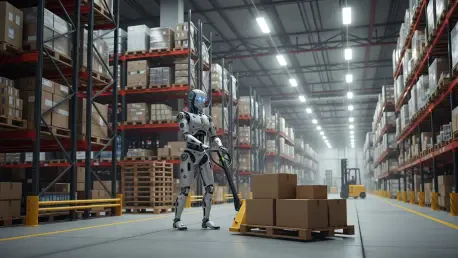
The single most critical breakthrough needed is in adaptable intelligence, which directly impacts dexterity. A warehouse is an unstructured environment. Unloading a trailer isn’t like grabbing identical boxes off a perfectly stacked pallet; it’s a jumble of different sizes, weights, and crushability. A humanoid needs the AI to instantly recognize an object, predict its properties, and determine the right way to grasp and move it without prior programming for that specific item. The second, and equally important, breakthrough has to be in energy efficiency. If a robot can only work for a few hours before needing a long recharge, it’s a non-starter for high-mobility tasks in a 24/7 operation. Without solving these two core issues, humanoids will remain confined to very limited, controlled applications.
Polyfunctional robots are often a better-suited alternative today. Can you describe a specific supply chain bottleneck where a polyfunctional robot would significantly outperform a humanoid on metrics like throughput-per-dollar, integration complexity, and uptime?
Absolutely. A perfect example is inventory management in a large distribution center. A common bottleneck is the cycle counting process—it’s time-consuming and prone to human error. A humanoid would have to walk the aisles, stop, identify a location, and scan, all while consuming significant energy just to stay upright and balanced. A polyfunctional robot designed for this task would be built on a wheeled base for rapid, energy-efficient movement. It could be equipped with a telescopic mast carrying multiple high-resolution cameras and scanners, allowing it to capture an entire section of racking in a single pass without stopping. Its uptime would be dramatically higher due to better battery life, and its throughput-per-dollar would be off the charts compared to the humanoid. It’s a solution purpose-built for the problem, not one constrained by mimicking human form.
For companies prioritizing outcome-driven automation over general headcount reduction, how should they identify the best initial use cases for robotics? Could you provide a step-by-step process for a supply chain leader to pinpoint a bottleneck where automation will deliver the most immediate value?
This is the right way to think about it. The first step is to map your entire workflow and identify the specific points of friction—not just where labor is expensive, but where processes are slow, inconsistent, or unsafe. Look for the tasks that are repetitive, physically demanding, and have high error rates. Second, quantify the impact of that bottleneck. Is it causing shipping delays? Is it leading to inventory inaccuracies that ripple through the entire chain? Third, evaluate available technologies against that specific problem. Don’t start with “we want a robot”; start with “we need to solve this picking-accuracy problem.” Finally, run a pilot program with clear, outcome-based metrics. The goal isn’t to replace a person; it’s to improve throughput, increase accuracy, or create a safer work environment. This outcome-driven approach is far less risky and delivers value much faster.
What is your forecast for the evolution of polyfunctional and humanoid robots in the supply chain over the next decade?
Over the next decade, I forecast that polyfunctional robots will become the dominant and standard form of automation in warehouses. They will become more modular, more intelligent, and more integrated, handling an ever-wider range of specialized tasks with incredible efficiency. They are the practical, high-ROI solution that will drive the industry forward. Humanoids, on the other hand, will remain largely in advanced pilot stages and very niche, controlled production environments. While their capabilities will certainly improve, the fundamental challenges of cost, energy, and adaptability for dynamic warehouse tasks mean they will not see broad, scaled adoption within this timeframe. The future for the next ten years is specialized, outcome-driven robotics, not a general-purpose robotic workforce.