
The sheer complexity of loading a trailer with millions of varying parcel dimensions remains one of the final frontiers for robotics in the global supply chain. Dexterity’s Foresight platform addresses this by moving beyond simple pre-programmed instructions toward a physics-consistent world model. This approach creates a real-time, transactable representation of the physical environment, allowing robots to perceive and reason with precision. Unlike traditional automation that relies on static environments, Foresight bridges the gap between theoretical AI and the messy reality of production-scale logistics.
The 4D Packing Agent: Solving Complexity with Spatiotemporal Logic
At the heart of this system lies the 4D packing agent, which treats the packing process as an evolving puzzle where time serves as the critical fourth dimension. While spatial dimensions dictate where a box fits, the temporal element manages how the wall of freight changes as items are added. This logic allows the system to solve combinatorial problems that are mathematically more complex than the game of Go, yet it reaches decisions in under 400 milliseconds. Such speed is vital for maintaining the flow of a high-volume sorting facility without bottlenecks.
Interpretable Safety: A Framework for Reliability
Safety in high-speed robotics often comes at the cost of transparency, but Foresight utilizes an asynchronous coordination model that separates perception from motion. This interpretable architecture allows human operators to observe the reasoning behind every robotic action, ensuring that the system remains predictable even when handling unpredictable freight. By making the robotic reasoning process visible, the platform builds trust in environments where human-robot collaboration is necessary to maintain safety standards.
Hardware Agnosticism: Versatility Across Platforms
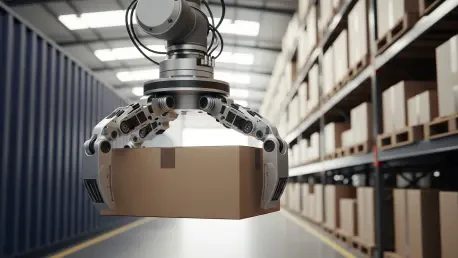
The utility of this software is further amplified by its hardware-agnostic nature, functioning across five different types of robotic hands. This flexibility ensures that the technology is not tied to a single mechanical design, allowing logistics providers to upgrade their physical infrastructure while retaining the same intelligent core. With a training dataset exceeding 100 million autonomous actions, the system demonstrates a level of maturity that few competitors can match in the current market.
Emerging Trends: The Rise of General-Purpose World Models
A significant shift is occurring in the industry as companies move away from narrow, task-specific automation toward general-purpose world models. These models enable robots to possess a form of “common sense” physics, understanding constraints like gravity and friction without needing a dedicated simulation for every new box type. Moreover, the industry is trending toward open innovation, as seen with the Foresight API Challenge, which invites the global developer community to build atop this sophisticated foundation.
Real-World Applications: From Warehouses to Global Distribution
In practical deployment, the technology excels in autonomous truck loading and unloading, where freight variability is at its highest. Maintaining load density and wall stability is a critical requirement for transport efficiency, and the 4D agent optimizes these factors in real-time. This scalability is already evident across six distinct production applications, proving that the system can handle the rigorous demands of the global supply chain while reducing the physical strain on human workers.
Challenges: Overcoming Technical and Regulatory Barriers
Despite its success, the path to full autonomy is not without hurdles, particularly regarding the processing of massive real-time datasets. Maintaining sub-half-second latency while interpreting high-resolution sensor data requires significant computational resources. Furthermore, integrating these advanced agents into legacy warehouse management systems presents a logistical challenge for older facilities that were never designed for high-speed, dual-armed robotic labor.
Future Outlook: A New Standard for Physical Intelligence
The development of Foresight established a precedent for how machines interact with unstructured physical environments through sophisticated world modeling. This transition toward general-purpose robotics suggested that the gap between digital reasoning and physical action was finally closing. Industry leaders looked toward a future where end-to-end logistics networks operated with minimal intervention, driven by agents capable of learning from every package handled. Ultimately, the integration of these systems promised to redefine the global labor market by automating the most grueling tasks in the supply chain.