
A quiet stillness is descending upon the heart of Kentucky bourbon country, a silence that speaks volumes about the state of America’s native spirit. For the first time in recent memory, an industry titan has pressed pause, sending a ripple of unease through a market once defined by seemingly endless growth. The decision by Jim Beam to halt production at its flagship Clermont distillery for the entirety of 2026 is more than a logistical adjustment; it is a clear signal that the great bourbon boom has reached a moment of reckoning. This move, echoing across an industry grappling with a glut of aging whiskey and shifting consumer tastes, forces a hard look at the foundations of a multi-billion-dollar market. The question now facing distillers, investors, and enthusiasts alike is whether this is a temporary correction or the start of a profound and lasting transformation.
From Bourbon Boom to Production Bust: Why a Distilling Giant’s Pause Signals a Market Reckoning
The announcement from Jim Beam’s parent company, Suntory, marks a pivotal moment for the American spirits industry. For years, the narrative has been one of explosive growth, with new distilleries opening and production ramping up to meet insatiable global demand. Jim Beam, as one of the world’s best-selling bourbon brands, has long been a bellwether for the industry’s health. Its decision to silence the stills at its primary manufacturing facility is therefore not just an internal corporate matter but a public acknowledgment of severe underlying economic pressures. The move suggests that the calculus of supply and demand has fundamentally shifted, forcing even the most established players to rethink their strategies in the face of a cooling market.
This production halt serves as a stark indicator of an industry-wide slump driven by a convergence of factors. Waning domestic consumption, coupled with the immense financial burden of a historic surplus of aging barrels, has created a perfect storm. The following analysis explores the intricate details of this downturn, examining how Jim Beam’s strategic pause reflects a broader crisis. From the challenges facing its competitors to the daunting scale of Kentucky’s bourbon surplus and the difficult path toward international market expansion, the industry is navigating a new and uncertain landscape.
Navigating the Crossroads of a Saturated Market
Inside the Clermont Stillhouse: Deconstructing the One-Year Production Pause
Suntory’s decision to cease manufacturing at the main Clermont plant for 2026 is a direct response to a changed economic reality. The company has cited two primary drivers: a noticeable decline in consumer demand for alcohol and the significant financial strain imposed by high barrel-aging taxes in Kentucky. While the main stills fall silent, the brand’s public-facing operations, including the popular visitor center, bottling lines, and warehousing units, will continue without interruption. Production will also proceed at the company’s craft distilleries, signaling a potential shift in focus toward smaller, more premium batches.
This period of dormancy is not being treated as idle time. The company plans to undertake significant property enhancements, a strategic move to retool and optimize operations during the downturn. However, the future of the workforce remains a critical point of negotiation, with Suntory currently in discussions with union leadership to map out a plan for the transition. This deliberate pause and reinvestment strategy raises important questions about Jim Beam’s long-term outlook, suggesting a belief that the market will eventually rebound, but perhaps in a leaner, more competitive form.
Echoes Across the Bourbon Trail: How Competitors Are Bracing for Impact
Jim Beam’s operational halt is far from an isolated incident; rather, it is the most visible symptom of a malaise affecting the entire spirits sector. Across the industry, major producers are making similarly defensive moves to insulate themselves from weakening consumption and oversupply. Last year, Brown-Forman, the parent company of Jack Daniel’s, dealt a blow to the Louisville economy by closing its bourbon cooperage and laying off 640 employees. This decision underscored the falling demand for new barrels as distillers scaled back production forecasts.
The trend continues with other industry giants. Diageo initiated temporary shutdowns at its Balcones distillery in Texas and the historic George Dickel distillery in Tennessee, citing the need to manage inventory levels. These actions, taken collectively, paint a clear picture of an industry pulling back from the aggressive expansion that characterized the last decade. The financial pressures are forcing even the most powerful brands to adopt a more conservative posture, prioritizing balance sheet health over production volume in a market that can no longer absorb a limitless supply.
The Billion-Dollar Barrel Glut: Unpacking Kentucky’s Record Surplus
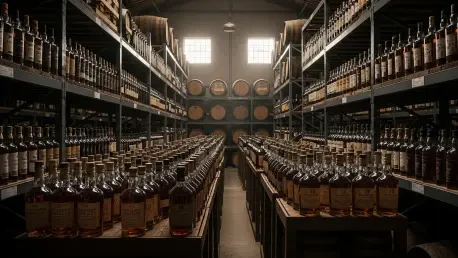
At the heart of the industry’s current predicament lies a staggering oversupply of product. According to the Kentucky Distillers’ Association, a record 16.1 million barrels of bourbon are currently aging in the state’s warehouses. This colossal inventory is the direct result of years of optimistic production increases, intended to meet a future demand that now appears to have been overestimated. The majority of this whiskey is slated to reach maturity around 2030, threatening to flood the market and exert intense downward pressure on prices.
This glut challenges the long-held industry assumption that more aging inventory is always a strategic asset. While a deep stock allows for premium-aged releases, the current scale of the surplus has become a significant financial liability. The costs of warehousing, insurance, and taxes on these barrels accumulate annually, creating immense financial strain on distillers. Moreover, the risk of market devaluation is substantial; if too much mature bourbon becomes available at once, it could erode the premium image and profitability that the industry has worked so hard to build.
A Desperate Search for New Shores: Export Hurdles and Policy Headwinds
With domestic demand softening and warehouses overflowing, the American bourbon industry is pinning its hopes on international markets to absorb the excess inventory. A primary strategy involves reopening and expanding trade negotiations with key partners, including Canada and Ireland, to create new channels for offloading the surplus. This push for exports is seen as one of the few viable paths to alleviating the immense pressure building within the domestic market.
However, this strategy is encountering significant obstacles. Recent data reveals a troubling trend, with American distilled spirits shipments declining by 9% in the second quarter of 2025 compared to the previous year. Industry analysts attribute part of this downturn to unfavorable White House policies that have complicated international trade relationships. This difficult export climate, contrasted with the more favorable conditions of previous years, raises serious doubts about whether new markets can realistically absorb a surplus of this magnitude, leaving distillers in a precarious position.
Strategic Imperatives for an Industry Under Pressure
The key takeaways from the current industry climate are clear: the bourbon slump is not the result of a single issue but a convergence of overproduction, waning domestic demand, and challenging external economic factors, including trade policy headwinds. The era of unchecked growth has definitively ended, forcing distillers to adopt a more strategic and cautious approach to navigate the turbulent years ahead. Survival and success in this new environment will depend on agility and innovation.
In response, distillers must pursue a multi-pronged strategy. This includes innovating with new product lines that can capture the interest of a changing consumer base, such as lower-proof offerings or unique cask finishes. A renewed focus on premiumization, emphasizing quality and scarcity over sheer volume, can help protect brand value. Concurrently, the industry must engage in aggressive and unified lobbying efforts to secure more favorable trade policies, as robust export markets are essential for managing the current inventory surplus. For stakeholders, from investors to supply chain partners, the immediate future requires careful interpretation of market signals and preparation for a period of potential consolidation and intense competition.
The Future of America’s Native Spirit: Weathering the Storm or a Permanent Correction?
The bourbon industry has reached a critical inflection point. The shift from a period of rapid, unchecked expansion to one of necessary market correction is reshaping the landscape for producers large and small. The long-term implications of the massive surplus and the widespread production cuts initiated by major players like Jim Beam are set to define the next decade. These developments have prompted a fundamental reevaluation of growth strategies and consumer expectations across the board.
Ultimately, the events of the past year have forced a crucial question upon the industry. The downturn is certainly a cyclical slump, a painful but perhaps temporary contraction after years of overheating. Yet, it also holds the potential to be something more permanent—the beginning of a new, more sober era for American whiskey, one defined by slower growth, fiercer competition, and a market that values balance over boom. How the industry navigates this storm will determine the very future of America’s native spirit.