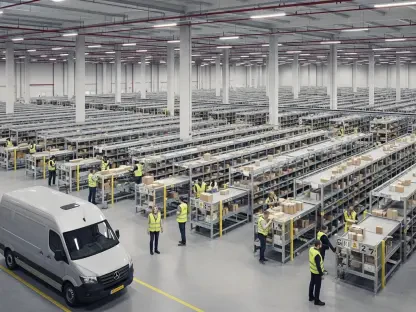
With decades of experience navigating the complexities of the global supply chain, Rohit Laila has seen firsthand how technology and geopolitical shifts are reshaping the logistics landscape. In an era where tariffs are volatile and consumer expectations for fast delivery are non-negotiable, companies are rushing to move inventory closer to their customers. We sat down with Rohit to discuss the hidden trade-offs of this localization trend. He sheds light on the unforeseen challenges in customs and compliance, the operational headaches of managing a distributed inventory network, and the strategic thinking required to balance the competing demands of speed and cost in today’s turbulent market.
Given that tariffs are making cross-border fulfillment unpredictable while 68% of shoppers will pay more for guaranteed holiday delivery, how should a brand calculate the tipping point where the cost of faster, localized fulfillment becomes more strategic than risking customs delays and fees?
That’s the million-dollar question, and the answer isn’t a simple formula. It’s a strategic calculation of risk versus reward. The tipping point arrives when the potential financial and reputational damage from an unpredictable customs process—think surprise duties, lengthy delays, and angry customers—surpasses the known, budgeted cost of operating a local fulfillment center. You have to weigh the very real possibility of a shipment getting stuck for weeks against the investment in local infrastructure. When 68% of your customers are explicitly telling you they value guaranteed delivery over lower costs, that’s a powerful signal. It becomes less about operational penny-pinching and more about a strategic investment in the customer experience and supply chain resilience. A predictable, albeit higher, local cost is almost always better than a volatile, potentially catastrophic cross-border one.
When companies localize inventory, they often trade tariff exposure for new operational risks. Could you describe a common scenario where a lack of a single source of truth for customs, transport, and fulfillment leads to a costly inventory imbalance or compliance failure?
I see this all the time, and it’s a classic case of the right hand not knowing what the left is doing. Imagine a mid-sized apparel brand that uses separate partners for customs brokerage, ocean freight, and their domestic fulfillment centers. The freight forwarder’s system shows a container is delayed at port due to a customs inspection, but that information isn’t automatically fed into the fulfillment partner’s inventory system. So, the fulfillment team, seeing the inventory as “in transit,” continues to promise two-day shipping to customers. Meanwhile, the customs broker is trying to resolve a small classification error on the paperwork, but that alert is buried in an email chain. The result is a painful cascade: the East Coast warehouse runs out of stock, customer orders are backlogged, and all the while, the West Coast warehouse is overstocked with last season’s items. This isn’t just a frustrating inventory imbalance; it’s a compliance risk that can lead to audits and fines, all because there was no single source of truth to connect the dots.
Splitting inventory across multiple warehouses can introduce hidden costs that negate the intended savings. What specific challenges does this create for managing returns, especially around duty recovery and reconciliation, and what practical steps can prevent these issues from eroding profitability?
Returns are the silent killer of profitability in a distributed network. The biggest challenge arises because a product shipped from a warehouse in New Jersey might be returned by a customer to a facility in California. This immediately creates a logistical and financial nightmare. The original duty paid on that imported item might be recoverable, but all the documentation is tied to the initial port of entry and the New Jersey warehouse. Reconciling this discrepancy to file for a duty drawback becomes an incredibly manual, error-prone process. Furthermore, you’re now paying to transport that single returned item back across the country to its “home” warehouse or, more likely, you just accept the inventory imbalance. To prevent this, companies must invest in integrated technology from day one. You need a system that tracks an item’s entire lifecycle, including its customs and duty status, no matter which door it comes back through. Without that unified view, these small return-related costs will silently eat away at any savings you hoped to gain from localization.
Local fulfillment works well for high-margin apparel but is challenging for bulky furniture. For a brand with a diverse product catalog, what framework or metrics should they use to decide which products to prioritize for speed versus which to optimize for cost and stability?
A one-size-fits-all approach is a recipe for failure. The most effective framework is a matrix that plots products based on two key axes: one is margin and demand velocity, and the other is product size and demand predictability. Items in that high-margin, high-velocity quadrant—think popular electronics, cosmetics, or core apparel pieces—are your prime candidates for localized fulfillment. You reserve the expense of speed for these products because the customer expectation is high and the profit can absorb the cost. Conversely, items like bulky furniture or highly seasonal holiday decor, which have high storage costs and unpredictable demand, belong in the quadrant optimized for cost and stability. For these, a more centralized, consolidated shipping model makes far more sense. You have to be surgical, using speed as a competitive weapon for the right products and prioritizing stability and cost-efficiency for everything else.
For a company just beginning to localize, what are the first concrete steps to establish ownership and a single view of inventory and landed costs? Please explain how this foundation helps prevent forecasting and replenishment errors from snowballing as the network grows.
Before you even think about signing a lease on a new warehouse, the absolute first step is to establish clear ownership and a single source of truth internally. This means getting your fulfillment, transportation, and customs compliance teams out of their operational silos and mandating that they work from a single, integrated platform. This platform must provide a unified, real-time view of all inventory, whether it’s on a boat, in a container, or on a warehouse shelf, along with the true landed cost for every single SKU. This foundation is non-negotiable. Without it, as you expand from one local warehouse to three or four, small forecasting errors or minor compliance oversights don’t just add up; they multiply exponentially. You end up reacting to constant fires—stockouts in one region, overstocks in another—and the complexity quickly becomes a massive, expensive tangle that is nearly impossible to fix later. Getting that alignment right from the start creates a stable foundation that is far simpler and cheaper to scale.
What is your forecast for localized fulfillment?
I believe we are moving beyond the simple mantra of “closer is better.” Localized fulfillment will undoubtedly become the standard operating model, but its next evolution will be defined by intelligence and agility, not just proximity. The focus will shift from building a static network of warehouses to creating a flexible, responsive supply chain powered by better data and predictive forecasting. Companies will invest in networks that can quickly reposition inventory based on real-time shifts in tariffs, consumer demand, or transportation costs. The winning strategy won’t be about being permanently close to the customer; it will be about having the adaptability to be in the most strategically and financially advantageous position at any given moment.