
The rapid shift toward digital grocery shopping has transformed the logistics of food retail from a secondary concern into the central pillar of modern business survival. As consumer expectations for lightning-fast delivery and absolute order accuracy reach an all-time high, the traditional manual warehouse model has become a bottleneck that threatens to stifle growth. Automated grocery fulfillment systems, particularly the high-throughput Central Fulfillment Centers (CFCs) engineered by industry leaders like KNAPP, represent the definitive response to this challenge. These facilities are not merely warehouses but highly synchronized technological ecosystems designed to manage thousands of diverse stock-keeping units with minimal human intervention.
Evolution of Automated Grocery Fulfillment
The journey from cramped back-room picking to massive, dedicated CFCs marks a fundamental change in how retailers view inventory and labor. Historically, grocery fulfillment relied on manual labor, where staff walked miles of aisles to gather items, a process prone to error and physical fatigue. The emergence of automated systems has shifted the focus toward high-density storage and robotic speed. This evolution is driven by the need for scalability; as seen in the transformation of Shufersal Online in Israel, retailers are moving away from decentralized, inefficient stores toward centralized hubs that can process over 7,800 orders daily.
This technological shift is characterized by a transition from human-centric workflows to “goods-to-person” and “robot-to-goods” methodologies. By consolidating inventory into a single, high-tech environment, retailers can manage a massive assortment of products—often exceeding 19,000 unique items—without the spatial constraints of a traditional supermarket. The integration of these systems allows for a level of throughput that was once thought impossible, effectively decoupling business growth from the availability of manual labor.
Core Technological Components and Features
AI-Driven Robotic Picking and Recognition
At the heart of modern fulfillment lies the challenge of handling delicate and irregularly shaped items, such as fresh produce or fragile glass jars. Unlike standard industrial robots designed for rigid parts, the latest single-item picking robots utilize advanced AI-driven object recognition to identify and grasp diverse products with precision. This technology allows the system to adjust its grip and pressure in real-time, ensuring that a tomato is handled with more care than a detergent bottle. This capability is crucial for maintaining the high quality that online shoppers demand, as even a single damaged item can result in a lost customer.
Intelligent Shuttle Storage and Sequencing
Storage efficiency is maximized through high-speed shuttle systems that operate within dense racking structures. These shuttles move independently to retrieve items and deliver them to workstations, significantly reducing the “footprint” required for storage. Moreover, the system employs intelligent sequencing, which ensures that items are presented to the packing station in the exact order needed—typically placing heavy items at the bottom of a bag and fragile ones at the top. This logical flow not only protects the goods but also streamlines the final dispatch process, allowing an order that previously took an hour to assemble to be completed in just ten minutes.
Integrated Software and Data Analytics
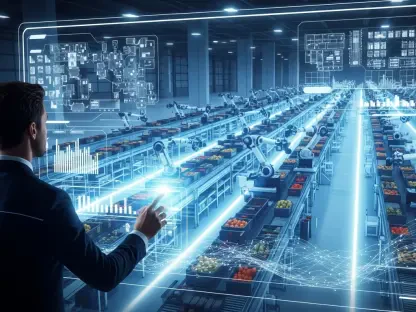
The physical machinery is governed by sophisticated software suites, such as the KiSoft platform, which act as the brain of the entire operation. These proprietary systems manage master data and provide real-time operational oversight, allowing managers to monitor every moving part from a single dashboard. By utilizing proactive monitoring, the software can identify potential mechanical issues before they cause downtime. This level of data integration ensures high system availability and allows for constant optimization of picking paths and inventory placement based on current demand trends.
Innovations in Cold-Chain Logistics and Quality Control
Maintaining the cold chain is perhaps the most difficult aspect of grocery fulfillment, requiring precise temperature management across various zones. Innovations such as the world’s first frozen Evo Shuttle system allow for fully automated storage in deep-freeze environments, removing humans from harsh conditions. To prevent thawing during the picking process, “dwell-time” tracking software monitors exactly how long a temperature-sensitive item remains outside its primary zone. If a product exceeds its safe time limit, the system flags it for immediate return or inspection, guaranteeing food safety and integrity.
Real-World Applications and Industrial Impact
The practical impact of these technologies is best observed in large-scale deployments like the Modi’in facility, which serves the densely populated Tel Aviv area. By implementing twenty-nine ergonomic workstations and automated bagging systems, the facility has pushed picking speeds to an impressive 600 units per hour. This industrial-scale efficiency allows the retailer to offer shorter delivery windows and a wider product range than any physical store could sustain. The result is a highly reliable service that can handle the volatile surges of urban consumer demand with surgical precision.
Operational Hurdles and Implementation Challenges
Despite the clear advantages, the path to full automation is not without obstacles. The initial capital expenditure for a CFC is substantial, often requiring years of strategic planning and significant financial investment. Furthermore, while AI has improved, the sheer diversity of grocery packaging still presents technical hurdles for robotic grippers. Regulatory requirements regarding food safety and cross-contamination also necessitate complex cleaning protocols and strict separation of goods. Retailers must balance these costs and complexities against the long-term benefits of labor independence and reduced operational overhead.
Future Outlook of Automated Retail Distribution
The trajectory of this technology points toward even greater integration of autonomous systems and hyper-local fulfillment. We are likely to see breakthroughs in “dark store” automation, where small-scale robotic hubs are placed in the hearts of cities to enable sub-thirty-minute delivery. As AI continues to evolve, the ability of robots to handle increasingly complex tasks—such as bagging soft items or identifying spoilage via hyperspectral imaging—will become standard. This will lead to a global grocery landscape where the human role shifts from physical labor to high-level system management.
Final Assessment and Conclusions
The implementation of automated fulfillment systems has fundamentally altered the retail landscape by prioritizing speed, accuracy, and product safety. By reducing fulfillment times from hours to minutes and enabling massive throughput, these systems provided a scalable solution to the inherent inefficiencies of traditional grocery logistics. The integration of specialized cold-chain software and robotic picking ensured that quality was not sacrificed for speed. Ultimately, the industry moved toward a model where automation served as the essential infrastructure for modern urban living, setting a new standard for consumer convenience and operational excellence.