
With decades of experience spanning the supply chain and delivery sectors, Rohit Laila possesses a deep understanding of the logistics industry’s inner workings. His passion for technology and innovation places him at the forefront of a pivotal transformation, where robotics and artificial intelligence are not just theoretical concepts but practical tools reshaping the future of labor. This interview explores the nuanced design philosophy behind humanoid robots like Digit, the critical role AI plays in their real-world operation, and the profound safety considerations guiding their integration into human workplaces. We delve into how Agility Robotics leverages AI not only in its machines but also in its own development processes, and look ahead at the milestones that will define the next decade of robotics.
The article notes Digit is 5’9″ and handles 35-pound boxes, but also “smiles” and waves. What specific design choices make Digit suitable for warehouse tasks, and how do you balance its industrial utility with these more approachable, human-like features for co-worker acceptance?
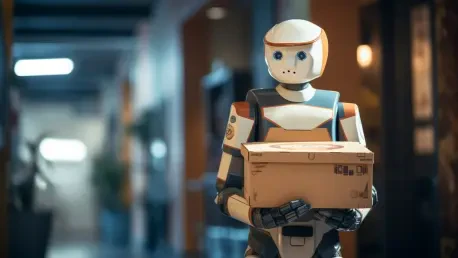
That’s a fantastic question because it gets to the heart of our design philosophy. First and foremost, a robot has to be useful; it must serve a purpose. Digit’s physical form—its 5-foot-9-inch height, its ability to lift and carry boxes up to 35 pounds—is purpose-built for the warehouse environment. It’s designed to operate in spaces built for humans, handling the kind of manual labor that people often don’t want to do. But utility is only half the battle. For successful adoption, the robot also has to be accepted by its human colleagues. The “smile” from its pixelated eyes and the simple wave are not gimmicks; they are crucial elements of social robotics. These small gestures make the robot feel less like a cold, imposing machine and more like a partner, which is essential for creating a smooth, collaborative, and safe work environment.
You mentioned AI is crucial where you “can’t write an equation for everything,” like balance and perception. Could you walk us through a specific step-by-step example of how Digit’s AI observes, interprets, and reacts in real time when it encounters an unexpected obstacle in a warehouse?
Absolutely. Imagine Digit is moving a tote from a conveyor to a shelf. Its path is clear, and it’s executing a learned skill. Suddenly, a worker on a pallet jack crosses its path unexpectedly. This is where modern AI shines. First, Digit’s perception system, which is constantly scanning the environment, observes the new object. It’s not just seeing a shape; its AI interprets that shape as a dynamic obstacle, a person moving, which triggers a higher level of caution. It then instantly re-evaluates its own state—its balance, the weight it’s carrying, its momentum—and calculates a new course of action in milliseconds. Instead of stopping abruptly, which could be unstable, it might subtly slow its pace, adjust its torso to keep the box level, and yield the right-of-way, all while maintaining perfect balance. It’s a fluid, intelligent response that you simply can’t program with a simple set of if-then rules.
Your team uses AI tools as a coding “coach.” How has this augmented your development cycle, given half your engineering team is in software? Can you share an anecdote or some metrics on how these tools have helped accelerate a project from concept to deployment?
It’s been a massive force multiplier for us. With half our engineering team focused on software, efficiency is paramount. We use AI tools from companies like Google and Nvidia not to write code for us, but to augment our developers’ abilities. Think of it as a tireless partner that helps offload tedious tasks like documentation or suggests optimizations, freeing up our engineers to tackle the really complex architectural challenges. It acts as a “coach” by spotting potential errors or inefficient patterns before they even get into the main codebase. While we hold our engineers fully responsible for the final code, this process makes them faster and more effective. It’s like going from a single builder to a builder with a full crew of assistants, allowing us to innovate at the fast pace required to stay ahead in this industry.
You made a great point comparing a humanoid to a dishwasher, noting the best robot isn’t always human-shaped. How does this philosophy guide your roadmap? What’s your process for deciding which real-world labor problems are a perfect fit for Digit versus those better left to other automation?
That philosophy is central to everything we do. We don’t believe in technology for its own sake; we believe in solving problems. Our process starts not with the robot, but with the labor challenge. We look at a task and ask, what is the most effective, safe, and efficient way to solve this? For something like welding a car frame, a fixed robotic arm is a brilliant solution. For washing dishes, the specialized box in your kitchen is perfect. You wouldn’t want a humanoid standing over your sink. But when the problem involves navigating an environment built for people—walking down aisles, reaching onto shelves, moving between workstations—the humanoid form becomes an “extremely powerful” and logical choice. We’re targeting Digit for those specific gaps in logistics and manufacturing where mobility and dexterity in a human-centric space are required, which is why our partnerships with companies like Amazon and Mercado Libre are such a natural fit.
The piece highlights that humanoid safety is a “much, much, much harder challenge” than for traditional robotics. Beyond the stanchions used at public events, what are the key safety protocols or systems you are developing to ensure Digit can operate safely alongside human workers at partners like Amazon?
The stanchions you see at public events are purely for crowd control in a completely uncontrolled environment. The safety systems we deploy in a real work setting are vastly more sophisticated. This is indeed a monumentally harder challenge than for a robot arm bolted to the floor, and AI on its own doesn’t magically solve it. Our approach is multi-layered. First, the robot’s perception system is its primary safety shield; it’s constantly mapping its surroundings, identifying where human workers are, and predicting their movements to maintain a safe operational bubble. Second, we are building in redundant physical and software-based safety stops that can bring the robot to a controlled, stable halt under any circumstance. Finally, we leverage AI to run millions of simulations of edge cases—what happens if someone trips? What if a box falls?—to train the robot’s behavior to be inherently cautious and predictable. We’re building on the foundation of industrial robot safety that began back in the 1960s, but adapting it for a mobile, dynamic, and collaborative future.
What is your forecast for humanoid robotics? Looking at the next decade, what key milestones in AI and hardware must be reached before robots like Digit can realistically move from structured warehouses into more dynamic, everyday environments?
Looking forward, I am incredibly optimistic. The most exciting part of this journey is that we are finally at a point where we can build machines that can go out into the world and affect it in ways similar to humans, without needing the world to be rebuilt for them. Over the next decade, for humanoids to make the leap from warehouses to more unstructured spaces like homes or retail stores, we need to hit key milestones on two fronts. In hardware, advancements in battery density and motor efficiency are critical for enabling longer runtimes and greater strength without adding prohibitive weight. On the AI side, the challenge is to move from sophisticated perception to true contextual understanding. A robot needs to not just see a door, but understand the concept of knocking before entering a private office. It needs to not just pick up a bottle, but recognize if it’s glass and needs to be handled gently. Once we bridge that gap between seeing and truly understanding, that’s when the true potential of humanoid robots in our everyday lives will be unlocked.