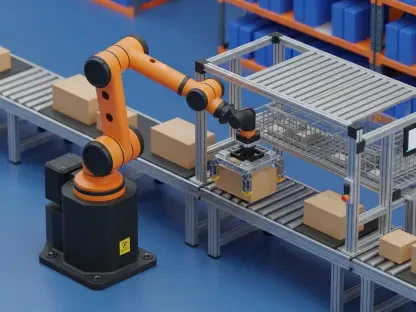

Imagine a world where every pallet in a massive retail supply chain can whisper its location and status in real time, without a single battery or manual scan. This isn’t a futuristic dream—it’s the reality being shaped by ambient IoT sensors, a transformative technology that’s already reshaping how retail giants manage inventory. With companies like Walmart leading the charge, these tiny, passive devices promise to tackle age-old challenges in supply chain efficiency, from stock inaccuracies to perishable spoilage. This review dives deep into the mechanics, applications, and future potential of ambient IoT sensors, spotlighting their game-changing role in modern retail.
Unveiling the Power of Ambient IoT Sensors
At the heart of this technological shift are ambient IoT sensors, small but mighty devices that operate without batteries, harvesting energy from their surroundings to transmit data. These sensors are designed to seamlessly integrate into supply chain systems, capturing real-time information about goods as they move from distribution centers to store shelves. Their emergence comes at a critical juncture when retailers face mounting pressure to optimize operations amid rising costs and consumer expectations for speed and accuracy.
What sets this technology apart is its ability to function passively while still providing a constant stream of actionable data. By embedding sensors into pallets or packaging, businesses gain unprecedented visibility into inventory levels and product conditions. This capability is particularly vital in sectors like retail and logistics, where delays or errors can ripple through the entire supply chain, costing millions. As adoption grows, ambient IoT sensors are becoming a cornerstone of data-driven decision-making.
The significance of these devices extends beyond mere tracking. They represent a broader movement toward digital transformation, where technology bridges the gap between physical goods and digital insights. Retailers now stand at the threshold of a new era, equipped with tools to not only monitor but also predict and adapt to supply chain dynamics. This foundation sets the stage for a closer look at their standout features and real-world impact.
Key Features and Performance Analysis
Real-Time Tracking with Wiliot Pixels
One of the standout elements of ambient IoT sensors lies in innovations like Wiliot’s Pixels, which have redefined inventory tracking at the pallet level. These sensors deliver real-time updates on stock locations and quantities, eliminating guesswork for massive operations like those at Walmart, where they’re currently deployed in 500 stores. The result is a dramatic boost in supply chain visibility, allowing for swift responses to discrepancies or shortages.
Moreover, the passive nature of these devices means they require minimal maintenance while still feeding continuous data into management systems. Performance-wise, they’ve proven reliable in high-volume environments, cutting down on manual labor by automating processes like pallet receipt confirmations. This efficiency isn’t just a convenience—it’s a competitive edge in an industry where every minute counts.
Cold Chain Compliance for Perishables
Another critical strength of ambient IoT sensors is their role in cold chain management, especially for perishable goods like fresh produce. By monitoring conditions and ensuring items are moved to proper storage upon arrival, these sensors help retailers avoid spoilage and meet strict regulatory standards. Walmart’s implementation across hundreds of stores highlights how this technology safeguards product quality, protecting both revenue and customer trust.
This application shines in high-stakes scenarios where temperature deviations can ruin entire shipments. The sensors trigger alerts if conditions falter, enabling immediate corrective action. Such precision underscores their value beyond basic tracking, positioning them as essential tools for industries handling sensitive inventory, and paving the way for broader adoption in diverse settings.
Innovations and Industry Trends
The landscape of ambient IoT technology is evolving rapidly, with recent advancements pushing the boundaries of what’s possible. A notable trend is the move toward finer granularity, such as case-level tracking, as envisioned by Wiliot’s leadership. This shift could unlock even deeper insights into inventory flows, offering retailers a microscopic view of their supply chains by next year or beyond.
Equally compelling is the integration of IoT data with artificial intelligence systems, a direction Walmart is aggressively pursuing. By funneling sensor data into AI platforms, retailers can anticipate demand, optimize stock levels, and make smarter decisions faster than ever before. This synergy represents a leap forward in digital transformation, merging raw data with predictive analytics to outpace traditional methods.
As these trends gain momentum, the technology is also inspiring new use cases across industries. From automating routine tasks to enhancing supplier collaboration through shared data, ambient IoT sensors are proving their versatility. Their trajectory suggests a future where such tools are not just optional but indispensable for staying ahead in a hyper-connected market.
Real-World Impact and Case Studies
Turning to practical applications, Walmart’s partnership with Wiliot offers a compelling case study of ambient IoT sensors in action. Deployed across 500 stores with plans to expand to 4,600 retail locations and over 40 distribution centers by 2026, this initiative showcases how the technology streamlines inventory tracking on a massive scale. It’s not just about knowing where goods are—it’s about transforming that knowledge into operational agility.
Beyond tracking, the sensors have reshaped cold chain logistics by ensuring perishables reach coolers without delay, directly impacting product freshness and compliance. Unique benefits also emerge in supplier relationships, as automated data sharing fosters transparency and trust. This ripple effect demonstrates how a single innovation can enhance an entire ecosystem, from retailer to vendor.
Perhaps most striking is the reduction in manual processes, freeing up staff for higher-value tasks while minimizing errors. As Walmart scales this technology, it serves as a blueprint for other retailers, illustrating how ambient IoT can address inefficiencies that have long plagued the industry. This real-world success story hints at the broader potential waiting to be tapped.
Challenges on the Horizon
Despite their promise, ambient IoT sensors face notable hurdles that temper unchecked enthusiasm. Scaling to case-level tracking, for instance, presents technical challenges in maintaining data accuracy across sprawling networks. Ensuring consistent performance as deployments grow will require ongoing refinement and robust infrastructure, a task that demands significant investment.
Additionally, concerns around data privacy and regulatory compliance loom large, especially as sensitive information flows through shared systems. Smaller retailers might also struggle with adoption costs, risking a divide between industry giants and independents. These market barriers highlight the need for accessible solutions that democratize access to such cutting-edge tools.
Nevertheless, companies like Wiliot are actively addressing these limitations through innovation and strategic partnerships. While obstacles remain, the commitment to overcoming them suggests that ambient IoT technology will continue maturing. Balancing scalability with affordability and security will be key to unlocking its full transformative power.
Reflecting on a Technological Milestone
Looking back, the journey of ambient IoT sensors stood out as a pivotal chapter in retail supply chain evolution. Their ability to deliver real-time insights without the burden of batteries or manual intervention marked a significant departure from past practices. Walmart’s bold adoption underscored how these devices tackled entrenched inefficiencies, setting a benchmark for others to follow.
As the technology matured, its integration with AI revealed even deeper potential, turning raw data into strategic foresight. Moving forward, stakeholders needed to prioritize scalable solutions that addressed privacy and cost barriers, ensuring wider accessibility. Collaborative efforts between tech innovators and retailers could accelerate this progress, paving the way for industry-wide standards.
Ultimately, the focus shifted toward anticipating the next breakthroughs, from finer tracking to cross-industry applications. Exploring these frontiers promised to not only refine supply chain operations but also redefine how businesses interacted with their physical assets. The path ahead was clear—embracing and adapting to ambient IoT held the key to lasting competitive advantage.